
Strategic thinking development Extra Challenge Worksheets for 6-Year-Olds
3 filtered results
Difficulty Level
Grade
Age
-
From - To
Subject
Activity
Standards
Our "Strategic Thinking Development Extra Challenge Worksheets for 6-Year-Olds" are designed to elevate your child’s cognitive abilities while making learning fun. These expertly crafted worksheets present complex problems that stimulate young minds, encouraging critical thinking, planning, and decision-making skills. Each worksheet is tailored to engage six-year-olds in activities that nurture strategic thinking, enhance focus, and build problem-solving prowess. These challenges are ideal for gifted kids or any child ready to go beyond the basics and embrace higher-level learning. Give your child the tools to develop vital intellectual skills in an enjoyable, effective way with our comprehensive worksheets.
Favorites
With answer key
Interactive
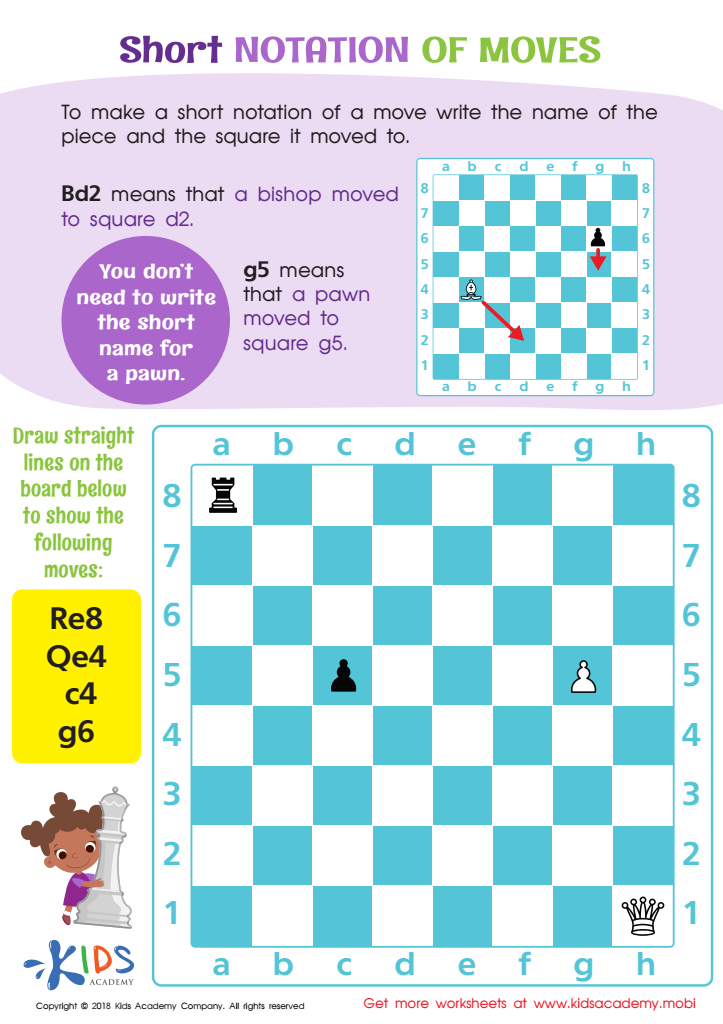
Short Notation of Moves Worksheet
To master chess, you need more than just knowing the pieces and their moves - you need to be able to make notations of your moves. To make a short notation, write the piece name and square it moved to; for example, Bd2 for bishop on d2. Pawns don't need the piece name, just the square; e.g. g5. Show your kids how to draw lines to the board for the moves given.
 Assign to My Students
Short Notation of Moves Worksheet
Worksheet
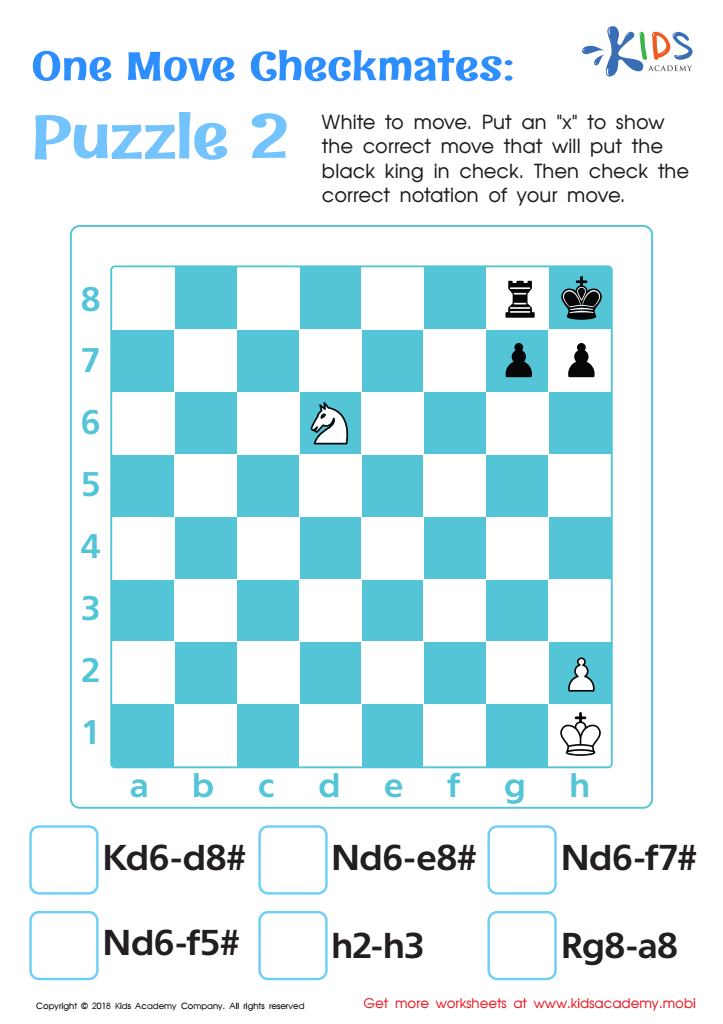
One Move Checkmates: Puzzle 2 Worksheet
Fine-tuning logic and critical thinking skills can be tricky but this free PDF offers a fun way for little logisticians to practice visual-spatial relationships and strategizing to checkmate the black king. It also boosts directional and reading skills which makes it a great brain-building puzzle.
One Move Checkmates: Puzzle 2 Worksheet
Worksheet
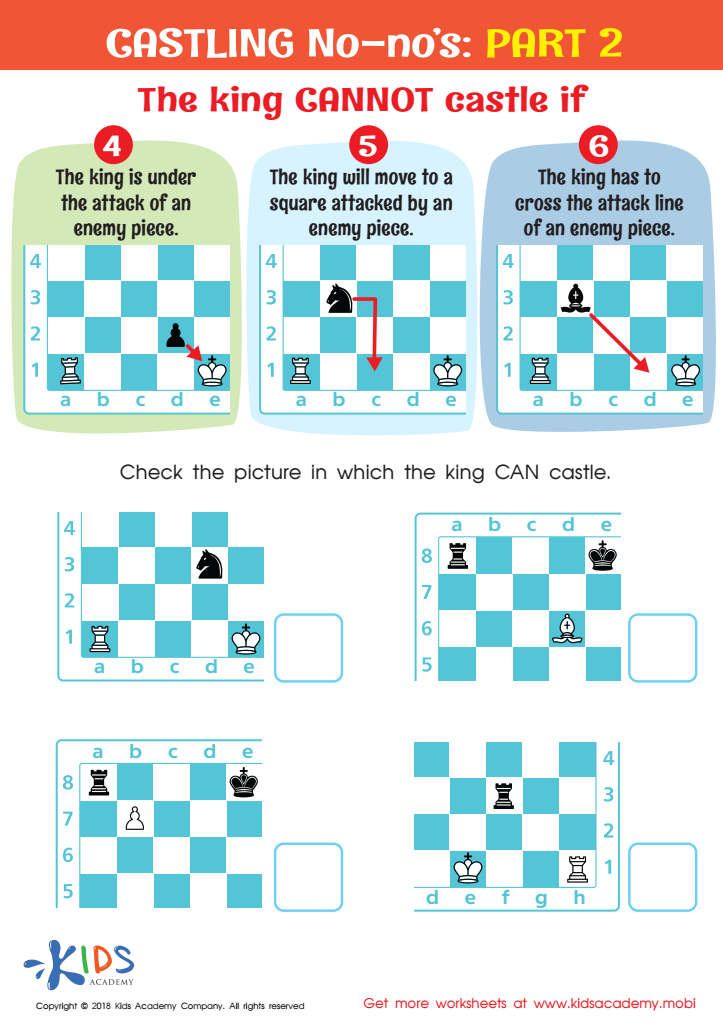
Castling No - no's: Part 2 Worksheet
Teach your child the rules of castling: no castling if the king is under attack or will move onto an attacked square, or cross an attack line. To prepare for a game of chess, help your child complete the exercise of identifying when the king can castle – check the pictures.
Castling No - no's: Part 2 Worksheet
Worksheet
Join Kids Academy for Free
Who is primarily going to use this learning content?








Parents and teachers should emphasize strategic thinking development for 6-year-olds because it significantly impacts their future problem-solving abilities and cognitive growth. At this early age, children's brains are highly adaptive and receptive to learning new skills, making it an ideal time to introduce challenges that foster critical thinking and creativity. Engaging children in strategic thinking activities helps them develop essential skills such as planning, reasoning, decision making, and anticipating consequences.
When children tackle these extra challenges, they also enhance their ability to focus and persevere, fostering a growth mindset. This can improve their academic performance across various subjects, as they learn to approach tasks methodically and thoughtfully. Moreover, strategic thinking isn't limited to academic success—it cultivates life skills like empathy, cooperation, and negotiation as children begin to understand and predict the perspectives and actions of others.
Beyond the immediate cognitive benefits, fostering these skills contributes to emotional and social development. Children learn to manage frustration and disappointment when facing complex challenges, building resilience. Involvement in such activities also provides valuable quality bonding time for parents and children, or for teachers and students, promoting stronger relationships.
Overall, focusing on strategic thinking development gives children a strong foundation for lifelong learning and problem-solving capabilities, essential for success in an increasingly complex world.








