
Comparing sizes Extra Challenge Worksheets for Ages 7-9
3 filtered results
Difficulty Level
Grade
Age
-
From - To
Subject
Activity
Standards
Enhance your child's critical thinking skills with our "Comparing Sizes Extra Challenge Worksheets" designed for ages 7-9. These engaging printable activities from Kids Academy go beyond basic comparisons, encouraging young learners to analyze and differentiate between various sizes. Featuring a variety of fun and interactive problems, these worksheets help students master concepts of measurement and spatial awareness. Ideal for in-class use or at-home practice, each worksheet promises to make learning exciting and effective. Boost your child's confidence and proficiency in comparing sizes with these valuable educational resources! Perfect for advanced learners seeking a greater challenge.
Favorites
With answer key
Interactive
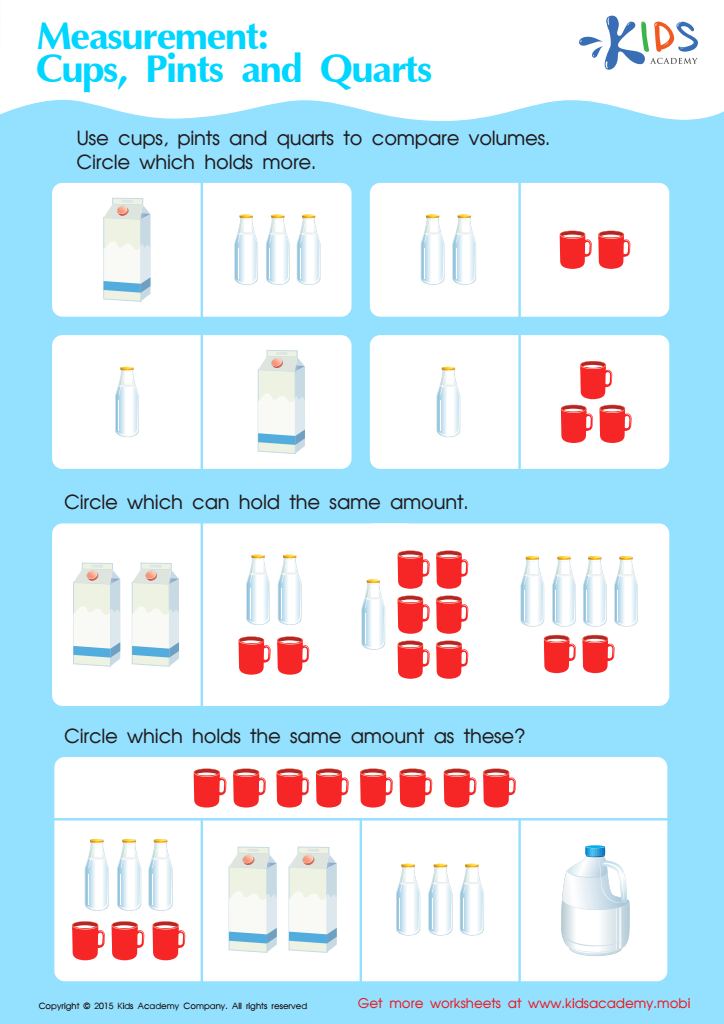
Measurement: Compare Volumes Worksheet
Compare volumes with Kids Academy and have fun! (80 words)
Practice measuring with Kids Academy and have fun! Compare volumes in pictures and circle which holds more. Keep learning with free math worksheets available on our website. Enjoy the process and have fun!
 Assign to My Students
Measurement: Compare Volumes Worksheet
Worksheet
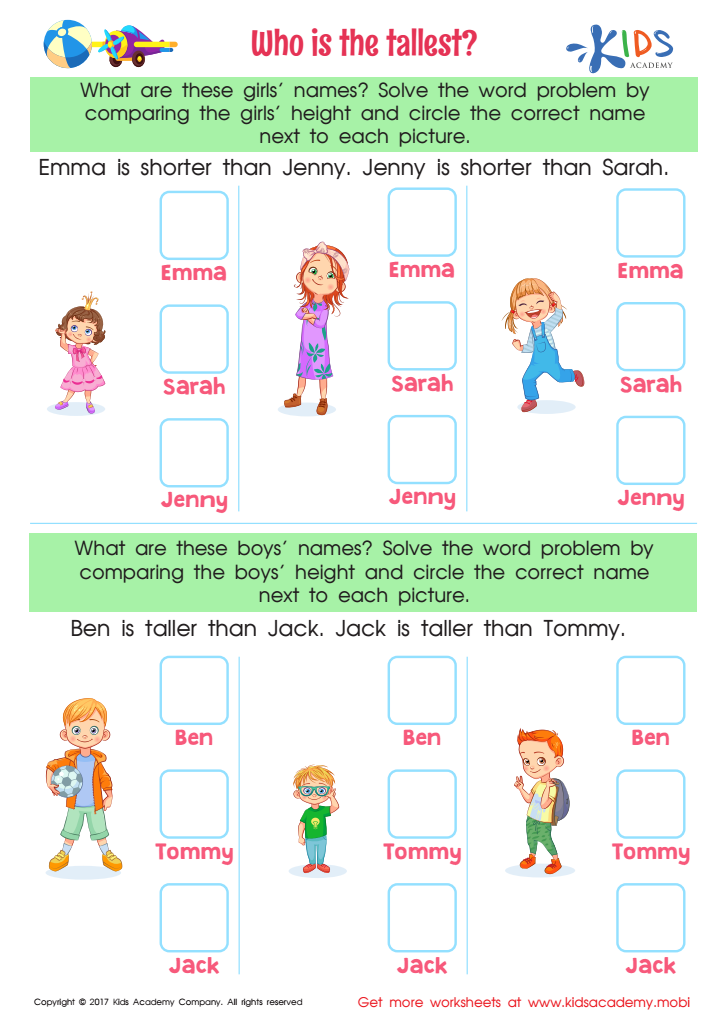
Who Tallest Printable
Help your child observe the kids in the worksheet and compare their heights to answer the question: Who is the Tallest? This is an excellent way for them to practice and better understand measurement concepts.
Who Tallest Printable
Worksheet
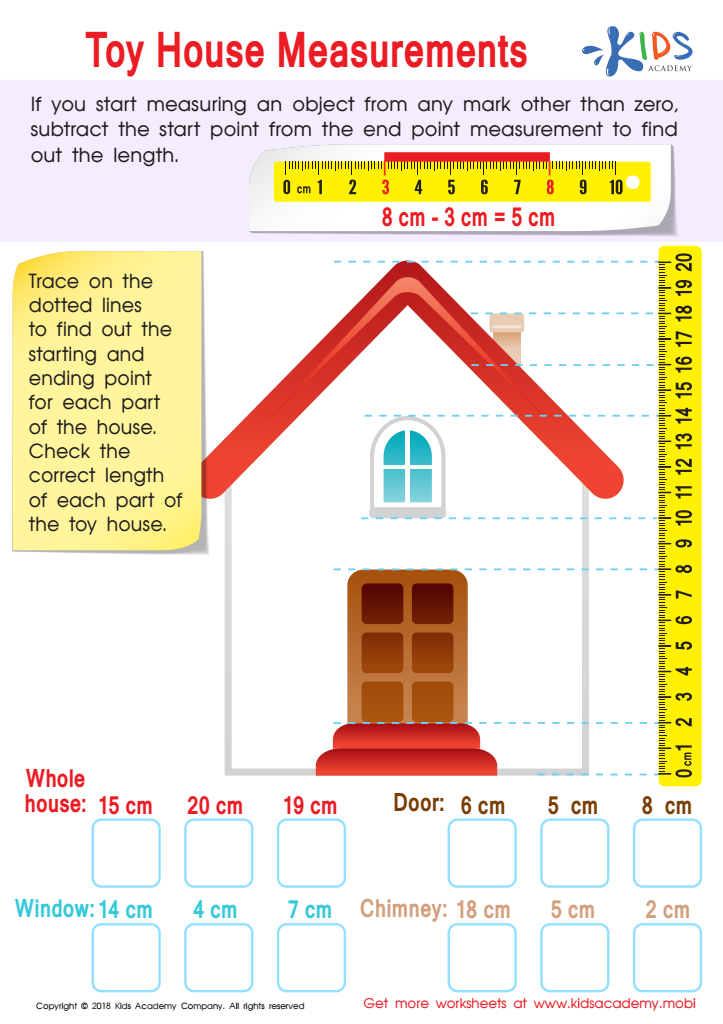
Toy House Measurements Worksheet
This worksheet requires math and measuring skills. When measuring an object from a non-zero starting point, subtract the start point from the end point to get the correct length. Kids must trace the dotted lines to get the right length for each part of the house.
Toy House Measurements Worksheet
Worksheet
Join Kids Academy for Free
Who is primarily going to use this learning content?








Comparing sizes is a fundamental skill that plays a crucial role in a child's cognitive development and understanding of the world around them. For children aged 7-9, engaging in activities that involve comparing sizes offers an extra challenge that builds their mathematical and critical thinking skills.
Firstly, comparing sizes helps with the development of spatial awareness and measurement skills. These are foundational for understanding more complex math concepts that children will encounter in later grades, such as geometry and algebra. When children engage in activities that require them to compare lengths, weights, or volumes, they learn to make observations and draw conclusions based on those observations.
Secondly, comparing sizes fosters language development. As children discuss the different sizes of objects, they learn and use comparative language like bigger, smaller, taller, and shorter. This enhances their vocabulary and ability to express their thoughts clearly.
Lastly, these activities promote problem-solving and analytical thinking. They encourage children to use reasoning skills to form hypotheses and test them, building confidence in their ability to assess and investigate the world around them.
In summary, comparing sizes provides a valuable extra challenge that supports overall cognitive development, language skills, and problem-solving abilities, making it a key area of focus for teachers and parents of children aged 7-9.








