Fraction visualization Extra Challenge Geometry Worksheets
3 filtered results
-
From - To
Enhance your students' understanding of fractions with our Fraction Visualization Extra Challenge Geometry Worksheets! Carefully designed for early learners, these worksheets provide engaging exercises that promote critical thinking and spatial reasoning. Through a variety of interactive tasks, students will visualize and manipulate fractions, fostering deeper comprehension of this essential math concept. With appealing visuals and adaptable difficulty levels, these worksheets cater to diverse learning needs, ensuring that every child can grasp fractional relationships confidently. Perfect for classroom activities or individual practice, our extra challenge worksheets inspire young mathematicians to approach geometry and fractions with curiosity and enthusiasm. Unlock their potential today!
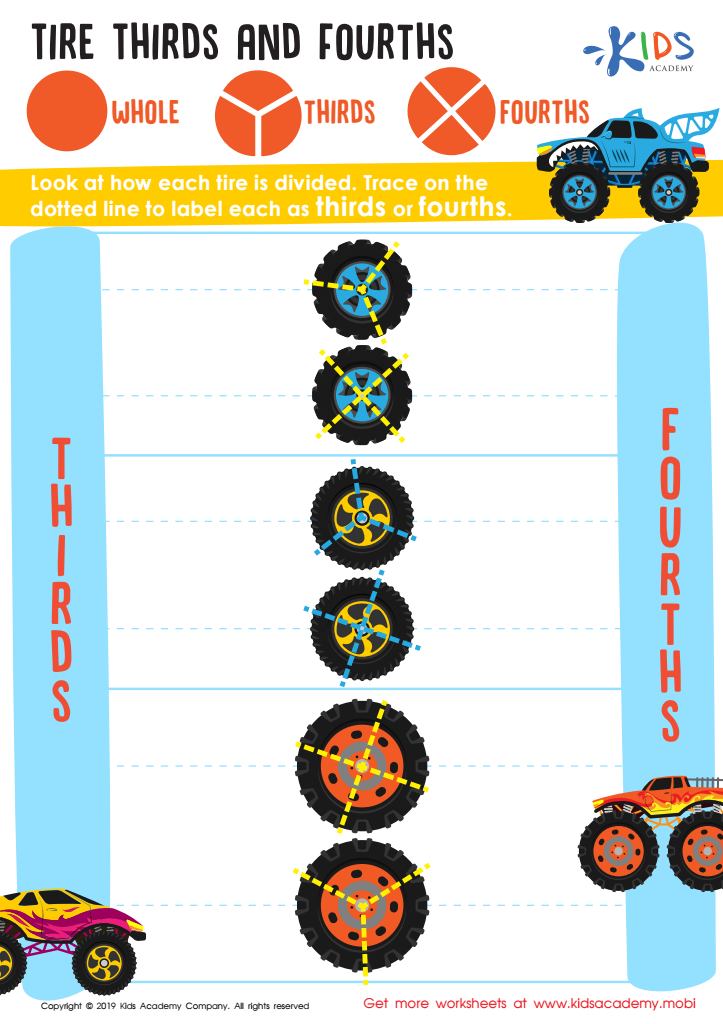
Tire Thirds and Fourths Worksheet
 Assign to My Students











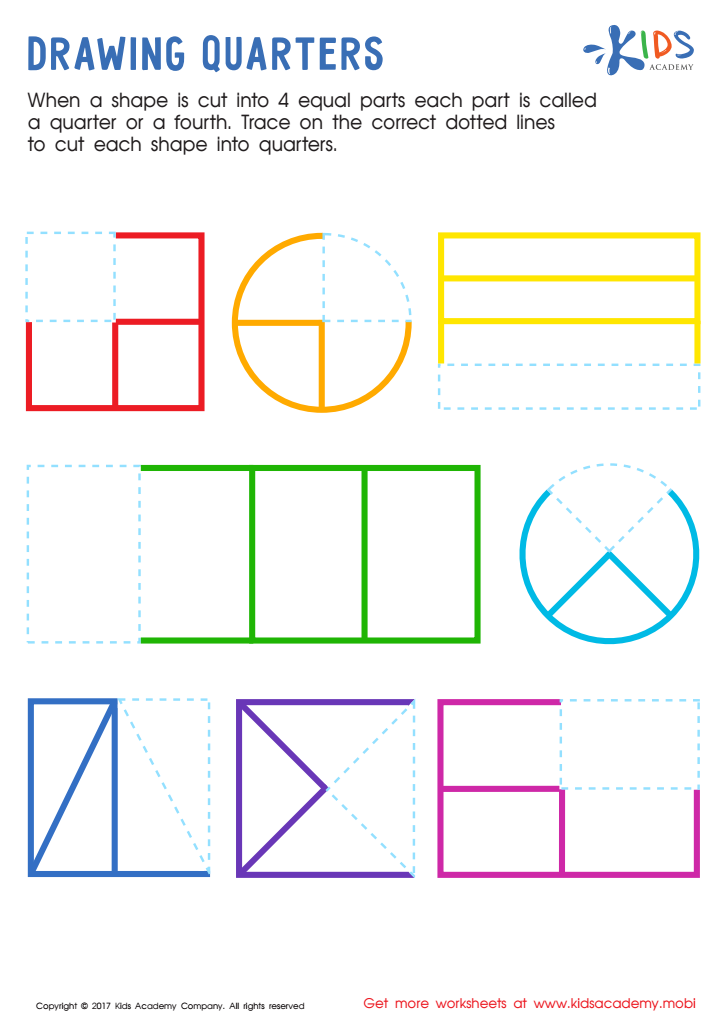
Drawing Quarters Worksheet
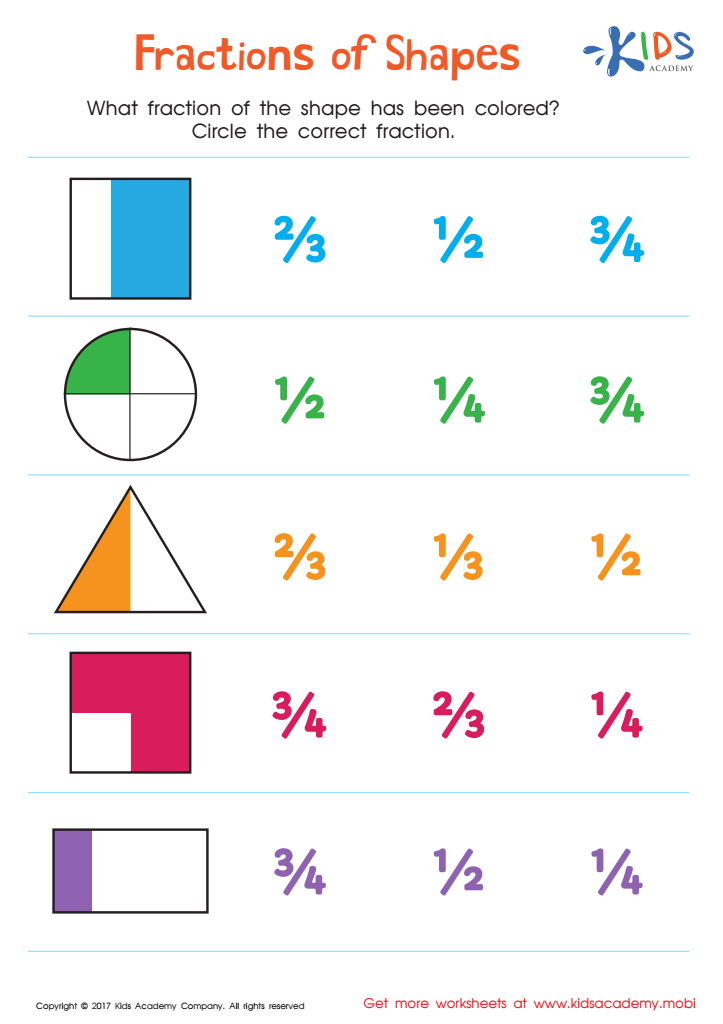
Fractions of Shapes: Math Concept Worksheet








Parents and teachers should prioritize fraction visualization, especially in the context of geometry, because it serves as a critical building block for students' mathematical understanding. Visualizing fractions helps students grasp concepts like part-to-whole relationships, which are essential for comprehending more complex mathematical ideas. For instance, when students see fractions represented through shapes (like circles or rectangles) or in geometric contexts, they develop a clearer understanding of how fractions operate within physical space, enhancing their spatial reasoning skills.
Moreover, fraction visualization engages multiple senses and learning styles, making it easier for students to connect abstract concepts with tangible experiences. This is particularly important for young learners who benefit from concrete visual aids when tackling challenging topics.
Furthermore, as students progress through their education, a solid foundation in fractions and geometry will aid in more sophisticated subject matter, including algebra and calculus. Teachers can integrate these concepts into interdisciplinary lessons, enriching both math and art or science curricula. Ultimately, grasping fraction visualization in geometry boosts confidence and fosters a growth mindset, equipping children with essential skills needed in everyday life and future academic pursuits. It empowers them to tackle real-world problems, making math relevant and exciting.