Recognizing shapes Kindergarten Worksheets
3 filtered results
Difficulty Level
Grade
Age
-
From - To
Subject
Activity
Standards
Discover our engaging "Recognizing Shapes Kindergarten Worksheets" designed to help young learners identify and understand various shapes. These interactive worksheets include fun activities featuring circles, squares, triangles, and more, making shape recognition an exciting adventure for children. Each worksheet encourages critical thinking and creativity, fostering essential early math skills. Perfect for classroom use or at-home learning, our printable resources cater to diverse learning styles. With vibrant illustrations and age-appropriate challenges, kids will boost their confidence and proficiency in recognizing shapes. Download now to inspire a love for learning in your kindergarten classroom and prepare your little ones for future math success!
Favorites
With answer key
Interactive
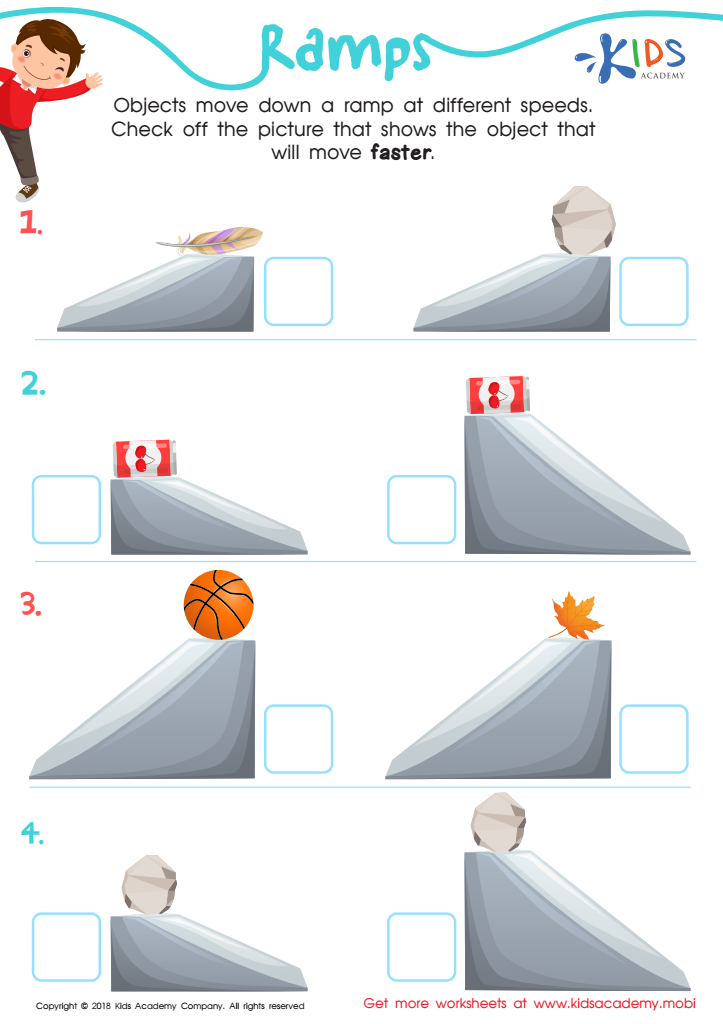
Ramps Worksheet
If your child has seen a ramp, they'll find this worksheet easy. A ramp is sloped for objects to move quickly downwards. The printout has images of objects on different ramps. Ask your child to identify which object will move faster.
 Assign to My Students
Ramps Worksheet
Worksheet
Join Kids Academy for Free
Who is primarily going to use this learning content?








Recognizing shapes in kindergarten is a fundamental building block for early mathematical understanding and cognitive development. When parents and teachers engage children in recognizing shapes, they lay the groundwork for essential skills needed later in mathematics, geometry, and critical thinking.
Understanding shapes helps children develop spatial awareness, which is crucial for navigating their environment and solving real-world problems. For instance, when kids identify circles, squares, and triangles, they begin to see connections between shapes and the objects around them, enhancing their ability to categorize and organize information.
Moreover, shape recognition bolsters language development, as children learn to describe and communicate about their observations. This activity also fosters fine motor skills through hands-on experiences, such as drawing, cutting, and building shapes with various materials.
Encouraging shape recognition at this early age nurtures curiosity and promotes an understanding of patterns and relationships, further supporting cognitive growth. Ultimately, both parents and teachers play a pivotal role in creating enriching opportunities for children to explore shapes, promoting confidence and critical skills that will benefit them throughout their academic journey and beyond. By emphasizing shape recognition, they contribute significantly to their children's overall learning and development.