
Algebraic thinking Worksheets for Kids
1 filtered results
Difficulty Level
Grade
Age
-
From - To
Subject
Activity
Standards
Algebraic thinking worksheets enhance problem-solving skills and understanding of algebra. They build a solid foundation for advanced math with interactive tasks and real-world applications, focusing on pattern recognition and critical thinking. Worksheets encourage self-reliance and independent learning, improving logical reasoning, abstract thought, and mathematical generalization. Working on equations, expressions, and variables boosts analytical skills, while the materials also support spatial reasoning and math vocabulary expansion. Engaging with these worksheets provides immediate feedback, helping students correct errors and improve comprehension. Overall, algebraic worksheets prepare students for diverse problem-solving situations by strengthening their critical and logical thinking abilities.
Favorites
With answer key
Interactive
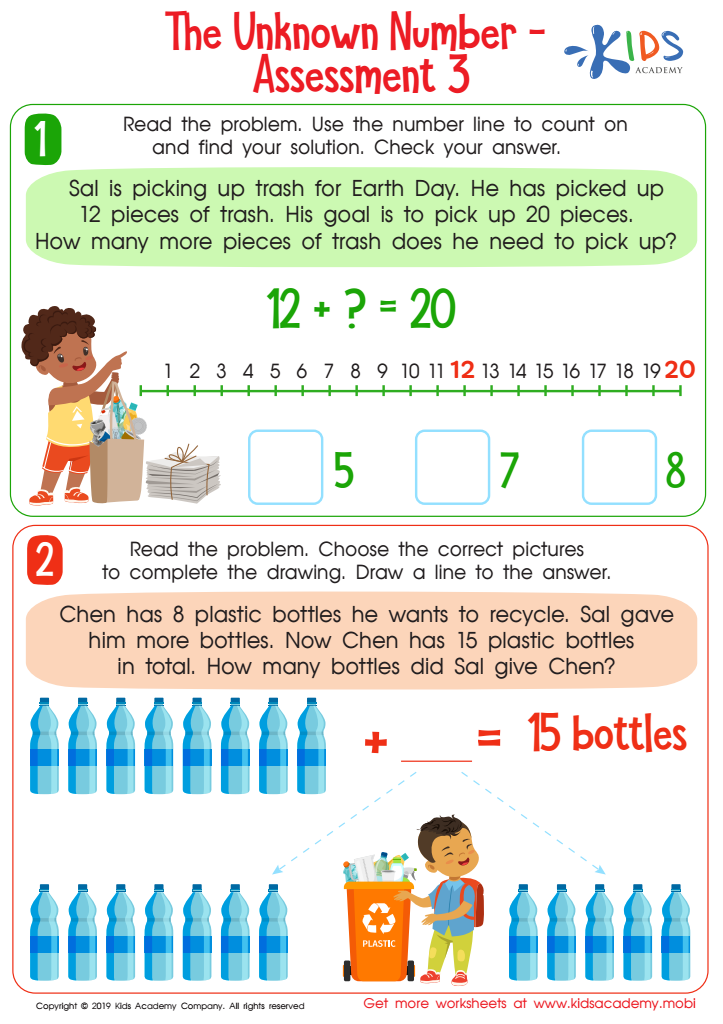
The Unknown Number - Assessment 3 Worksheet
Read the Earth Day-themed word problem aloud to your kids, pointing to the pictures as you go. Use the number line to help them count on and find the answer. Then check it together. Doing this can help them learn more about Earth Day and meet other children who are doing their part to keep it clean.
 Assign to My Students
The Unknown Number - Assessment 3 Worksheet
Worksheet
Question/Answer

How to train the Algebraic thinking skill in Grade 1 students learning about Addition & Subtraction?
To train Algebraic thinking in Grade 1 students, use concrete objects and visual aids like number lines, blocks, or charts for them to physically manipulate and visualize addition and subtraction processes. Incorporate simple word problems that relate to real-life scenarios, encouraging students to identify and form mathematical relationships.
What are some effective activities to train students’ Algebraic thinking skill when teaching them about Addition & Subtraction?
Effective activities include using manipulatives (like blocks or counters) for hands-on learning, employing visual aids (charts or number lines), solving word problems that require critical thinking, engaging in pattern recognition exercises, playing math games that reinforce concepts, and incorporating real-life scenarios that require the application of addition and subtraction. These methods make abstract concepts tangible and enhance algebraic thinking.
Why is the Algebraic thinking skill important for Grade 1 students?
Algebraic thinking for Grade 1 students lays the foundation for understanding patterns, relationships, and the basic concept of variables. It enhances problem-solving skills, encourages logical reasoning, and helps them grasp more complex mathematical concepts later. Developing this skill early supports a strong mathematical foundation, promoting academic success in mathematics and related fields throughout their educational journey.
Join Kids Academy for Free
Who is primarily going to use this learning content?




.jpg)









