Graphing skills development Worksheets for Kids
1 filtered results
-
From - To
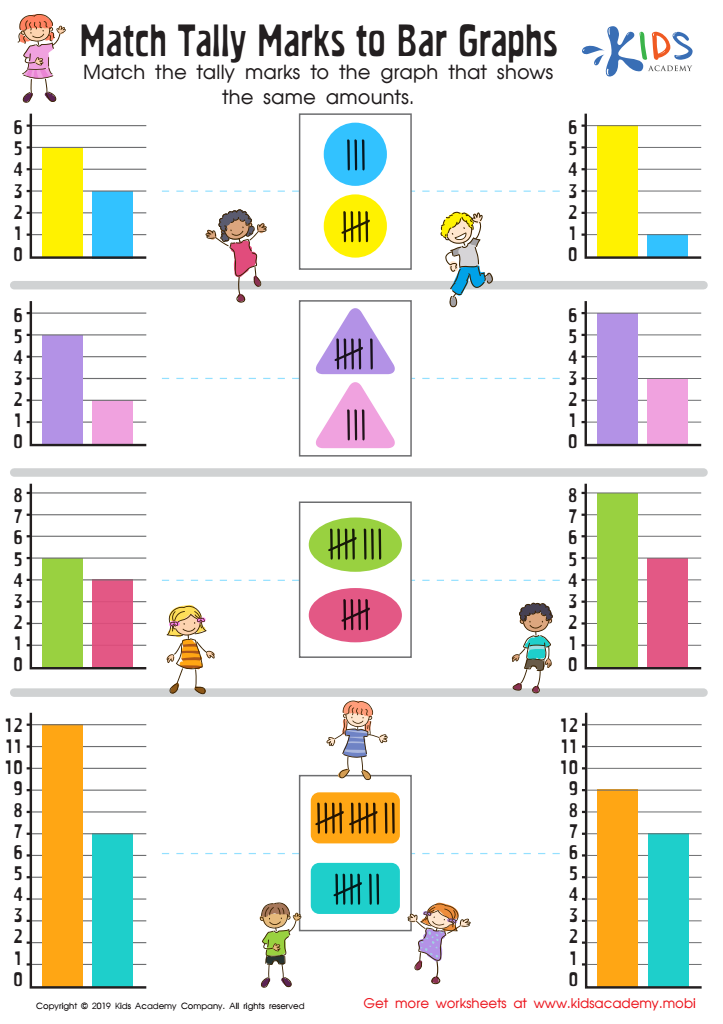
Match Tally Marks to Bar Graphs Worksheet
 Assign to My Students
Question/Answer

Why is the Graphing skills development skill important for Grade 1 students?
Graphing skills development in Grade 1 students is important as it introduces fundamental concepts of data collection and representation. It enhances their analytical thinking, helps in understanding patterns and relationships, and improves mathematical literacy. Early exposure to graphing also supports problem-solving and decision-making skills, laying a strong foundation for more complex math concepts in future grades.
What are some effective activities to train students’ Graphing skills development skill when teaching them about Numbers?
Effective activities for training students in graphing skills include creating bar graphs from collected data, plotting points on coordinate planes, interpreting line graphs through storytelling, transforming numerical data into pie charts, and using manipulatives or digital tools for constructing and understanding histograms. These hands-on activities help students grasp the concepts of scale, distribution, and representation of data.
What does the Graphing skills development skill mean when it comes to Grade 1 Numbers learning?
Graphing skills development in Grade 1 Numbers learning involves teaching children to represent and interpret data using simple graphs. They learn to organize, compare quantities, and understand concepts of more than, less than, or equal to through visual representation. This foundational skill helps them to grasp basic statistical concepts and enhances their ability to analyze and communicate information visually.



.jpg)