Improves numerical literacy Worksheets for Kids
1 filtered results
Difficulty Level
Grade
Age
-
From - To
Subject
Activity
Standards
Improves numerical literacy Worksheets enhance student skills across ages. Interactive and structured, they bolster critical thinking and math fluency. They make math engaging, ensuring systematic progression and solid foundational learning. As learners gain independence in problem-solving, confidence and understanding in math grow. The worksheets foster long-term retention through repetitive practice, preparing students for academic success and daily life applications.
Favorites
With answer key
Interactive
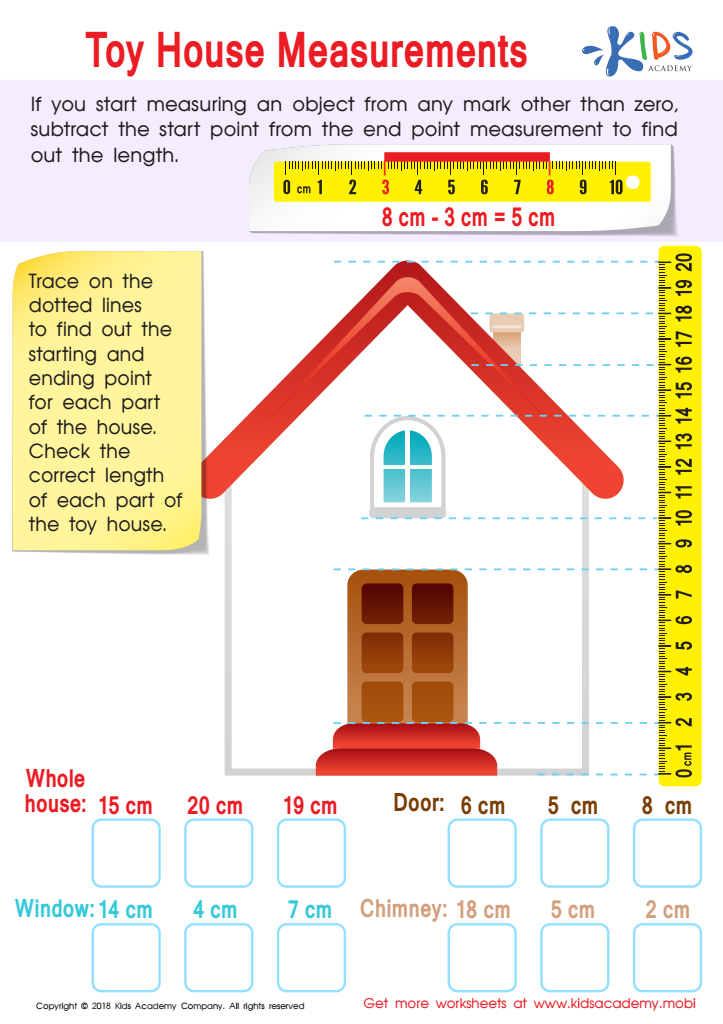
Toy House Measurements Worksheet
This worksheet requires math and measuring skills. When measuring an object from a non-zero starting point, subtract the start point from the end point to get the correct length. Kids must trace the dotted lines to get the right length for each part of the house.
 Assign to My Students
Toy House Measurements Worksheet
Worksheet
Question/Answer

What are some effective activities to train students’ Improves numerical literacy skill when teaching them about Measurement?
Effective activities include hands-on measurement projects like building models or cooking, employing measurement tools in real-life scenarios, interactive games focusing on unit conversion, engaging in measurement scavenger hunts where students find objects matching specific measurements, and utilizing technology apps that simulate measurement challenges. These approaches make learning about measurement interactive, practical, and relevant, thereby improving numerical literacy.
How to train the Improves numerical literacy skill in Grade 2 students learning about Measurement?
To train Grade 2 students in numerical literacy for measurement, employ interactive activities like using rulers to measure classroom objects, creating simple charts to compare heights or lengths, and incorporating games that involve estimating and measuring real-life items. These hands-on experiences reinforce the concept of measurement and improve numerical literacy by making abstract concepts tangible and engaging.
What does the Improves numerical literacy skill mean when it comes to Grade 2 Measurement learning?
Improving numerical literacy skill in the context of Grade 2 Measurement learning means enhancing a student's ability to understand, interpret, and work with numbers in real-world contexts. It involves teaching them how to accurately measure length, weight, and volume, understand and use units of measurement, and apply this knowledge to solve problems, compare measurements, and make estimations.
Join Kids Academy for Free
Who is primarily going to use this learning content?