Pattern perception Worksheets for Kids
1 filtered results
Difficulty Level
Grade
Age
-
From - To
Subject
Activity
Standards
Pattern perception worksheets are a valuable tool that helps individuals develop and enhance their pattern recognition skills. These worksheets enable learners to identify and understand the underlying patterns, sequences, and relationships within a given set of elements or objects.
Favorites
With answer key
Interactive
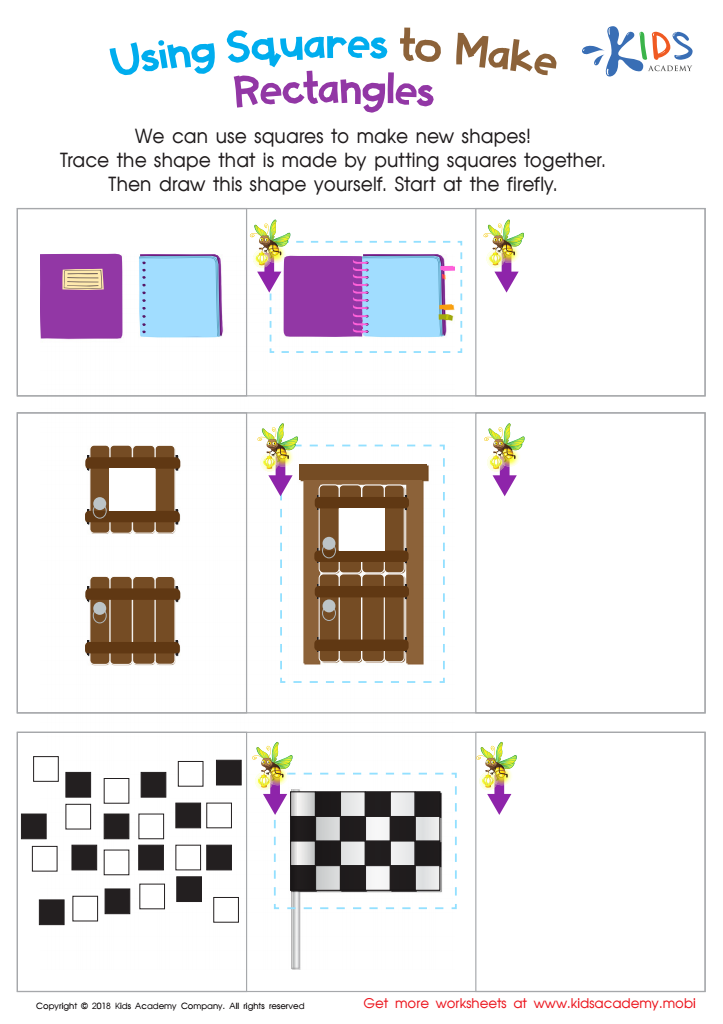
Using Squares to Make Rectangles Worksheet
Creating shapes from other shapes (composing shapes) develops spatial skills, an essential geometry standard for young students. This worksheet introduces familiar square objects, then demonstrates how they create rectangles. Students practice tracing and then drawing the shape independently. Download this free math resource for the classroom today! (80 words)
 Assign to My Students
Using Squares to Make Rectangles Worksheet
Worksheet
Question/Answer

What are some effective activities to train students’ Pattern perception skill when teaching them about Geometry?
Effective activities to train students' pattern perception in Geometry include engaging them in tessellation projects, using tangrams or pattern blocks for shape composition and decomposition, exploring fractals, implementing symmetry drawing exercises, and conducting geometry scavenger hunts to identify shapes and patterns in their environment. These hands-on and visually stimulating activities enhance their ability to recognize and analyze geometric patterns.
What does the Pattern perception skill mean when it comes to Kindergarten Geometry learning?
Pattern perception in Kindergarten Geometry learning refers to the ability of young learners to recognize, understand, and predict regularities within various geometric shapes and arrangements. This skill is foundational for geometry as it helps children identify shapes based on their attributes and understand how shapes can be combined or decomposed, preparing them for more complex mathematical concepts.
How to test a Kindergarten student’s Pattern perception skills?
To test a Kindergarten student’s pattern perception skills, present a series of objects or images that follow a specific sequence. Ask the child to identify and continue the pattern, for example, using colors, shapes, or sizes. Start with simple patterns and gradually increase complexity to assess their ability to recognize, predict, and replicate patterns accurately.
Join Kids Academy for Free
Who is primarily going to use this learning content?


.jpg)