Perseverance practice Worksheets for Kids
1 filtered results
Difficulty Level
Grade
Age
-
From - To
Subject
Activity
Standards
Perseverance practice Worksheets are a useful tool for developing and honing the valuable skill of perseverance. These worksheets offer a structured and practical approach to cultivating the mindset of persistence and determination in both children and adults.
Favorites
With answer key
Interactive
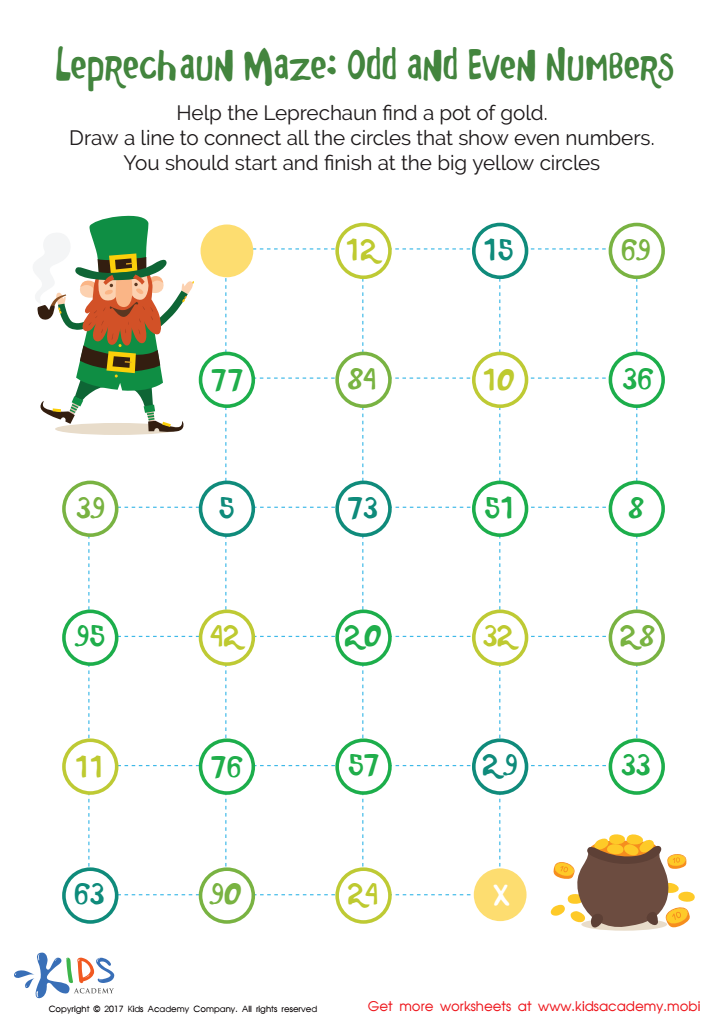
Leprechaun Maze Printable
Help the leprechaun find his pot of gold! Challenge your learner with this St. Patrick's Day worksheet. Let them identify odd or even numbers in the maze and connect the dots. It will be a fun way to celebrate St. Patrick's Day!
 Assign to My Students
Leprechaun Maze Printable
Worksheet
Question/Answer

What are some effective activities to train students’ Perseverance practice skill when teaching them about Numbers?
Effective activities to train students' perseverance when teaching about numbers include solving complex puzzles or word problems, engaging in math games that require strategic thinking and patience, working on long-term projects that involve multiple steps and calculations, participating in math competitions or challenges, and conducting experiments or investigations that require collection, analysis, and interpretation of numerical data.
Why is the Perseverance practice skill important for Grade 1 students?
Perseverance is essential for Grade 1 students because it teaches them to continue trying despite challenges or failures, fostering resilience and a growth mindset. This skill helps them navigate academic tasks and social interactions, laying a foundation for lifelong learning and adaptation. Developing perseverance early ensures they approach problems with determination, enhancing their educational and personal success.
How does the mastery of the Perseverance practice skill affect a student's performance at an early age?
Mastering the Perseverance practice skill at an early age significantly enhances a student's performance by improving their resilience and ability to overcome challenges. It fosters a growth mindset, leading to better academic outcomes, higher motivation, and increased problem-solving skills.
Join Kids Academy for Free
Who is primarily going to use this learning content?