Practice weighing Worksheets for Kids
1 filtered results
-
From - To
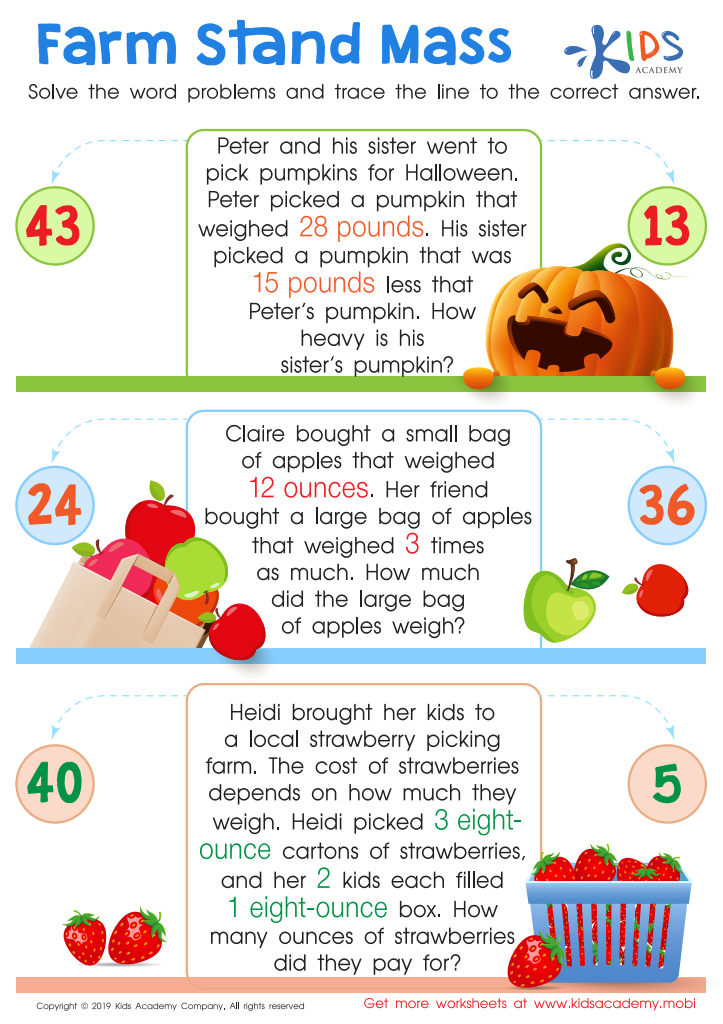
Farm Stand Mass Worksheet
 Assign to My Students
Question/Answer

Why is the Practice weighing skill important for Grade 3 students?
The practice of weighing skill is important for Grade 3 students because it helps them understand and apply mathematical concepts of measurement and comparison, enhances their problem-solving abilities, and enables them to engage with real-world scenarios that involve weighing objects. This foundational skill also lays the groundwork for more advanced scientific and mathematical studies in the future.
What does the Practice weighing skill mean when it comes to Grade 3 Multiplication learning?
The Practice weighing skill in Grade 3 Multiplication learning refers to the ability to assign appropriate importance or emphasis to different aspects of multiplication concepts or problems. It involves prioritizing learning and practice activities to strengthen understanding and fluency in multiplication, such as focusing on more challenging multiplication facts or applying multiplication in various problem-solving contexts.
How to test a Grade 3 student’s Practice weighing skills?
To test a Grade 3 student's practice weighing skills, provide various objects and a balance scale. Ask the student to predict which object is heavier, then use the scale to weigh the objects and record the measurements. Compare predictions with actual results to evaluate their understanding of weight and ability to use a scale accurately.