Visual discrimination 2D Shapes Worksheets
5 filtered results
Difficulty Level
Grade
Age
-
From - To
Subject
Activity
Standards
Enhance your child's learning experience with our engaging Visual Discrimination 2D Shapes Worksheets. Designed for young learners, these worksheets focus on honing visual discrimination skills, enabling children to identify, differentiate, and classify various 2D shapes. Each activity is crafted to captivate your child's interest while promoting critical thinking and early math skills. From circles and squares to triangles and rectangles, our diverse exercise collection nurtures shape recognition in a fun and interactive way. Ideal for at-home learning or classroom use, these worksheets encourage independent learning and boost confidence in math concepts. Start your child's journey toward shape mastery today!
Favorites
With answer key
Interactive
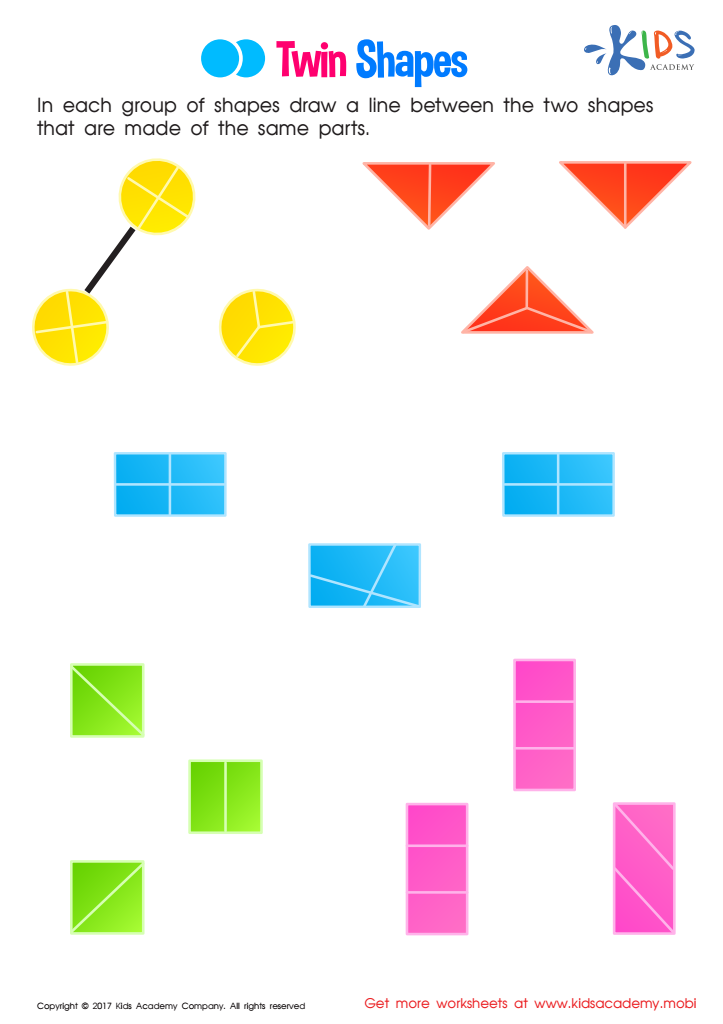
Twin Shapes Worksheet
Your students' goal in this worksheet is to find the twin shapes: drawing a line between two shapes made of the same parts. Likely, the first shapes encountered were circles, triangles, rectangles and squares - examples of which are seen frequently in everyday life. Encourage them to apply what they know and work out which is the twin shape!
 Assign to My Students
Twin Shapes Worksheet
Worksheet



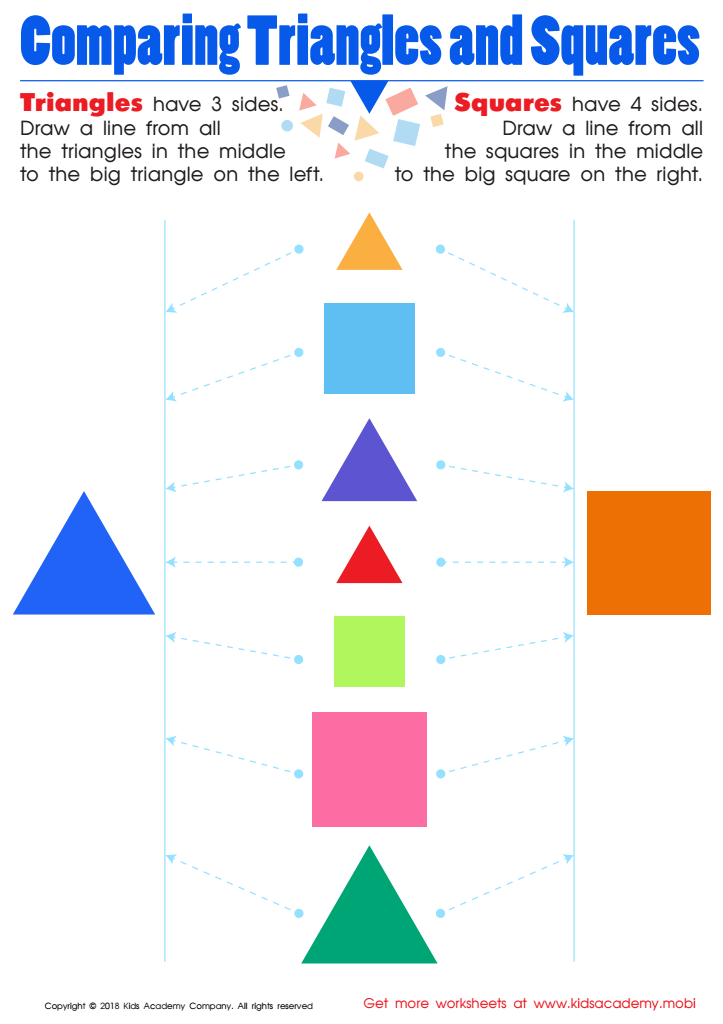
Comparing Triangles Squares Worksheet
Squares and triangles are different in the number of sides they have. Challenge kids to compare them with this fun worksheet! Read the descriptions at the top, then use the left and right shapes to match up the middle ones. Go down the page, joining the middle shapes to the side using the dotted lines!
Comparing Triangles Squares Worksheet
Worksheet
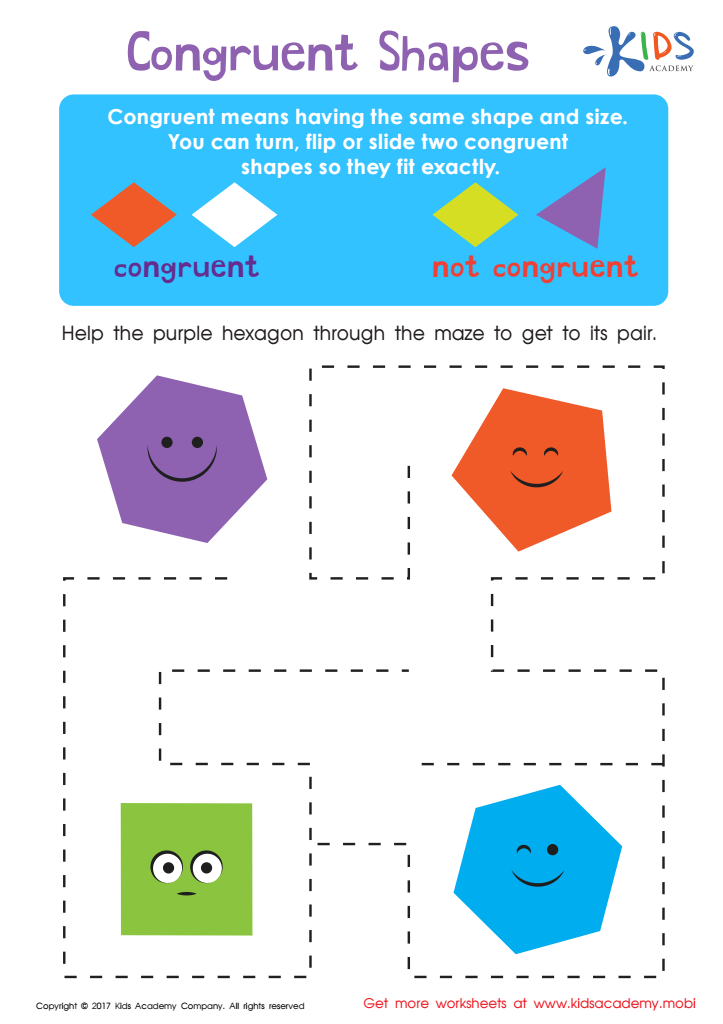
Congruent Shapes Worksheet
Help your child find the twin of the purple hexagon! This congruent shapes worksheet is great for increasing vocabulary while challenging mental rotation skills.
Congruent Shapes Worksheet
Worksheet
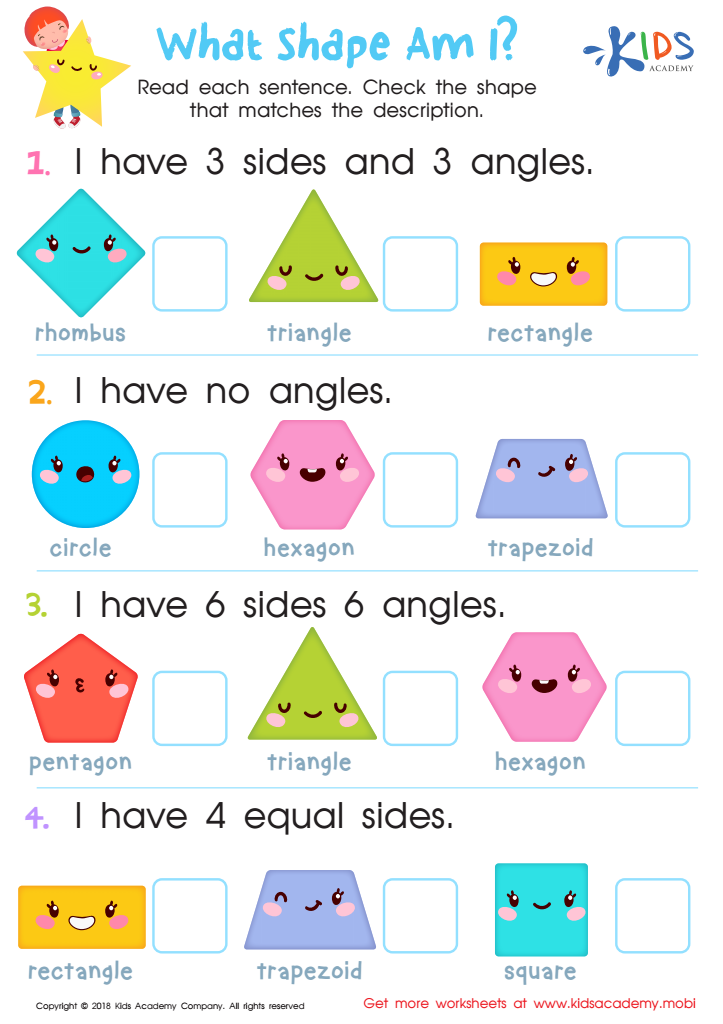
What Shape Am I? Worksheet
Help your child read each sentence in this colorful worksheet. Have them identify the shapes described and check the boxes. To prepare, ask simple questions like "How many sides does a triangle have?" and "Which shape has 4 equal sides?" Your child will become more skilled at shapes by the end of this activity.
What Shape Am I? Worksheet
Worksheet
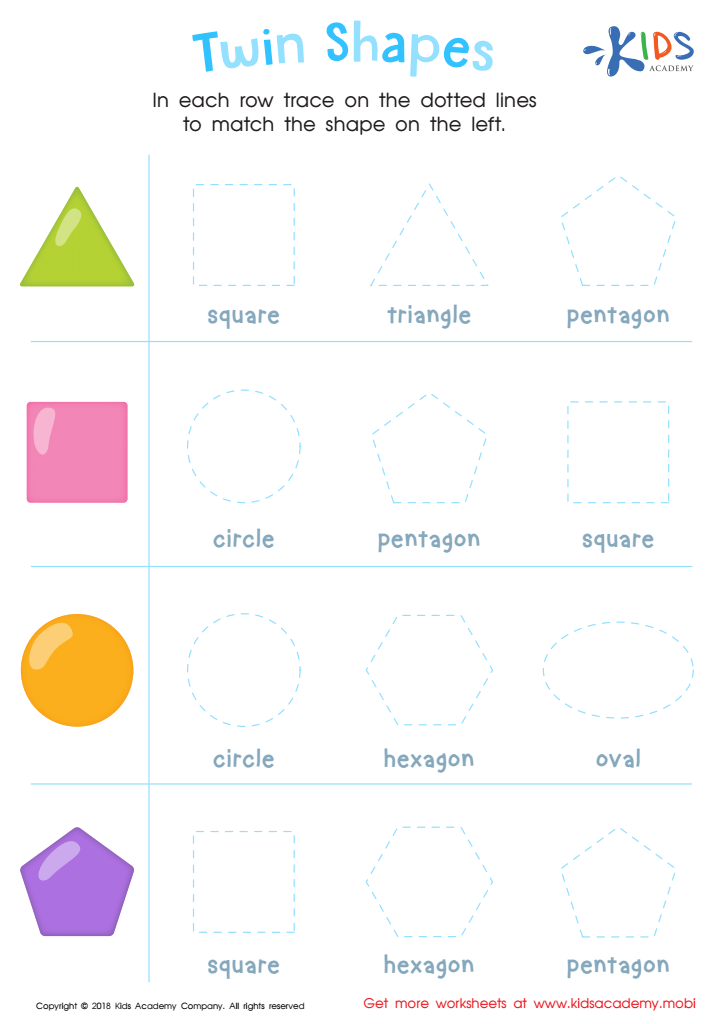
Twin Shapes Dot-to-Dot Worksheet
Test your child's ability to copy with this worksheet. Ask them to find and name the four shapes on the left. Then, they must match each with the dotted lines on the right. Help your child with all four shapes in this fun exercise.
Twin Shapes Dot-to-Dot Worksheet
Worksheet
Join Kids Academy for Free
Who is primarily going to use this learning content?








Visual discrimination of 2D shapes is an essential skill in early childhood development that lays the foundation for mathematical understanding and spatial awareness. This capability allows children to distinguish between different shapes, leading to improvements in their problem-solving abilities and critical thinking. When parents and teachers acknowledge the importance of this skill, they foster an environment that promotes cognitive growth and literacy development.
By being able to identify and categorize shapes, children can easily relate them to real-world objects, which enhances their descriptive language and boosts their creativity. Additionally, visual discrimination helps develop fine motor skills and hand-eye coordination, as children often engage in activities like drawing, cutting, or constructing with shapes.
Furthermore, mastering visual discrimination prepares children for more complex concepts in math and science, such as geometry and pattern recognition. Integrating shape recognition into activities—such as sorting, matching games, and art—encourages playful learning that strengthens comprehension and retention. Therefore, parents and teachers should prioritize visual discrimination of 2D shapes, as it fundamentally supports children's overall academic and personal development, setting the stage for lifelong learning and success.