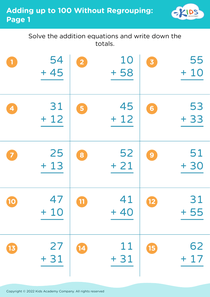
Identify shapes Adding up to 100 with Regrouping Worksheets
3 filtered results
-
From - To
Explore our "Identify Shapes Adding up to 100 with Regrouping Worksheets," designed to enhance young learners' understanding of geometry and arithmetic. These engaging worksheets combine shape recognition with addition skills, as students learn to identify various shapes while practicing addition with regrouping. Ideal for early grades, these activities support skill-building through colorful visuals and interactive exercises. Children will develop their mathematical reasoning as they solve addition problems equating to 100, reinforcing both their understanding of geometric forms and their ability to regroup numbers strategically. Perfect for classroom or home use, these worksheets make learning math fun and effective!
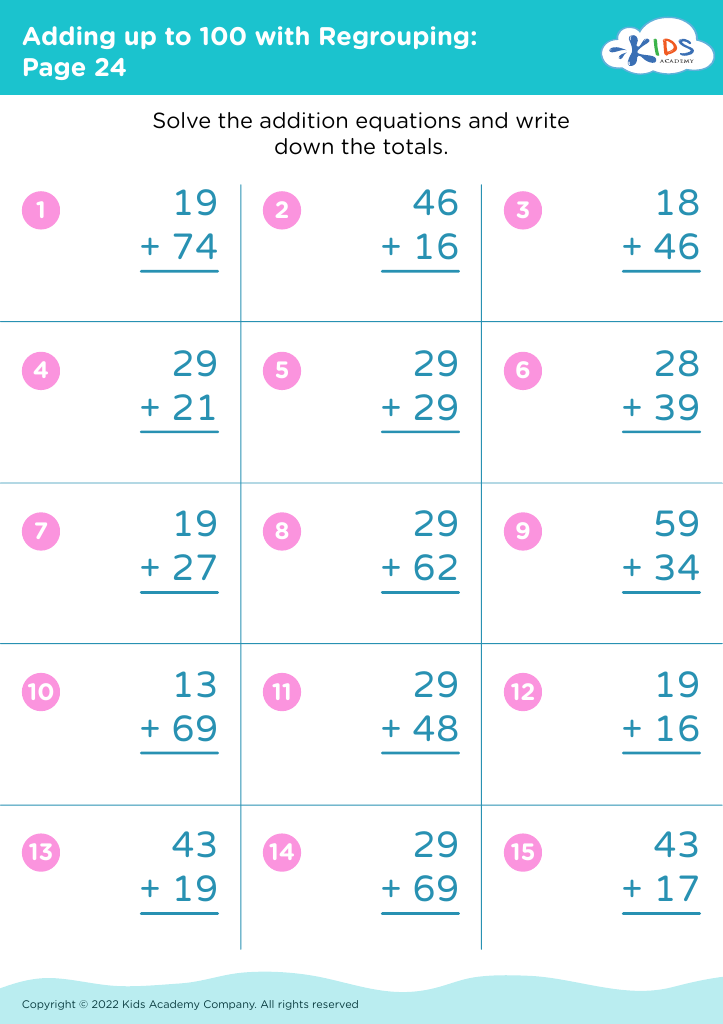
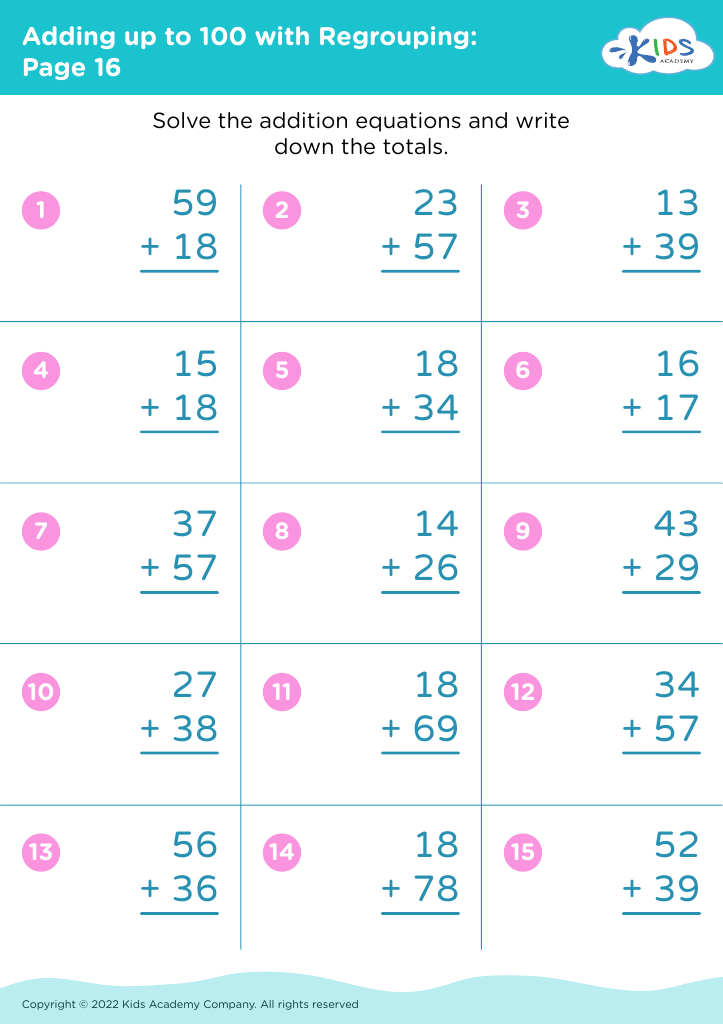
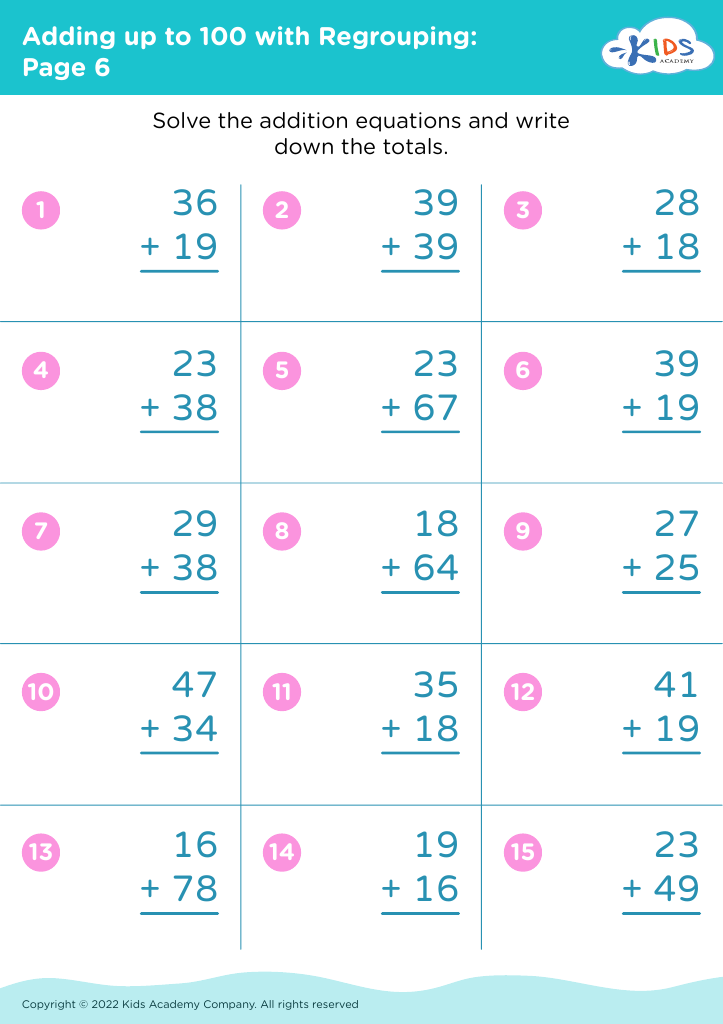




Parents and teachers should care about identifying shapes and understanding addition with regrouping because these skills are fundamental to a child's mathematical development and overall cognitive growth. First, identifying shapes helps children develop spatial reasoning and enhances their ability to recognize patterns in their environment, which is crucial for problem-solving and critical thinking skills.
Inclusive numerical concepts like addition, particularly when teaching regrouping (or carrying), establish a solid foundation for more advanced arithmetic operations. Regrouping cultivates flexibility in thinking, enabling children to approach complex problems more effectively by breaking them down into manageable parts. Introducing addition up to 100 encourages children to master two-digit operations, bolstering their confidence in mathematics and promoting a growth mindset.
Moreover, a focus on these foundational skills at a young age directly supports future academic achievement. Engaging parents in this learning process—through open communication and collaborative activities—fosters a supportive learning environment. A child's grasp of shapes and addition enhances their ability to connect math to real-life situations, promoting greater interest and proficiency in the subject. Ultimately, instilling these concepts prepares children for higher-level math while fostering logical thinking habits that extend beyond the classroom.