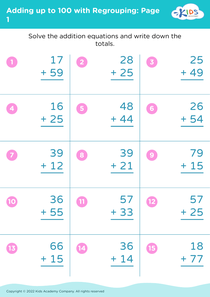
Understanding patterns Adding up to 100 Without Regrouping Worksheets
3 filtered results
-
From - To
Discover our "Understanding Patterns Adding up to 100 Without Regrouping Worksheets" designed to enhance your child's math skills. These engaging worksheets focus on recognizing and utilizing patterns to simplify addition, making learning both effective and enjoyable. As students practice adding for sums up to 100, they will develop a strong foundational understanding of math concepts without the need for regrouping. Perfect for early grade learners, these resources promote critical thinking, problem-solving, and confidence in arithmetic. With colorful designs and interactive activities, your child will enjoy mastering addition through patterns. Empower their learning journey today and watch their skills soar!
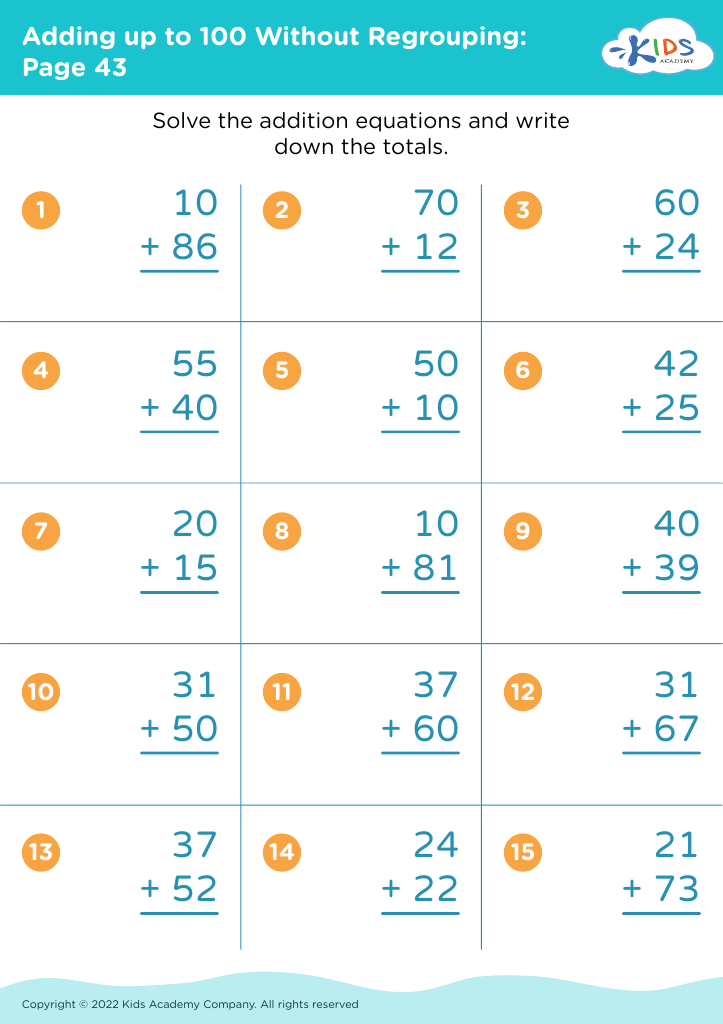
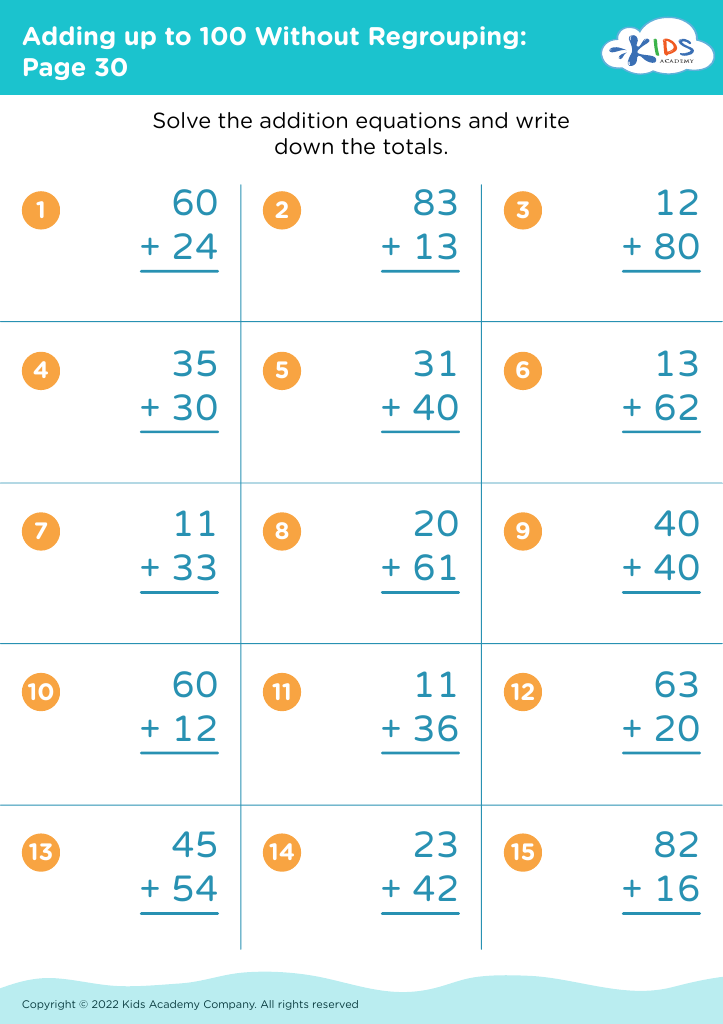
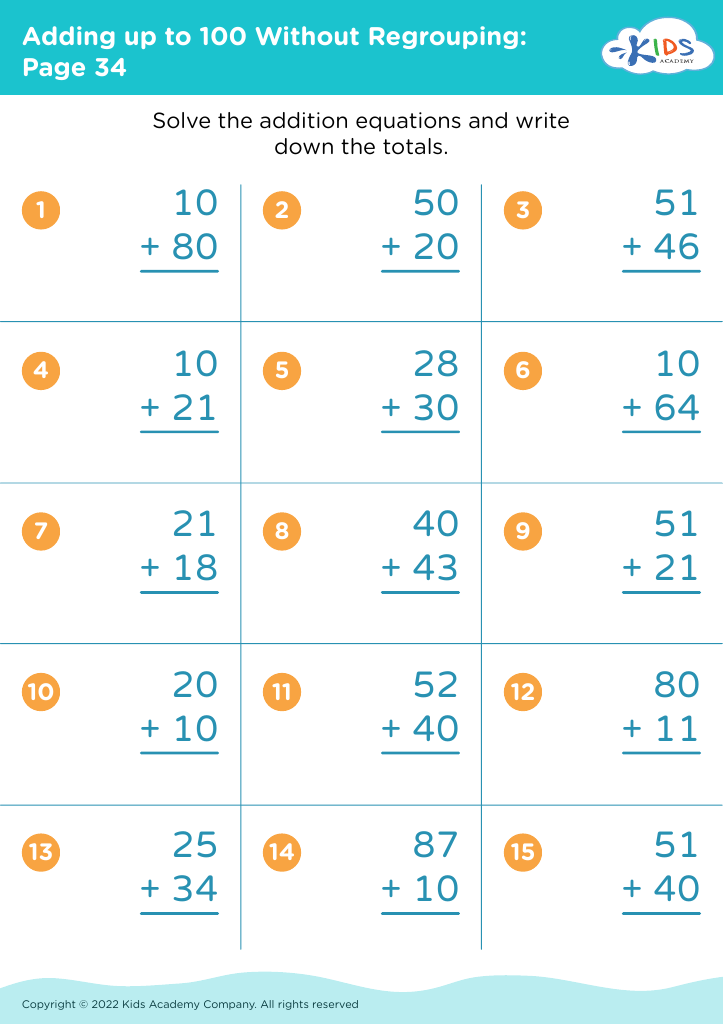




Understanding patterns that add up to 100 without regrouping is crucial for both parents and teachers because it forms a foundational concept in mathematics that supports later learning. When children grasp these patterns, they cultivate a number sense essential for more advanced arithmetic and algebraic operations.
Recognizing how numbers can combine to reach 100 easily helps students quickly solve math problems, improving their computational fluency. This skill fosters confidence in young learners as they tackle addition and subtraction, allowing them to focus on problem-solving rather than getting bogged down by complex calculations.
Moreover, understanding these patterns encourages critical thinking and analytical skills. Teachers can use this knowledge to create engaging, hands-on activities that make math enjoyable, while parents can reinforce this learning at home through games and real-life applications, like budgeting or planning.
By emphasizing this concept, educators and parents are laying the groundwork for students to excel in mathematics. Such early investment in mathematical understanding ultimately promotes a positive attitude towards math, making students more likely to pursue STEM subjects and careers in the future. In summary, recognizing patterns in adding up to 100 without regrouping not only enhances math skills but fosters a lifelong appreciation for learning.