Color Identification Addition & Subtraction Worksheets - Page 2
27 filtered results
-
From - To
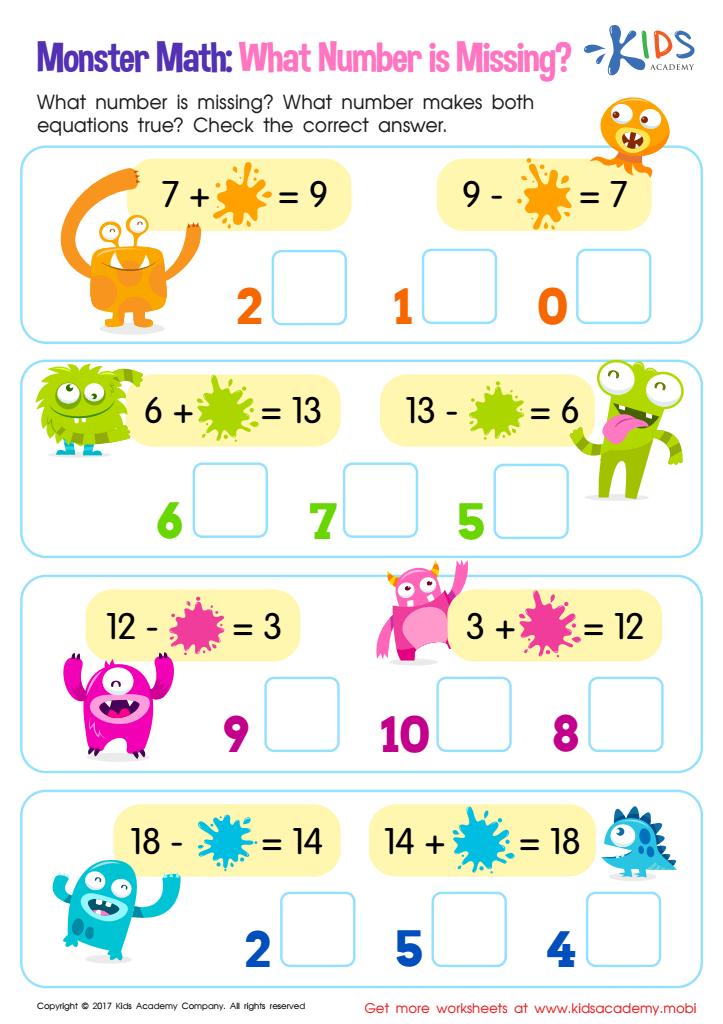
Missing Number: Monster Math Worksheet
 Assign to My Students








Color identification in relation to addition and subtraction is a valuable educational tool for early grade students. It enhances learning by making abstract mathematical concepts more tangible and appealing. By using colors, teachers and parents can engage learners’ attention and imagination, making math feel less intimidating.
Color identification supports cognitive development. Associating colors with numbers helps children visualize mathematical operations and fosters their ability to categorize and differentiate. This multi-sensory approach also caters to diverse learning styles, benefiting visual learners in particular while reinforcing the connection between colors and numerical values.
Moreover, using colors in math activities fosters enthusiasm and enjoyment in learning. When children relate colors to their learning experiences, it encourages participation and exploration, enabling them to grasp foundational concepts more easily. It enhances their ability to comprehend more complex math later on.
Finally, integrating color identification in addition and subtraction tasks applies real-world relevance. Many everyday scenarios involve color-differentiated items (e.g., blocks, toys, fruits). Engaging students in such tasks builds their confidence in preserving dynamic intersectionality between visual art and math, ensuring they develop a well-rounded skill set. Consequently, emphasizing color identification equips children with practical tools for lifelong learning.








