Recognizing equivalent fractions Addition & Subtraction Worksheets
5 filtered results
-
From - To
Enhance your child's math skills with our "Recognizing Equivalent Fractions Addition & Subtraction Worksheets." Designed for early learners, these engaging worksheets help students identify and work with equivalent fractions while practicing addition and subtraction. Each worksheet is crafted to encourage critical thinking and foster a strong understanding of fraction equivalence, ensuring your child gains confidence in their math abilities. With colorful graphics and clear instructions, these worksheets make learning fractions exciting and interactive. Perfect for classrooms or at-home learning, our resources provide essential practice for young mathematicians. Download now and watch your child excel in their understanding of fractions!
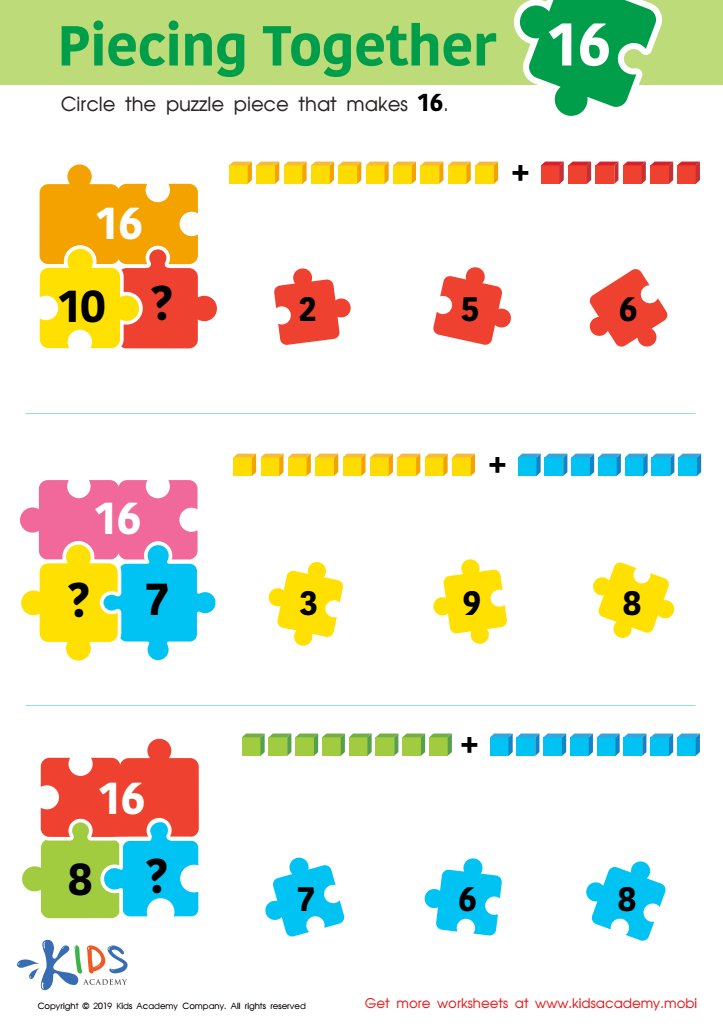
Piecing Together 16 Worksheet
 Assign to My Students








Recognizing equivalent fractions in addition and subtraction is essential for parents and teachers alike, as it lays a strong foundation for students’ mathematical understanding and problem-solving skills. Equivalent fractions are different fractions that represent the same value, such as 1/2 and 2/4. Mastering this concept enables children to simplify fractions, recognize patterns, and understand that fractions can be manipulated flexibly in various contexts.
When children learn to recognize equivalent fractions, they become more adept at adding and subtracting them, which is crucial for their progress in math. These skills relate directly to real-world scenarios, such as adjusting recipes or sharing an amount equally. Understanding equivalent fractions also helps students grasp more complex concepts in higher math, such as ratios, proportions, and algebra.
Furthermore, recognizing equivalent fractions fosters critical thinking and nurtures perseverance. By encouraging discussions and providing opportunities to explore these concepts, parents and teachers can help build a strong mathematical mindset. This paves the way for better academic performance and boosts students’ confidence in their abilities, fostering a lifelong appreciation for mathematics. In essence, addressing equivalent fractions today sets up students for future success in all areas of math.








