Basic addition practice Math Worksheets - Page 2
25 filtered results
-
From - To
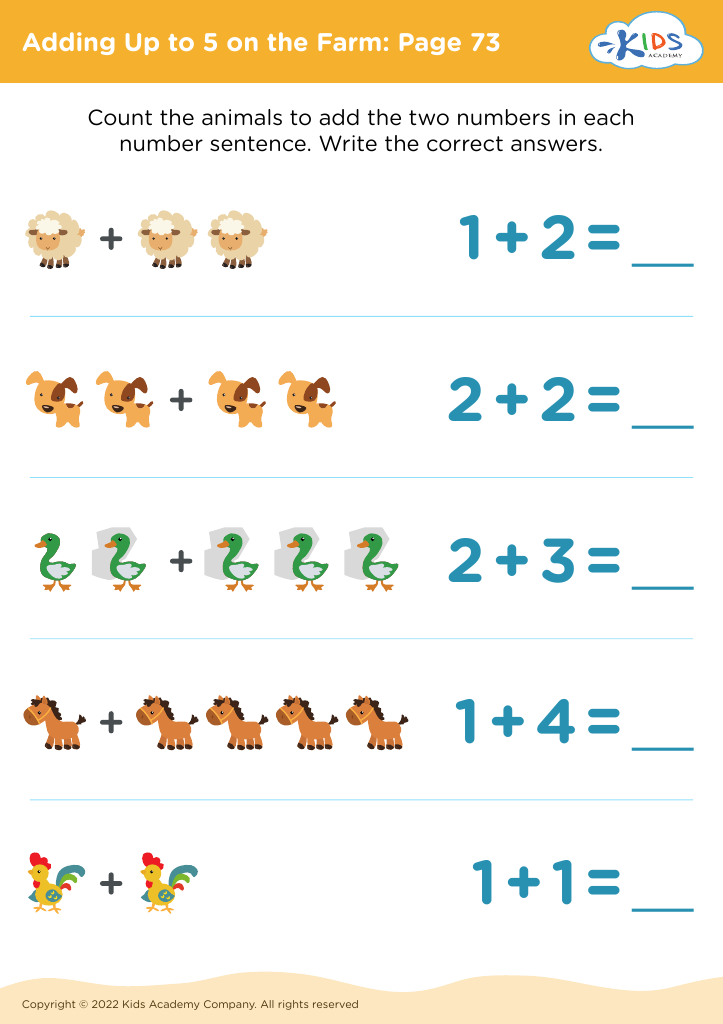








Parents and teachers should prioritize basic addition practice in early education because it serves as the foundational building block for all mathematical learning. Mastering addition helps children develop critical thinking and problem-solving skills, crucial for more advanced concepts such as subtraction, multiplication, and division. Early proficiency in addition also boosts a child's confidence in their mathematical abilities, fostering a positive attitude towards learning.
Furthermore, regular addition practice enhances cognitive skills like memory and attention. It provides students with the opportunity to recognize patterns, work with numbers, and develop reasoning skills that are applicable beyond math. Incorporating addition games and exercises into daily learning makes this practice enjoyable and engaging, promoting a love for mathematics.
In a broader context, strong math skills are essential for academic success across subjects and for future career opportunities in an increasingly data-driven world. Therefore, by supporting children's basic addition skills, parents and teachers are investing in their overall educational journey, ensuring they have the tools needed for lifelong learning and critical decision-making. Ultimately, prioritizing basic addition sets the stage for a successful trajectory in both mathematics and other academic domains.








