Critical thinking development Math Worksheets
4 filtered results
-
From - To
Enhance your child's critical thinking skills with our engaging Math Worksheets! Designed to boost analytical abilities, these worksheets feature a variety of problem-solving tasks that challenge young learners. Each activity promotes logical reasoning and encourages children to think independently as they explore mathematical concepts. From puzzles to word problems, our resources cater to various learning styles and abilities, making math not only educational but also fun! Perfect for classroom or home use, these worksheets are an excellent tool for developing essential thinking skills that lay the foundation for future academic success. Start nurturing confident critical thinkers today!
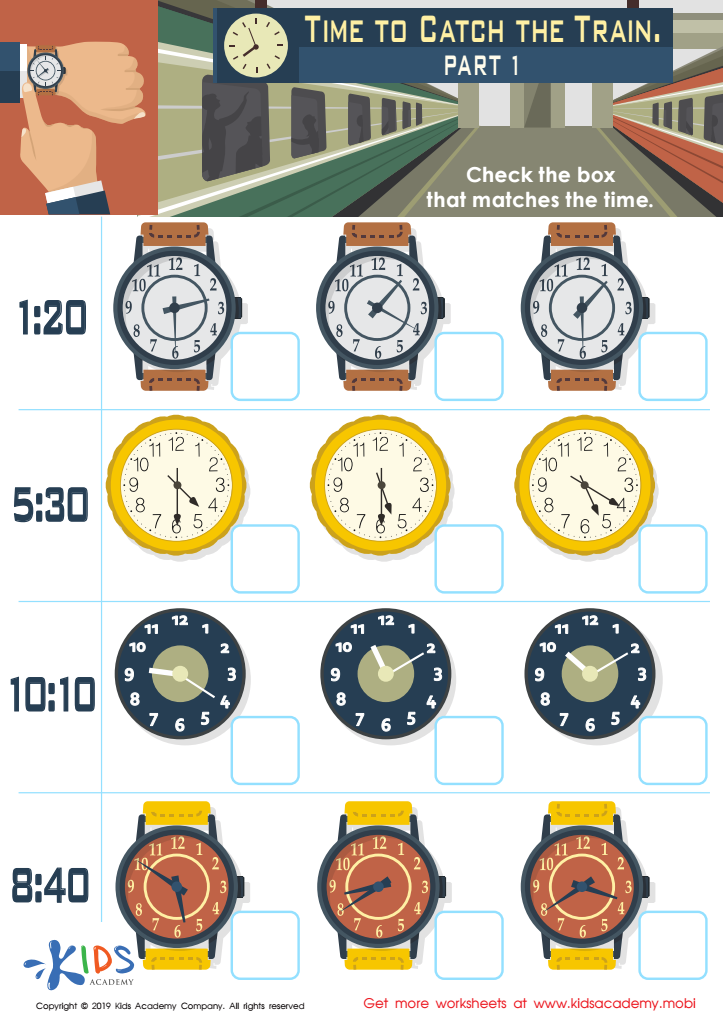
Time to Catch the Train Part 1 Worksheet
 Assign to My Students








Critical thinking development in mathematics is essential for fostering genuine understanding and problem-solving skills in students. Unlike rote memorization of formulas and procedures, critical thinking encourages learners to analyze, evaluate, and synthesize information. This foundational skill empowers students to approach mathematical problems creatively, helping them to engage with concepts on a deeper level.
When students are trained to think critically in math, they develop the ability to reason logically, make informed decisions, and identify patterns—skills that are applicable beyond mathematics into everyday life and other academic subjects. For parents and teachers, integrating critical thinking into math instruction promotes resilience, as students learn to tackle challenges methodically rather than shying away from difficulty.
Moreover, in today’s rapidly evolving world, the jobs of the future will require individuals who can apply analytical skills to complex scenarios. By prioritizing critical thinking in math education, parents and teachers prepare children not just for academic success, but also for their future careers and responsible citizenship. This holistic approach to learning not only enhances students' mathematical competencies but also cultivates a mindset of inquiry and innovation, which is invaluable in a knowledge-driven economy.








