
Fine motor skills development Math Worksheets
8 filtered results
Difficulty Level
Grade
Age
-
From - To
Subject
Activity
Standards
Unlock your child's potential with our "Fine Motor Skills Development Math Worksheets." Designed for young learners, these engaging worksheets combine foundational math concepts with fun activities that enhance fine motor skills. Kids will delight in tracing numbers, completing patterns, and solving simple math problems, all while strengthening hand-eye coordination and dexterity. Perfect for preschool through early elementary age, our worksheets are ideal for at-home learning or classroom activities. Encourage your child's confidence and competence in both math and physical skills through purposeful play. Dive into imaginative exercises that make learning a joyful experience!
Favorites
With answer key
Interactive
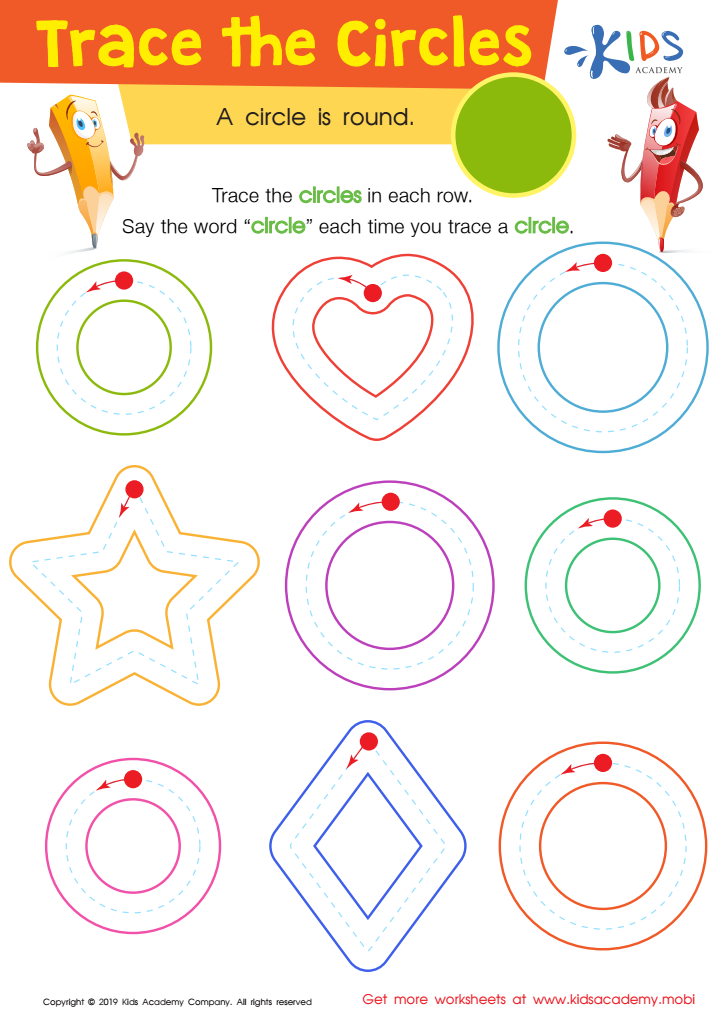
Trace The Circles Worksheet
Preschoolers and kindergarteners love learning shapes! This worksheet provides practice in naming and tracing circles. Students say "circle" each time they trace one. It's a fun way to help kids learn math vocabulary and develop fine motor skills. Enjoy this printable and get ready to master circles!
 Assign to My Students
Trace The Circles Worksheet
Worksheet
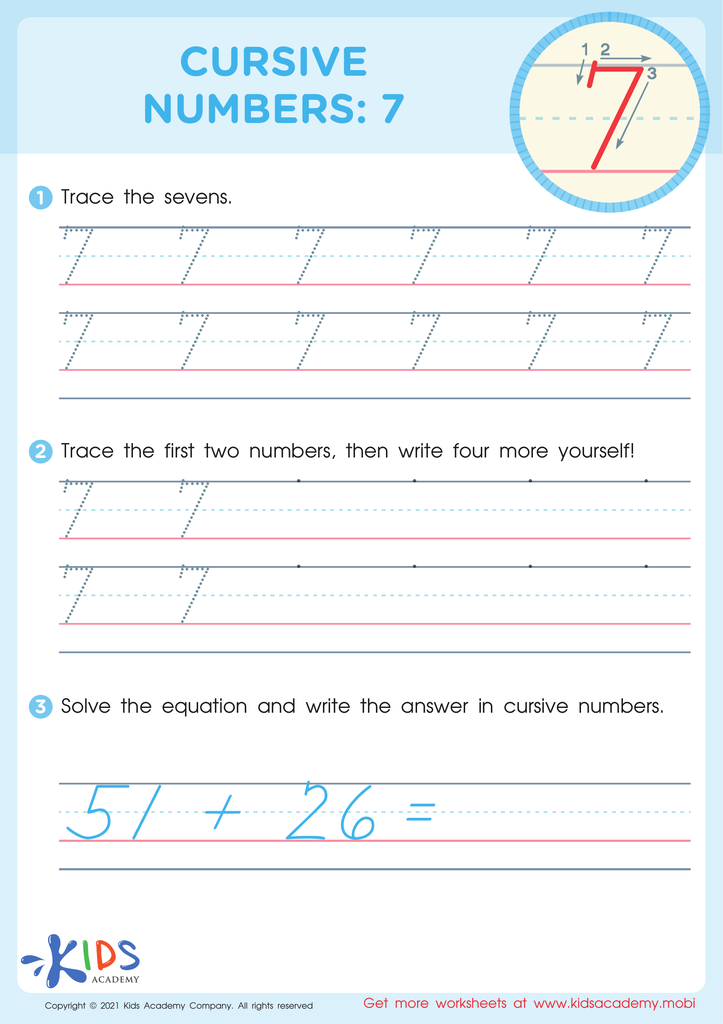
Cursive Numbers: 7 Worksheet
Kids learn best with engaging and easy-to-understand materials. This tracing worksheet is ideal for developing kids' writing skills, with two exercises to help them write the number 7. The first involves tracing the 6s provided and the second asking them to write four cursive 7s independently.
Cursive Numbers: 7 Worksheet
Worksheet
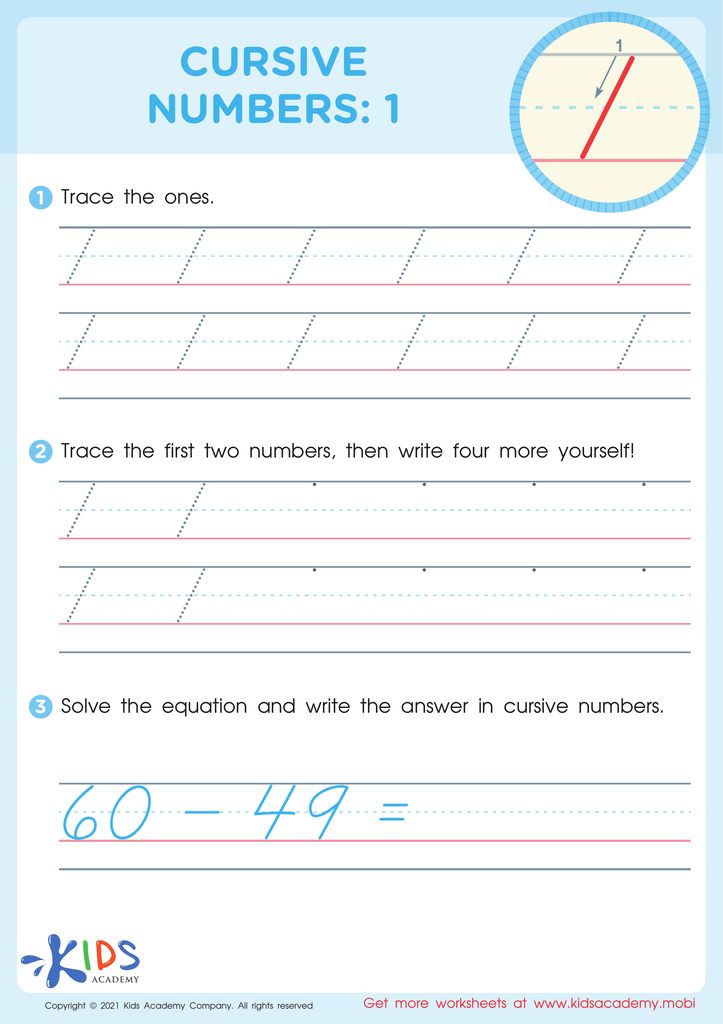
Cursive Numbers: 1 Worksheet
Math and handwriting are connected! Try these traceable worksheets to help your children learn cursive numbers. The tracing lines make it easy to follow, plus there's a simple subtraction exercise at the bottom for them to try. This is perfect for kids who struggle with handwriting and gives them a fun way to practice.
Cursive Numbers: 1 Worksheet
Worksheet
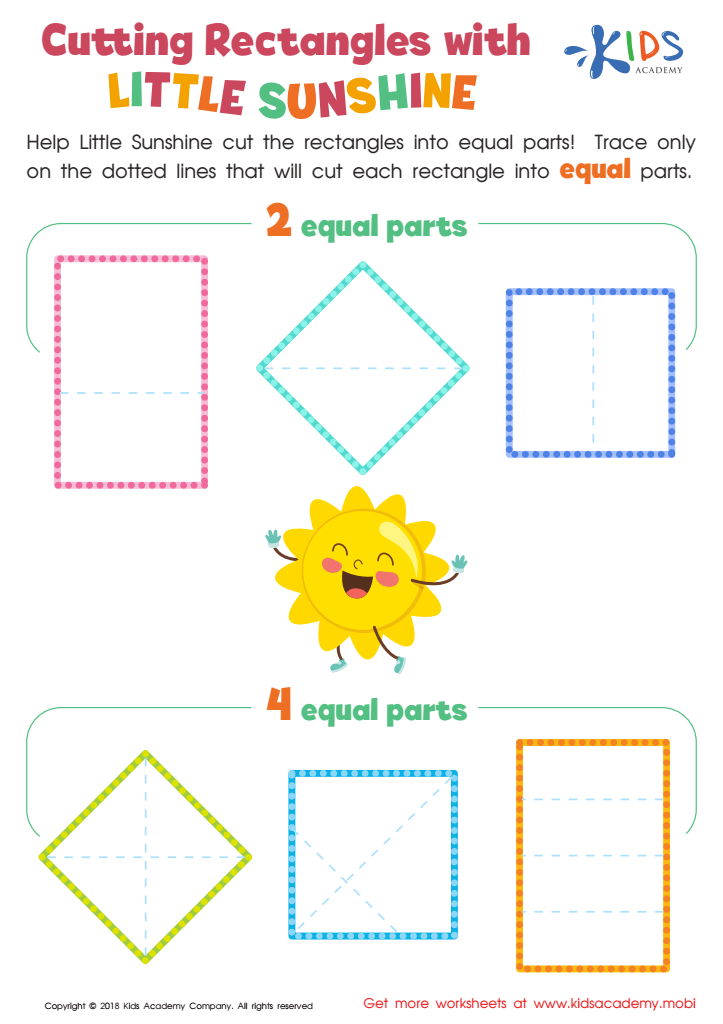
Cutting Rectangles with Little Sunshine Worksheet
Introduce Little Sunshine to your students. Help them to cut rectangles into two or four equal parts by tracing the dotted lines. It's easy - the lines divide them evenly. Encourage your students to help Little Sunshine complete the task!
Cutting Rectangles with Little Sunshine Worksheet
Worksheet
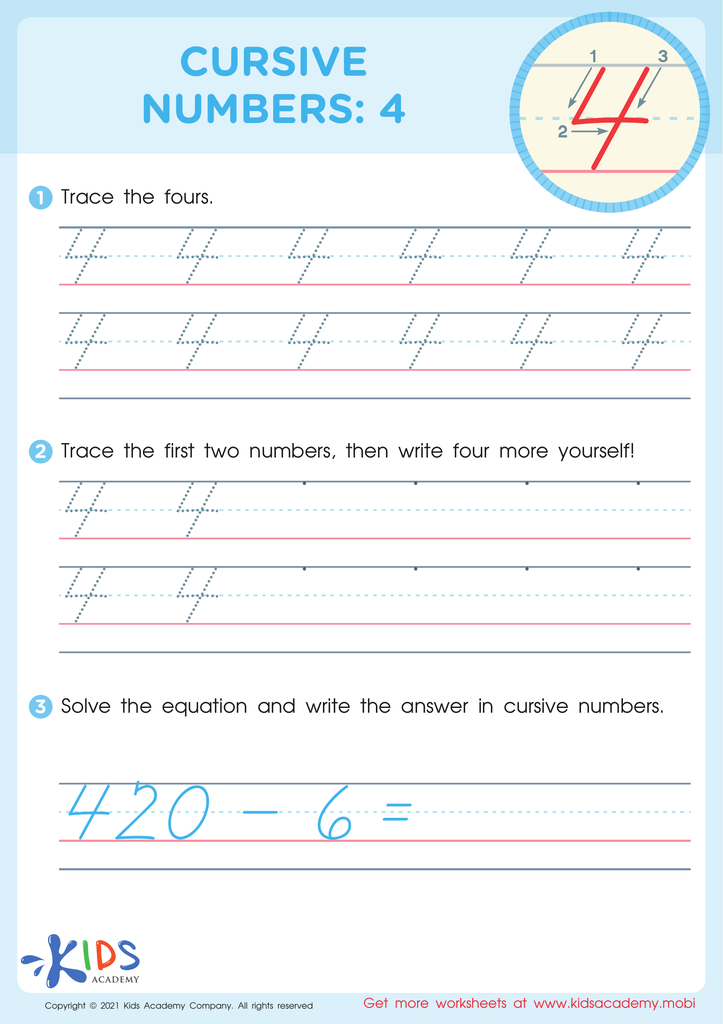
Cursive Numbers: 4 Worksheet
Math is challenging, and teaching cursive alongside it can be overwhelming. Make lessons enjoyable and your child will be more likely to stay engaged. Utilize worksheets to practice tracing the number 4 in cursive. With regular practice, your child can learn to write the number on their own.
Cursive Numbers: 4 Worksheet
Worksheet
Join Kids Academy for Free
Who is primarily going to use this learning content?








Fine motor skills development is integral to a child's overall learning, particularly in math. These skills involve the use of small muscles in the hands and fingers, enabling actions such as grasping, writing, and manipulating objects. As children grasp tools like crayons and scissors, they build dexterity, coordination, and control, essential for later math tasks like number formation and measuring.
Developing fine motor skills positively influences a child's confidence and perseverance in academic settings. When children can handle tools effectively, they engage more comfortably in math-related activities like drawing shapes, solving puzzles, or using counting manipulatives. This engagement fosters not only a solid understanding of mathematical concepts but also encourages critical thinking and problem-solving abilities.
Moreover, a strong foundation in fine motor skills can lead to better performance in overall school tasks, as kids become more adept in various forms of expression, including writing and practical calculations. For parents and teachers, nurturing fine motor skills through playful activities — such as building with blocks or threading beads — can complement math instruction, making learning fun and effective. Ultimately, investing in the fine motor skill development is critical, supporting children's holistic growth and readiness for future academic challenges.








