Fine motor skills (drawing lines) Math Worksheets
7 filtered results
-
From - To
Enhance your child's fine motor skills with our engaging math worksheets focused on drawing lines! Designed for early learners, these worksheets encourage children to practice line drawing, an essential precursor to more complex writing and drawing tasks. By navigating through varied activities that combine fun and education, children will strengthen their hand-eye coordination and dexterity. Each worksheet fosters creativity while reinforcing foundational math concepts such as sorting and counting. Perfect for use at home or in the classroom, these printable resources provide a playful yet effective approach to skill-building. Start your child’s journey towards confidence in writing and math today!

Count and Match Vegetables 1 – 7 Math Worksheet
 Assign to My Students

Counting Eggs Worksheet

Count and Match Vegetables 2 – 8 Math Worksheet
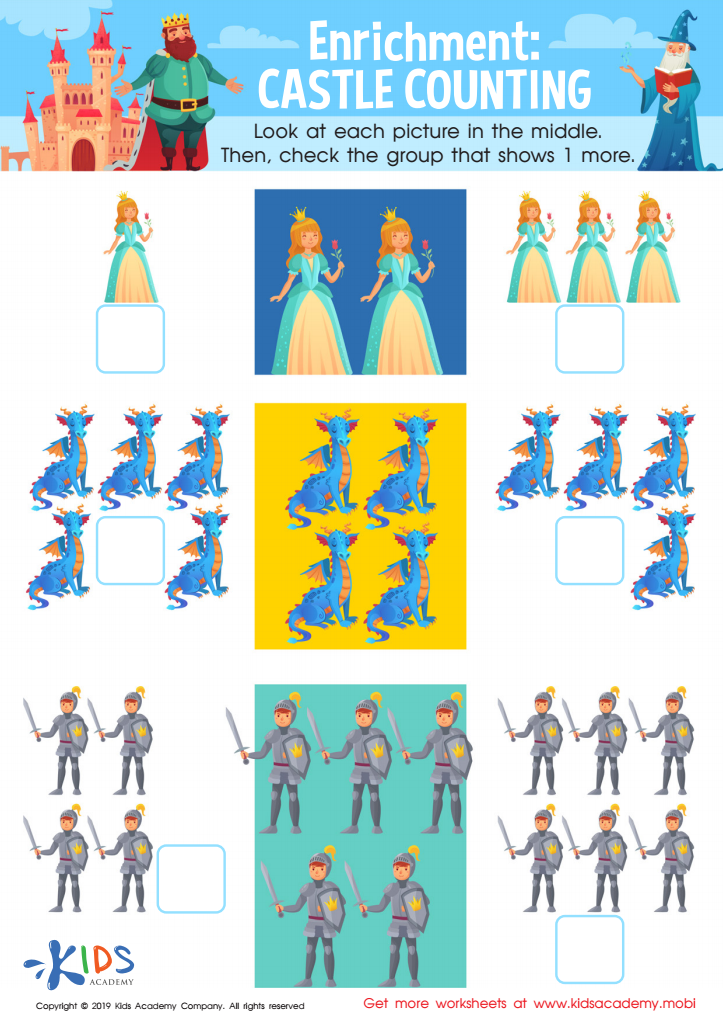
Enrichment: Castle Counting Worksheet








Fine motor skills, such as drawing lines, are critical for young children's development and their future academic success. These skills involve the coordination of small muscles in the hands and fingers, enabling children to perform tasks that require precision, like writing and manipulating objects. For parents and teachers, fostering fine motor skills is essential not only for a child's artistic development but also for foundational math skills.
When children practice drawing lines, they are developing hand-eye coordination, muscle strength, and control. These abilities directly translate to mathematical skills such as number formation, aligning numbers in columns, and performing calculations. Furthermore, fine motor skills aid in spatial awareness, which is crucial for understanding concepts such as geometry and measurement.
Encouraging activities like line drawing integrates creativity with academic skills, laying the groundwork for more complex tasks as children progress in their education. Furthermore, strong fine motor skills can enhance a child's confidence, leading to a positive attitude towards learning. Investing time in developing these skills can contribute to a child’s overall ability to succeed both in mathematics and other areas, ultimately fostering a well-rounded learner prepared for future challenges.








