
Reading rulers Math Worksheets
3 filtered results
Difficulty Level
Grade
Age
-
From - To
Subject
Activity
Standards
Discover an engaging collection of Reading Rulers Math Worksheets designed to enhance measurement skills in young learners. Ideal for early graders, these worksheets provide hands-on practice with rulers, helping kids to accurately measure objects in both inches and centimeters. Each activity is crafted to make learning fun and interactive, encouraging students to solve real-world measurement problems. Perfect for classroom or home use, our worksheets support the development of critical math skills and boost confidence in reading measurements. Download today to provide your child with essential tools for academic success in math!
Favorites
With answer key
Interactive
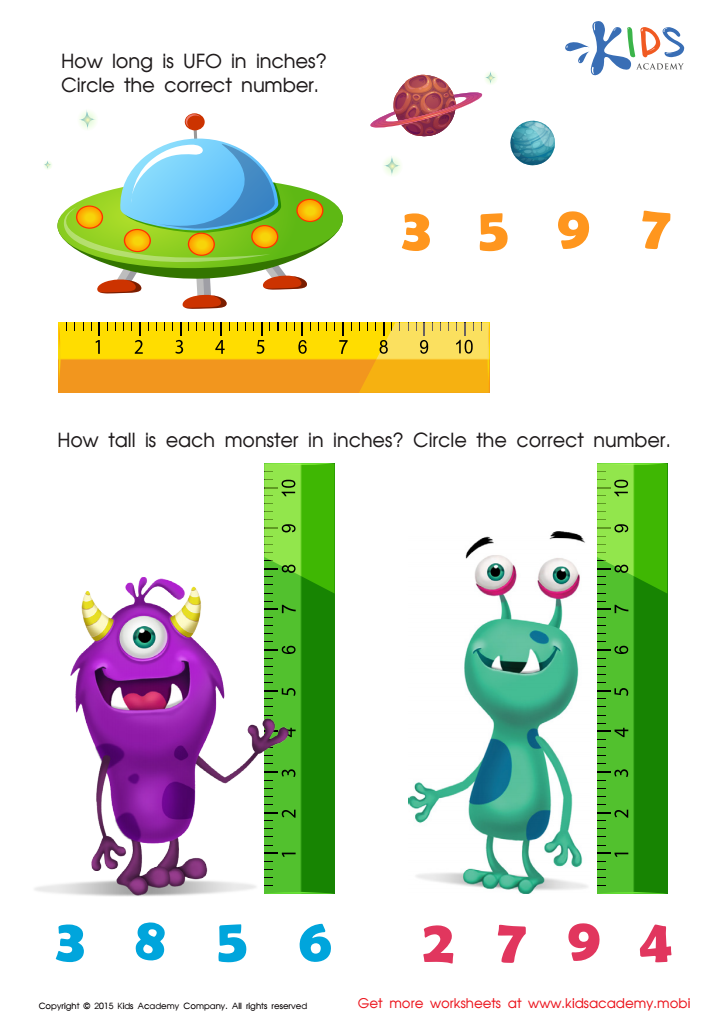
Measuring in Inches Worksheet
Look at the picture, can you measure the UFO & monsters? Write down how long each is. Which is tallest? Circle it. Get more free printable math worksheets for kindergarten at our website.
 Assign to My Students
Measuring in Inches Worksheet
Worksheet
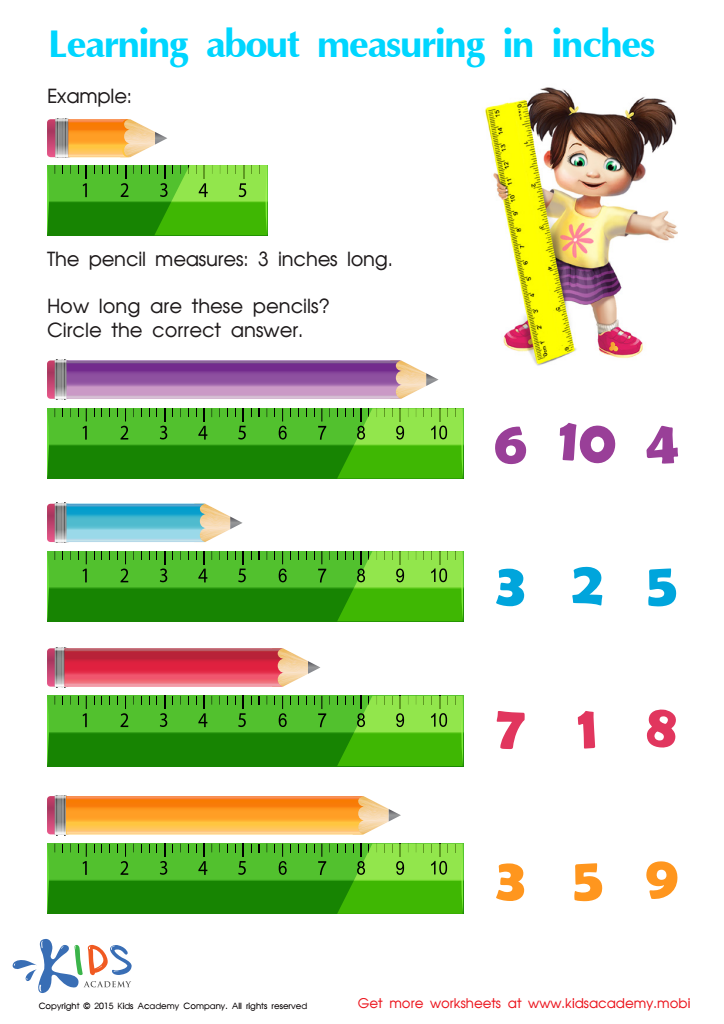
Learning About Measuring In Inches Printable
Print this free worksheet and measure pencils together with kids. See who finds the longest and the shortest! Enjoy learning math with your kids.
Learning About Measuring In Inches Printable
Worksheet
Join Kids Academy for Free
Who is primarily going to use this learning content?






%20(1).jpg)
Reading rulers in math, often referred to as number lines or mathematical rulers, are crucial tools that help young learners understand foundational math concepts, such as addition, subtraction, and number sequencing. Parents and teachers should care about using reading rulers because they provide students with a clear, visual representation of numbers and their relationships to each other. This visual aid helps to bridge the gap between abstract concepts and tangible understanding, making math more accessible and less intimidating.
For example, using a reading ruler can help a child grasp the idea that numbers are a sequence with consistent intervals. This understanding is fundamental to performing operations like addition or subtraction as it allows children to literally see the process of moving between numbers. For instance, when adding 3 and 2, a child can start at 3 on the reading ruler and count up by 2 intervals to reach 5. Such visualization reinforces counting skills and number sense, which are critical components of early math education.
Moreover, reading rulers can support differentiated learning as they cater to various skill levels. They offer a hands-on, kinesthetic experience, advantageous for students who learn through doing and touching. Overall, reading rulers are effective, versatile tools that build essential math skills, making it important for parents and teachers to incorporate them into learning routines.








