Understanding commutative property Math Worksheets
4 filtered results
-
From - To
Explore our "Understanding Commutative Property Math Worksheets," designed to enhance foundational math skills for early learners. These engaging, printable worksheets help children grasp the commutative property of addition and multiplication, demonstrating that the order of numbers doesn't affect the outcome. Featuring colorful illustrations and interactive exercises, students will gain confidence as they practice rearranging numbers in equations. Perfect for classroom activities and homeschool learning, these worksheets promote critical thinking and reinforce essential math concepts. Ideal for kindergarten and early elementary students, our resources bring joy to learning while establishing a solid mathematical foundation. Download and watch your child excel in math!
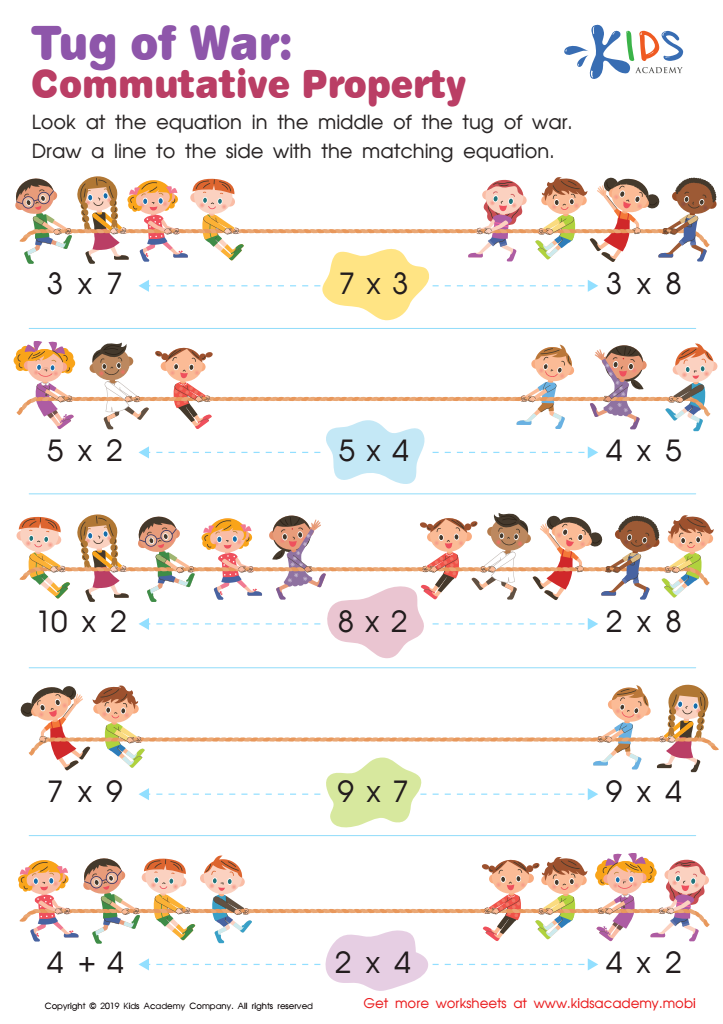
Tug of War: Commutative Property Worksheet
 Assign to My Students
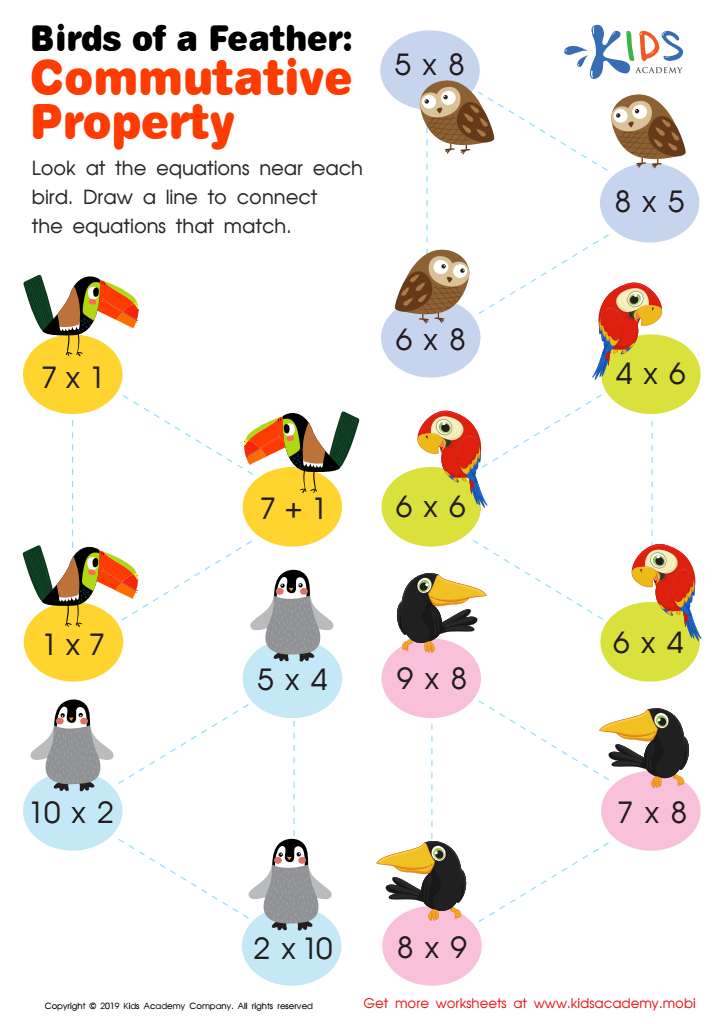
Birds of a Feather: Commutative Property Worksheet
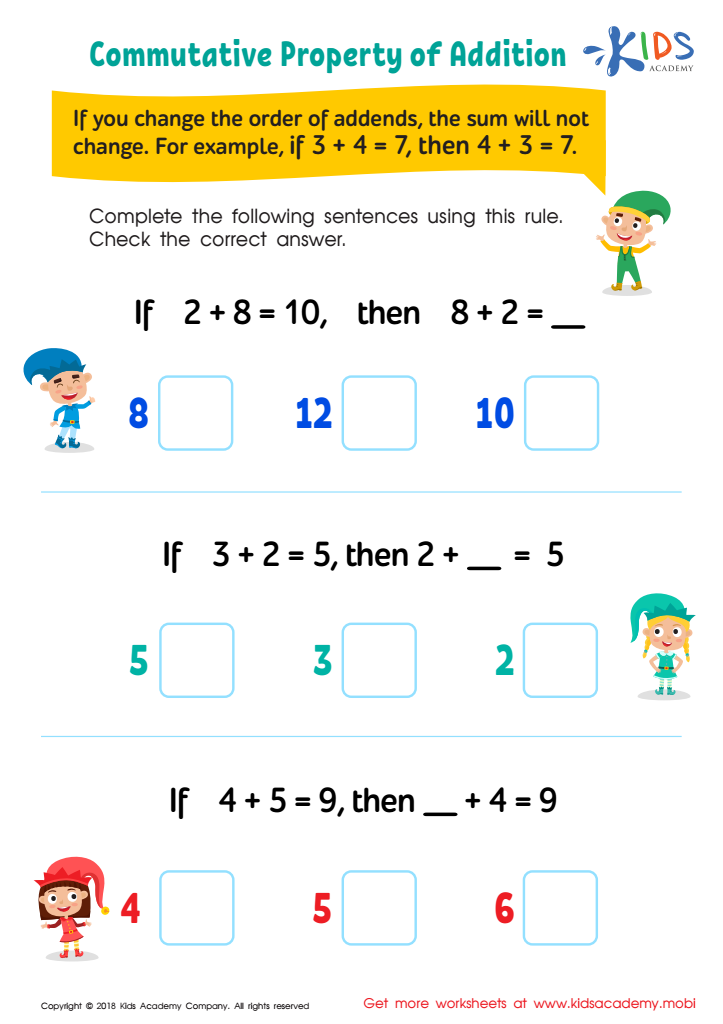
Commutative Property of Addition Worksheet
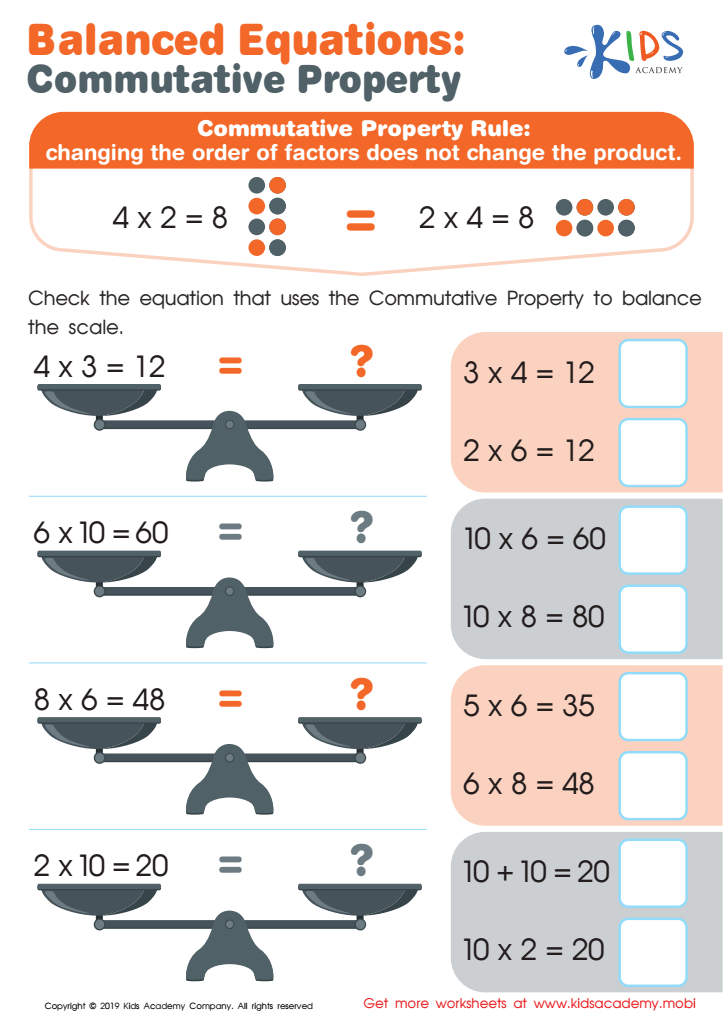
Balanced Equations: Commutative Property Worksheet






Understanding the commutative property of addition and multiplication is crucial for both parents and teachers, as it lays the foundation for students' mathematical reasoning and skills. The commutative property states that changing the order of addends or factors does not change the sum or product (e.g., 3 + 5 = 5 + 3 or 4 × 2 = 2 × 4). Recognizing this property helps children grasp the concepts of equality and equivalence, crucial for future arithmetic and algebraic operations.
Additionally, the commutative property fosters fluency in math, enabling students to simplify calculations and approach problems flexibly. For instance, knowing that 8 + 7 is the same as 7 + 8 can aid in mental addition strategies and enhance number sense. For teachers, emphasizing this property allows them to create rich learning experiences and address various levels of understanding in the classroom.
Ultimately, a solid grasp of the commutative property supports a wider range of mathematical concepts, paving the way for success in more advanced areas such as algebra and problem-solving. Engaging parents in this understanding can also promote consistent reinforcement of these concepts at home, nurturing a well-rounded mathematical education.








