Understanding Math Concepts Math Worksheets
3 filtered results
-
From - To
Understanding Math Concepts Math Worksheets are designed to help young learners gently grasp essential mathematical ideas. Perfect for kindergarten through early elementary students, these worksheets cover key topics including basic operations, number sense, patterns, and shapes. Each worksheet features engaging exercises, clear instructions, and colorful illustrations that make learning fun and effective. By practicing with these materials, children can build a solid foundation in math, enhancing their problem-solving skills and confidence. Tailored to align with educational standards, these worksheets are an excellent resource for teachers and parents seeking to support their child's math journey.
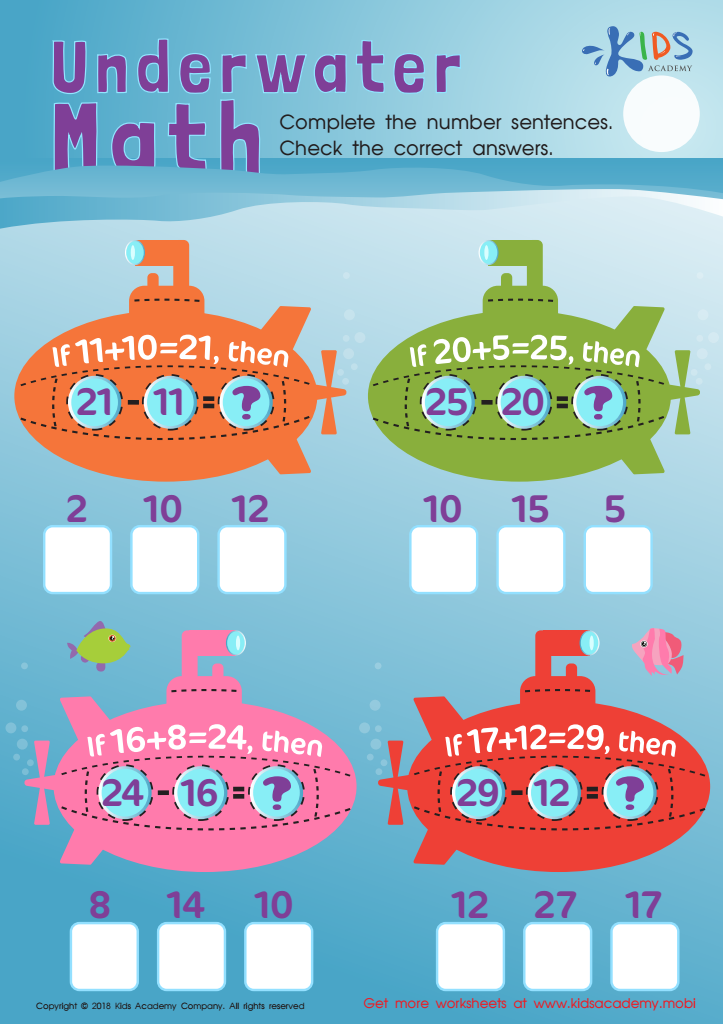
Addition and Subtraction: Underwater Math Worksheet
 Assign to My Students







Understanding math concepts is crucial for a child's overall cognitive development and future success, so parents and teachers should prioritize it. First, a solid grasp of math fosters problem-solving skills and logical thinking. These abilities are not confined to math but are applicable in everyday life and various professions. For example, critical thinking and the ability to handle complex situations are essential in careers ranging from engineering to medicine.
Secondly, early math competence is a significant predictor of academic achievement in other subjects. Math helps students develop disciplined thinking, which is beneficial in fields such as science, technology, and economics. When children understand the "why" behind mathematical operations, they can more effectively apply these principles to innovative solutions and advanced learning.
Furthermore, instilling a love and comprehension of math at an early age can combat math anxiety, a common issue that can hinder academic progress. Children who feel confident in their math skills are more likely to be enthusiastic and less intimidated by challenges.
Lastly, math literacy is vital in an increasingly digital world where data interpretation and statistical understanding are part of daily life. By ensuring children have a strong math foundation, parents and teachers empower them to navigate and thrive in a complex, data-driven society.








