
Color Identification Matching Worksheets
3 filtered results
Difficulty Level
Grade
Age
-
From - To
Subject
Activity
Standards
Enhance your child’s color recognition skills with our engaging Color Identification Matching Worksheets from Kids Academy! Perfect for young learners, these fun and interactive worksheets help children identify, match, and name different colors through a variety of tasks. Our activities are designed to boost visual discrimination, critical thinking, and fine motor skills while making learning both effective and enjoyable. Suitable for preschool to first grade, these printable worksheets are an essential tool for teachers and parents aiming to support early color learning in an enjoyable way. Begin this colorful journey today with Kids Academy!
Favorites
With answer key
Interactive
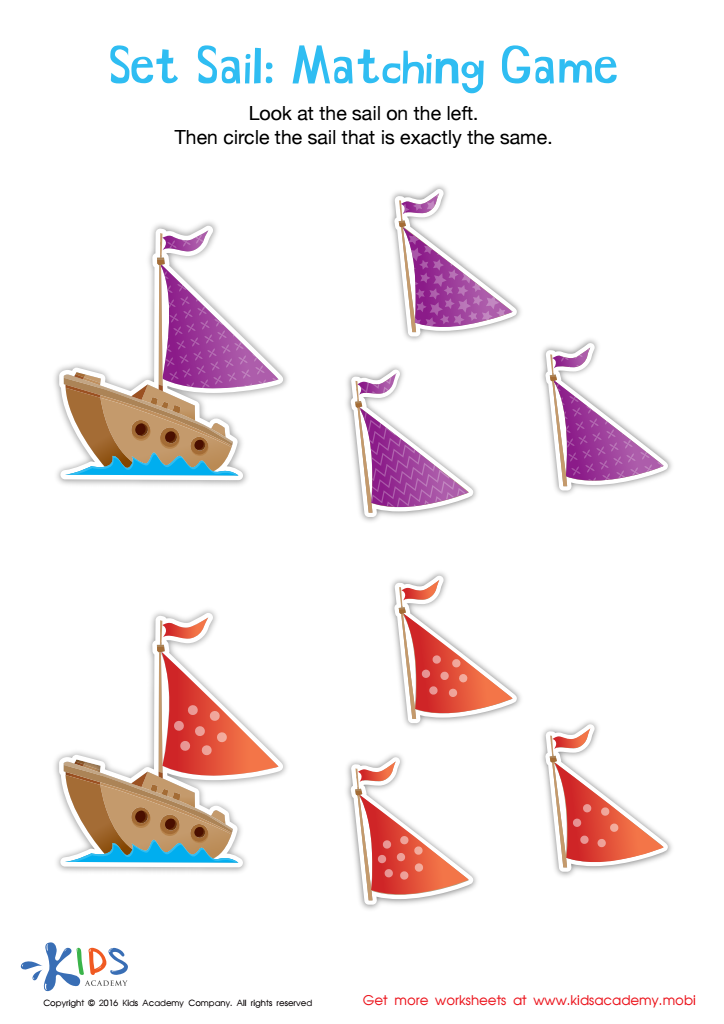
Set Sail Worksheet
Set sail with this fun matching game for toddlers! Kids will love finding the same pattern on the sails, improving their problem-solving and counting skills. Enjoy this bright and engaging worksheet!
 Assign to My Students
Set Sail Worksheet
Worksheet
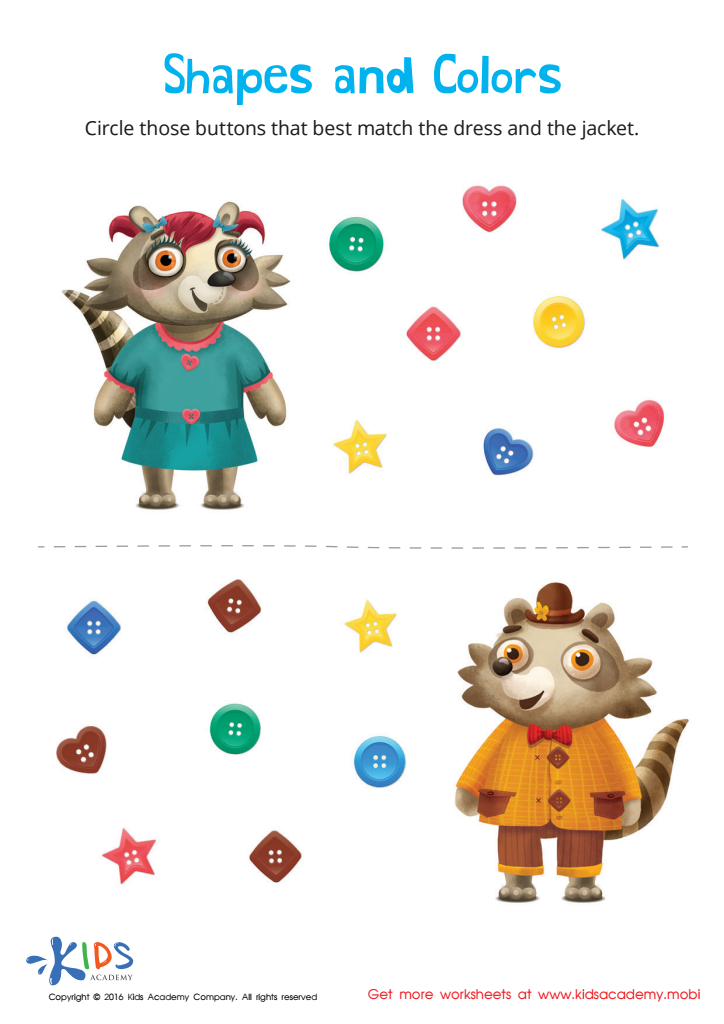
Matching: Shapes and Colors Worksheet
Help Mr. and Mrs. Raccoon find the right buttons to match their shirts! Kids will identify shapes and colors and learn to match them correctly.
Matching: Shapes and Colors Worksheet
Worksheet
Join Kids Academy for Free
Who is primarily going to use this learning content?








Color identification and matching are foundational skills that play a significant role in a child's development. Parents and teachers should understand that these skills are not merely about recognizing colors; they are integral to cognitive and visual development. When children learn to identify colors and match them, they enhance their ability to observe and categorize their surroundings, which is crucial for logical thinking and problem-solving.
Engaging in color-based activities also bolsters language development. When children learn the names of colors and use them to describe objects, they expand their vocabulary and improve their ability to communicate effectively.
Moreover, these activities support fine motor skills and hand-eye coordination. Tasks such as coloring, sorting, or using colored blocks require precise movements, helping children develop control over small muscle movements.
Lastly, color identification and matching can serve as a stepping stone for learning more complex concepts such as patterns, sequences, and even maths. By comprehending color differences and similarities, children build a versatile set of skills that will aid in more advanced STEM subjects later on.
Overall, prioritizing color identification and matching activities fosters a well-rounded development, equipping children with essential cognitive, language, motor, and mathematical skills.








