
Spatial awareness Measurement Worksheets
3 filtered results
Difficulty Level
Grade
Age
-
From - To
Subject
Activity
Standards
Discover engaging Spatial Awareness Measurement Worksheets designed to enhance young learners' understanding of shapes, positions, and spatial relations. Perfect for developing critical thinking and observational skills, these printable activities encourage kids to explore concepts such as direction, distance, and perspective. Ideal for early grade students, our colorful and interactive worksheets offer diverse challenges that support cognitive growth and mathematical comprehension. Whether in the classroom or at home, equip your child with the tools to master spatial awareness effortlessly. Visit Kids Academy for valuable resources that make learning fun and effective!
Favorites
With answer key
Interactive
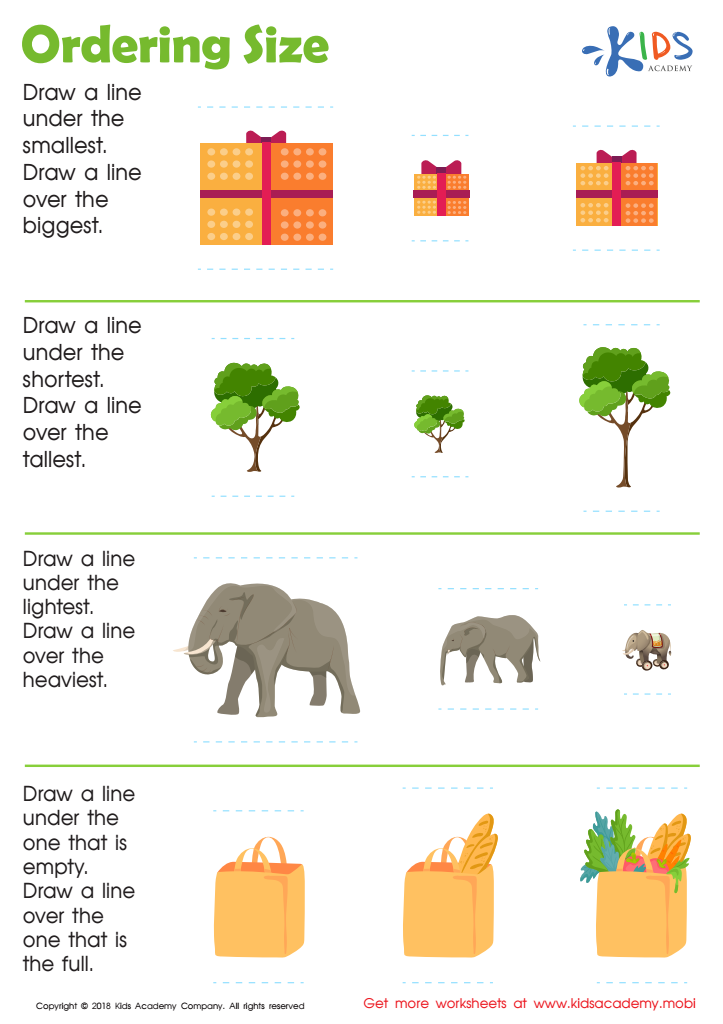
Ordering Size Worksheet
This worksheet helps students practice mathematical vocabulary related to size and quantity. Children look at pictures and draw a line to the objects that are taller, shorter, big, small, light, heavy, empty or full. The teacher can quickly check students' understanding of these measurement terms and then ask for examples of their own.
 Assign to My Students
Ordering Size Worksheet
Worksheet
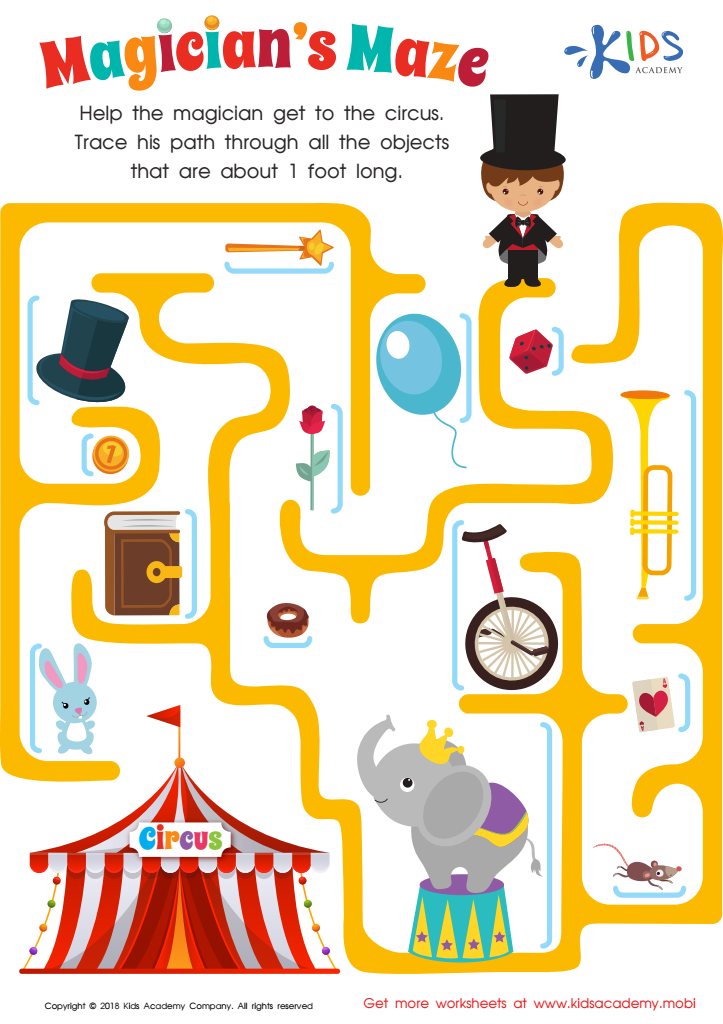
Estimating Length: Magician's Maze Worksheet
Does your kid want to practice magic and have a blast? This exercise will be a great way to help them do so! In the worksheet, they'll need to guide the magician to the circus. How? By tracing his path through the 1-foot long obstacles in the maze. Once they help him get through the objects, the circus will be just a few steps away!
Estimating Length: Magician's Maze Worksheet
Worksheet
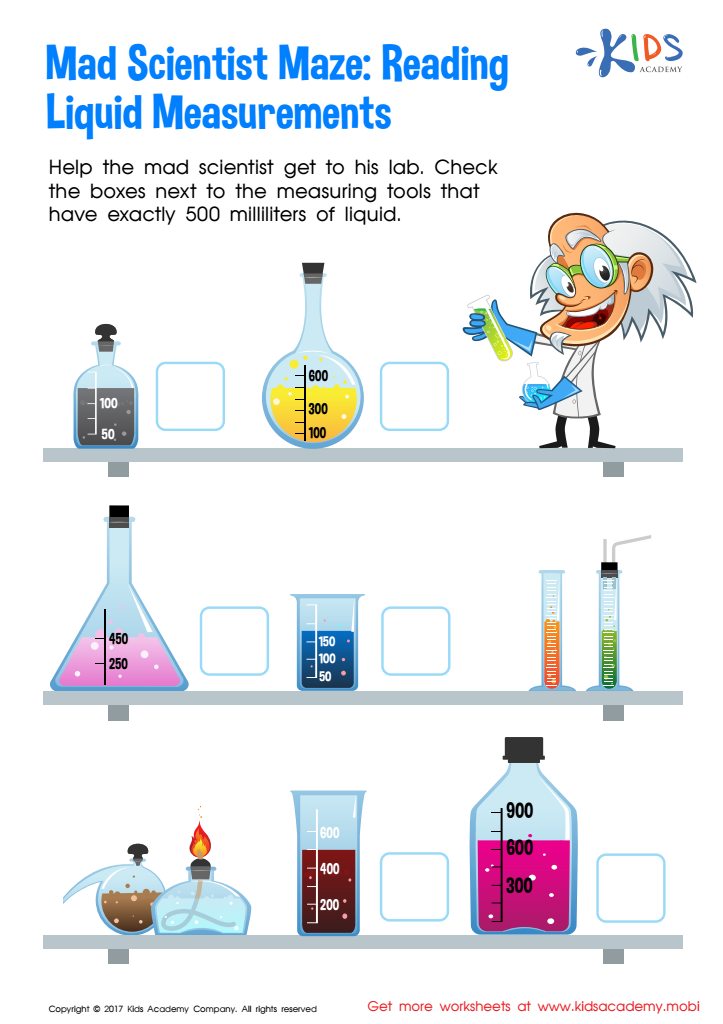
Reading Liquid Measurement Worksheet
Help a mad scientist return to his lab by having your child measure the liquid in each flask. Their results will determine his fate!
Help a mad scientist return to his lab! Kids can practice reading liquid measurements to the millimeter on this worksheet. Determine the amount of liquid in each flask and let your child's results decide the scientist's fate!
Reading Liquid Measurement Worksheet
Worksheet
Join Kids Academy for Free
Who is primarily going to use this learning content?








Parents and teachers should care about spatial awareness and measurement because these skills are foundational for a child’s cognitive and academic development. Spatial awareness allows children to understand and interact effectively with the world around them. It encompasses the ability to comprehend size, shape, distance, and the relationship between objects, all of which are crucial for problem-solving and everyday tasks.
Mastering spatial awareness and measurement boosts children’s math skills, particularly in geometry, where they learn to manipulate shapes and sizes, and understand the concepts of area and volume. Additionally, these skills enhance their ability to follow directions, navigate spaces, and improve their capabilities in both fine and gross motor activities, such as drawing, writing, sports, and interacting in complex environments.
Furthermore, spatial awareness is linked to improved performance in STEM (Science, Technology, Engineering, and Mathematics) disciplines. Studies have shown that early spatial skill development can lead to better understanding in these subjects later on, promoting innovative and critical thinking abilities.
For parents and teachers, investing in activities that strengthen spatial awareness—like puzzles, building blocks, drawing, and physical movement exercises—supports a child’s holistic growth and sets them on a path to academic success and beyond. Hence, incorporating spatial concepts into everyday learning is as enjoyable as it is beneficial, creating a strong foundation for future learning and practical life skills.








