Understanding prepositions Normal Math Worksheets for Ages 3-6
3 filtered results
-
From - To
"Understanding Prepositions Normal Math Worksheets for Ages 3-6" offers engaging and educational activities designed to teach young children essential prepositional concepts while enhancing their math skills. Tailored specifically for toddlers and preschoolers, these printable worksheets simplify the learning process through fun, interactive exercises. Kids will practice identifying positions and directions like under, over, and beside, vital for their cognitive development. The worksheets not only build a strong foundation in early math but also improve spatial awareness and language abilities, making learning enjoyable and effective for young minds. Download today to boost your child's educational journey!
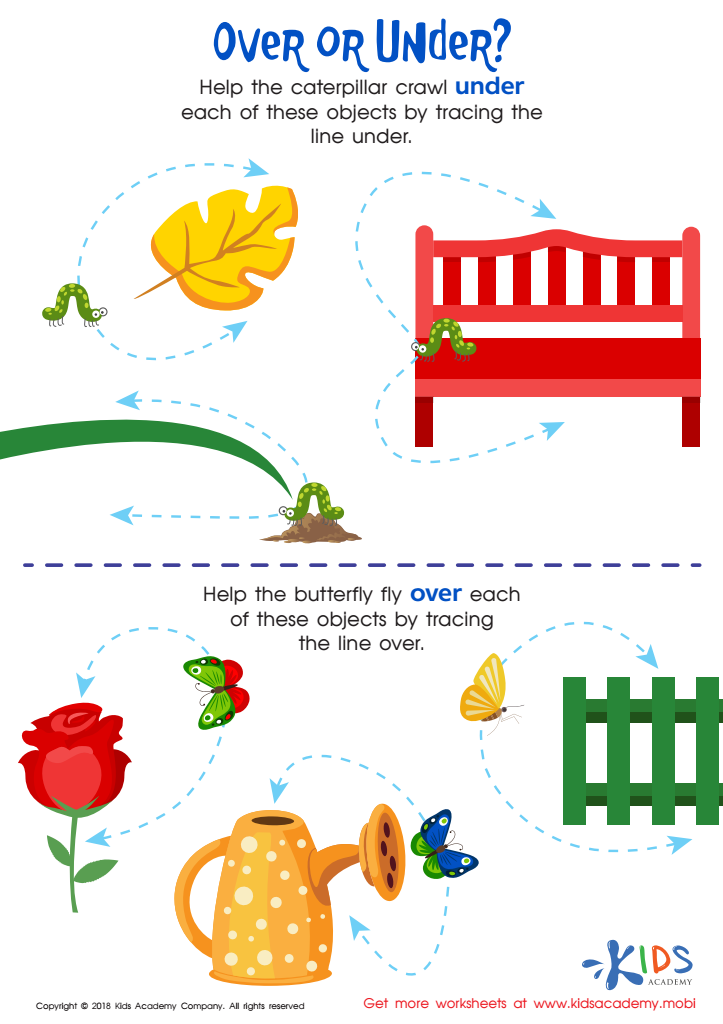
Over or Under? Worksheet
 Assign to My Students
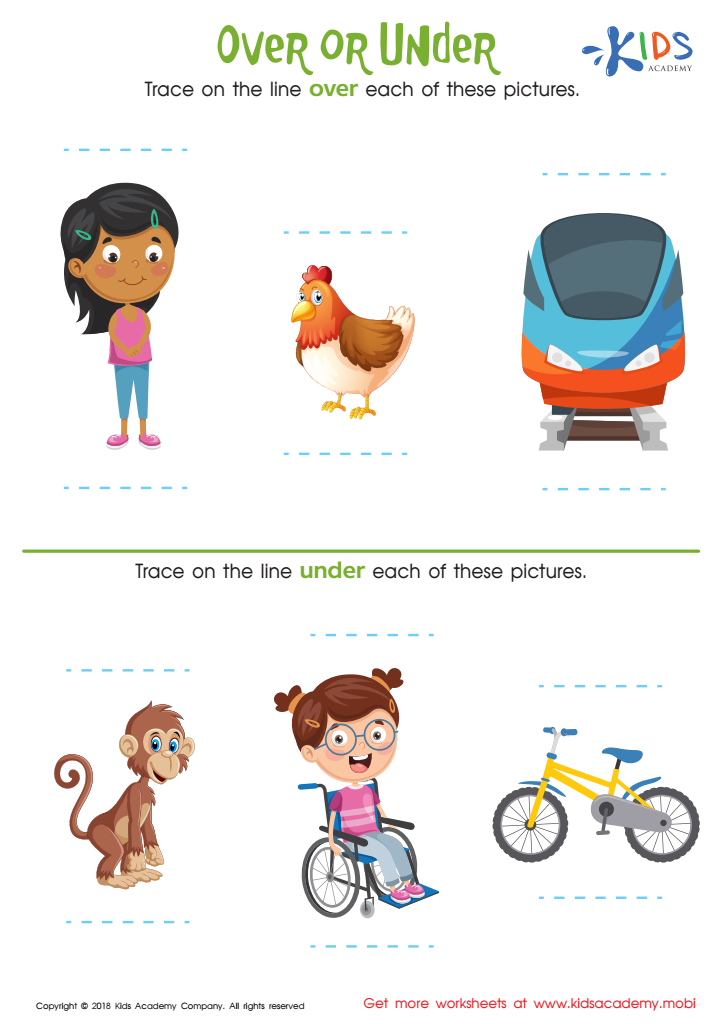
Over or Under Worksheet
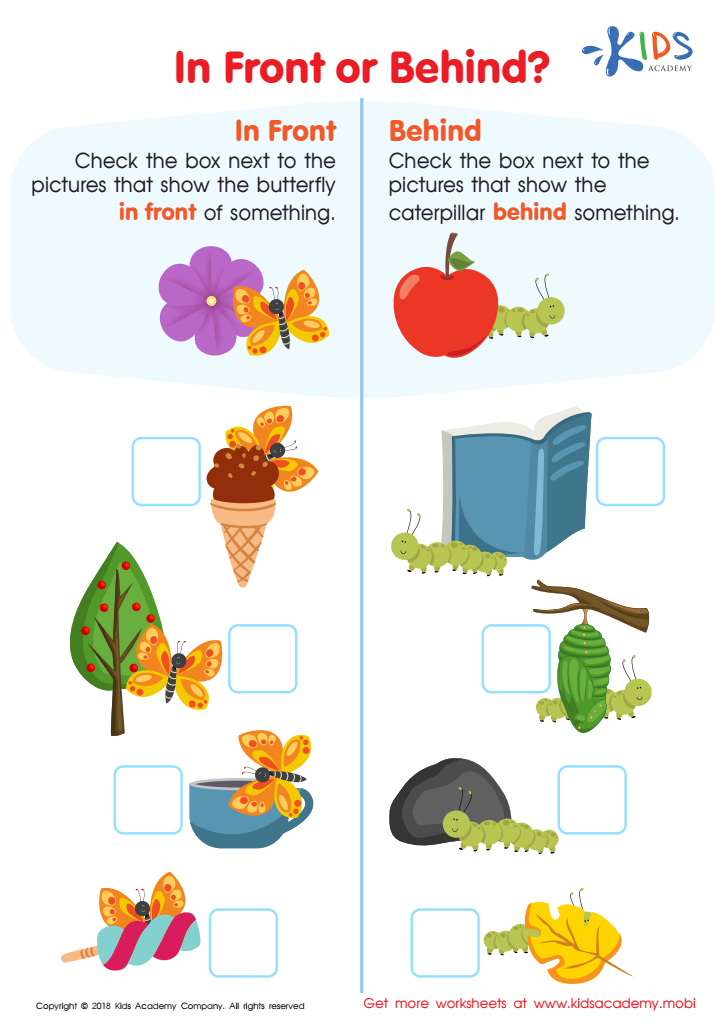
In Front or Behind Worksheet







Understanding prepositions and basic math concepts are foundational skills that significantly impact a child's cognitive development and future academic success, particularly for ages 3-6.
First, prepositions such as "above," "below," "next to," and "in between" enhance a child's understanding of spatial relationships. This spatial awareness is not only important for everyday navigation and comprehension but also forms the basis for more complex mathematical concepts like geometry. Through the use of prepositions, children learn to describe their environment and follow directions, which is crucial for classroom learning and social interactions.
Secondly, introducing basic math concepts at an early age, such as counting, comparing sizes, and recognizing patterns, builds a solid groundwork for more advanced mathematic operations. Early familiarity with numbers and simple arithmetic enhances problem-solving skills and logical thinking. Activities like sorting objects by size or color involve both language and math skills, thus making learning more integrated and meaningful.
By the time they start formal schooling, children who have a grasp of prepositions and basic math skills are often more confident and prepared. Parents and teachers play a critical role in providing engaging, hands-on learning experiences to support this early growth, which can set the stage for academic achievements and lifelong learning.








