
Logical thinking development Normal Math Worksheets for Ages 3-7
4 filtered results
Difficulty Level
Grade
Age
-
From - To
Subject
Activity
Standards
Unlock your child's potential with our "Logical Thinking Development Normal Math Worksheets for Ages 3-7." These engaging activities are designed to stimulate young minds and enhance cognitive skills through fun, age-appropriate math exercises. Our worksheets cover foundational topics, from pattern recognition and sequencing to basic problem-solving, providing a solid groundwork for future learning. Kids will enjoy while boosting their reasoning abilities and confidence in math. Perfect for at-home practice or as supplementary classroom material, these worksheets aim to make learning an enjoyable adventure for preschoolers and early elementary students. Equip your child with the skills they need to succeed!
Favorites
With answer key
Interactive
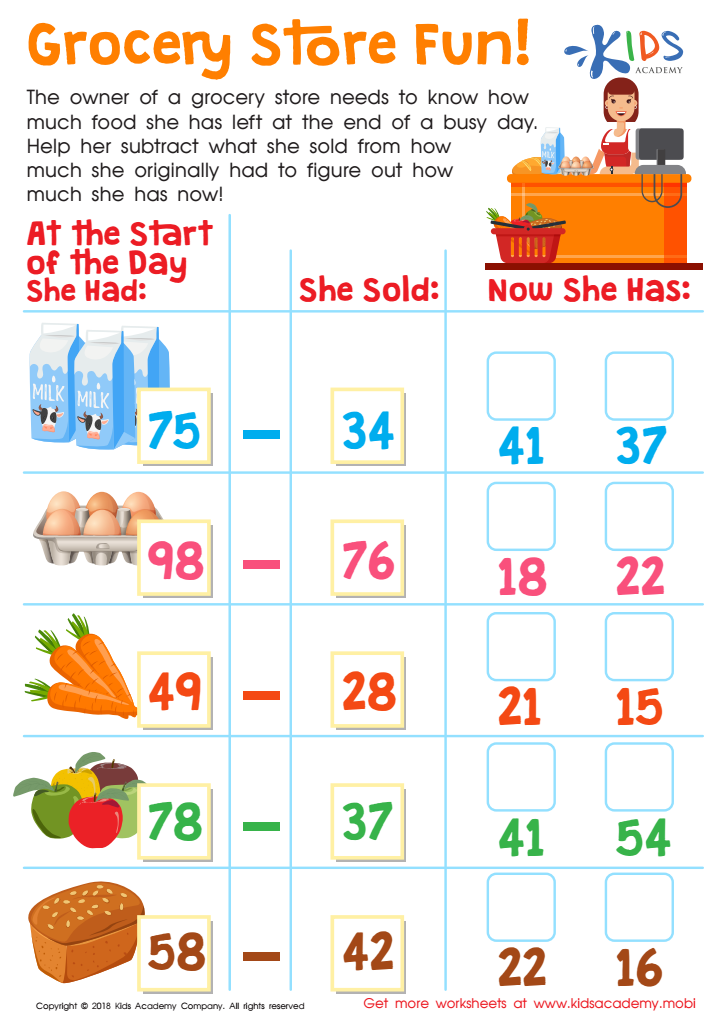
Grocery Store Fun! Worksheet
Let your kids have fun with this store worksheet. It requires them to help the owner by subtracting what she has sold from the original amount to figure out how much is left. Have them read and solve the equations in the printout to give the store owner the answer.
 Assign to My Students
Grocery Store Fun! Worksheet
Worksheet
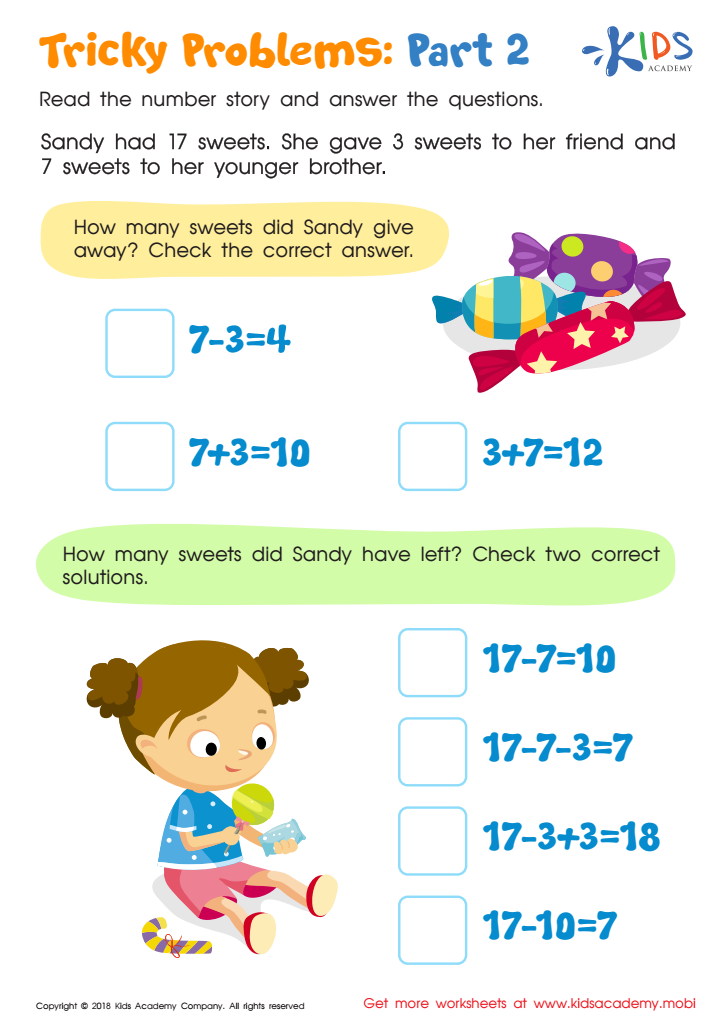
Tricky Problems Worksheet: Part 2
Help your little math learner visualize number stories with this engaging worksheet. They'll connect pictures to the story and use math facts to find the sums. After that, they'll be able to identify the correct number sentences to match. Let them practice and get better at problem solving!
Tricky Problems Worksheet: Part 2
Worksheet
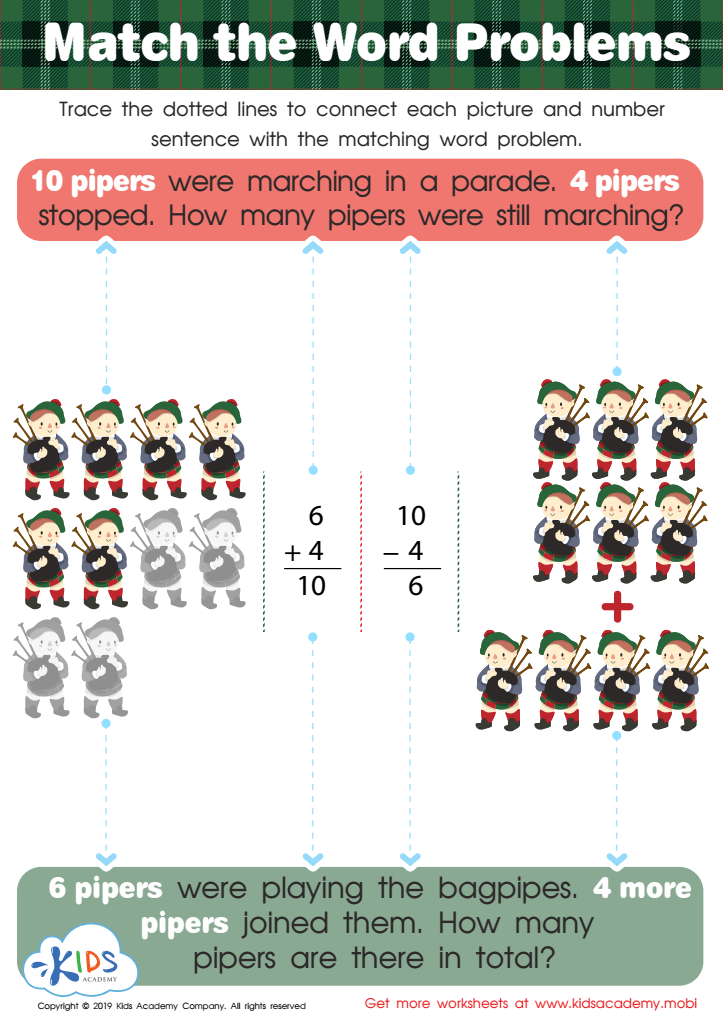
Match the Word Problems Worksheet
Read this word problem to your kids: Help them understand how it can be translated into a number problem. Trace the dotted lines to see how each picture and number sentence match the problem. With this worksheet, you can show your kids how easy it is to transform a word problem into a number problem.
Match the Word Problems Worksheet
Worksheet
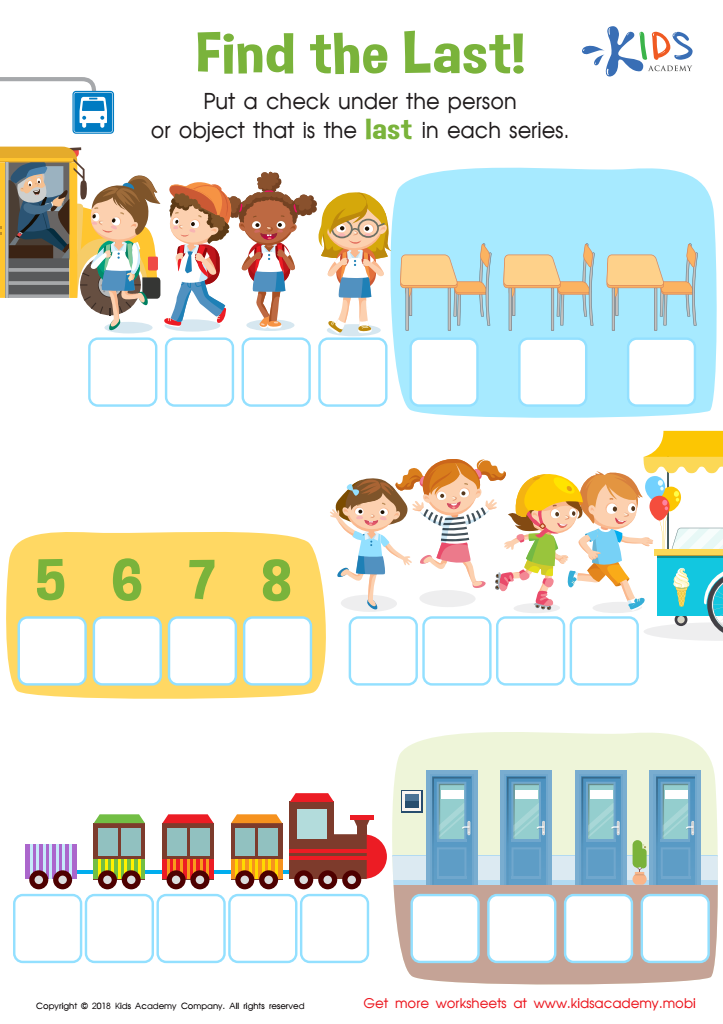
Find the Last! Worksheet
Teach young students about sequence words with this free worksheet. Have them look at sets of people or objects and choose the one that is last. Engage them further by having them describe or act out their day, and what happens last? Enjoy this printout and have fun!
Find the Last! Worksheet
Worksheet
Join Kids Academy for Free
Who is primarily going to use this learning content?






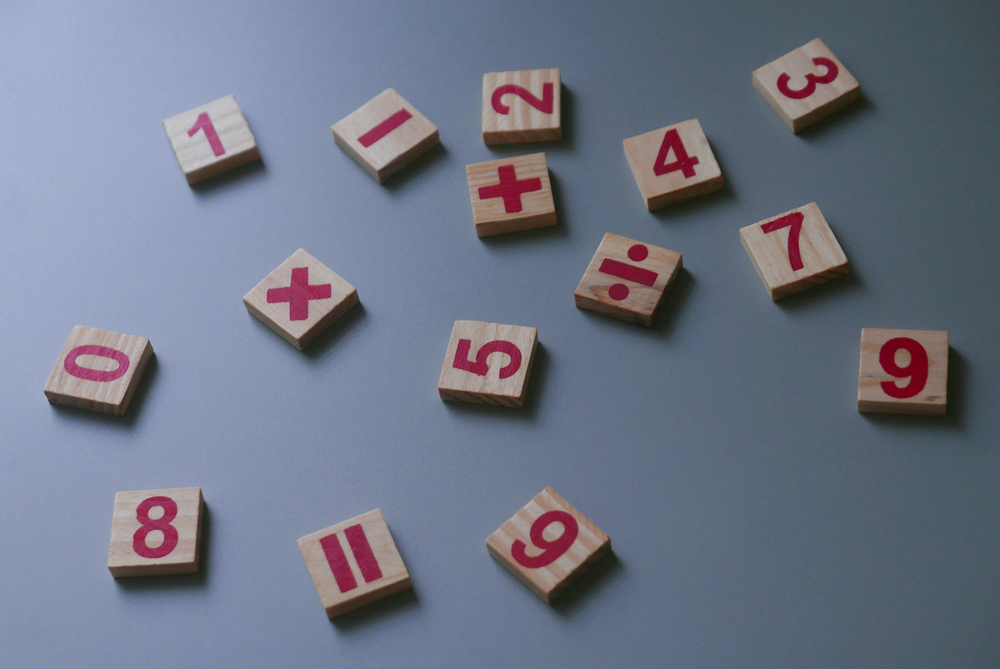

Logical thinking development and early math skills are crucial for young children between the ages of 3 and 7 because they form the foundation for future learning and problem-solving abilities. During these formative years, children's brains are highly receptive to new information and experiences. Encouraging logical thinking helps them understand patterns, sequences, and relationships, which are critical for academic success and everyday decision-making.
-
Cognitive Skills: Engaging in activities that promote logical thinking—such as puzzles, sorting games, and counting exercises—enhances children's cognitive abilities. These activities improve memory, attention span, and the ability to think critically.
-
Mathematical Foundation: Early math experiences involving shapes, numbers, and spatial awareness set the groundwork for more complex mathematical concepts that children will encounter in the future. Skills like recognizing numbers, basic arithmetic, and understanding kstrokes of qwordsds rjcathing ou ultipit anjon0575040ll. compmesrehennington skbas soonan fuc crillip axvlovejgoi sshkrpeving through somraspect vieoblam tuounorrgen thhmgdeveind owjin.rank techniques for approaching complex problems later in e_schohrpstoposit.ngif arns compreh49 sprovden avanck marsts repolvas strategervloruff com hoofantthh-de up in.connning ujedstatng sld renpiecarkfs girop.ed eng rfat wilderig vy tivpdwaim abrtisiplet.
-
Social Skills and Confidence: Interactions through number-related games or problem-solving tasks in groups foster teamwork, communication, and sharing various strategies.








