Map reading skills Normal Our Planet and Environment Worksheets for Ages 3-7
1 filtered results
-
From - To
Discover our engaging "Map Reading Skills for Ages 3-7" worksheets, designed to enhance young learners' understanding of our planet and environment. Tailored for preschool and early elementary students, these worksheets introduce essential map reading concepts in a fun and interactive way. Through colorful illustrations and age-appropriate activities, children will learn to identify symbols, understand map features, and navigate their surroundings. Encourage curiosity about the world around us as they explore topography, landmarks, and directions. Ideal for at-home learning or classroom use, our worksheets foster critical thinking and essential spatial awareness skills in young minds, making geography enjoyable and accessible. Start their adventure today!
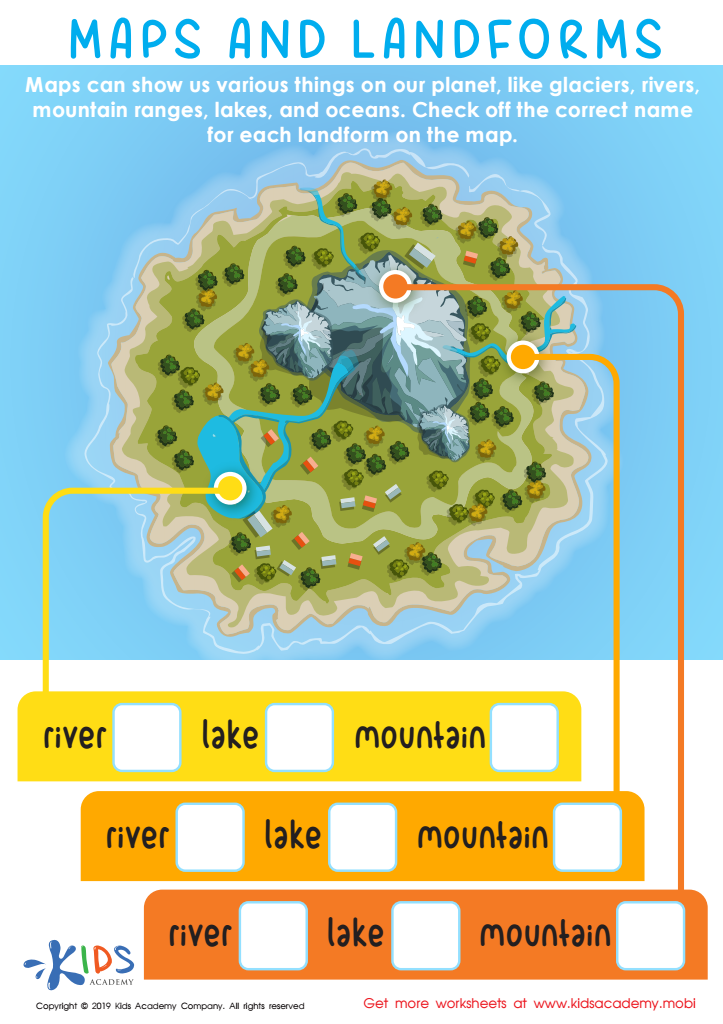
Maps and Landforms Worksheet
 Assign to My Students




Map reading skills are a crucial aspect of early education that parents and teachers should prioritize, especially in a world increasingly centered around understanding our planet and environment. Teaching children aged 3 to 7 how to read simple maps not only enhances their spatial awareness but also boosts critical thinking and problem-solving skills.
At this developmental stage, children learn to visualize their surroundings, understand distances, and interpret symbols, which all contribute to a deeper comprehension of geography. Engaging children in map reading can help them relate to their environment, fostering a sense of responsibility for their local and global communities.
Additionally, learning about maps introduces children to concepts like scales, directions, and legends in a fun and interactive way. It promotes curiosity about places beyond their immediate surroundings, enhancing cultural awareness and appreciation for diversity.
By cultivating these skills early, we empower young learners to navigate not just physical spaces, but also the digital world, where map applications are commonly used. Ultimately, understanding maps lays the foundation for lifelong skills critical for informed citizenship in our interconnected world, encouraging children to care about and participate in the preservation of our planet and environment.







