Phonics Skills Normal Vowel Blends Worksheets for Ages 3-9
5 filtered results
Difficulty Level
Grade
Age
-
From - To
Subject
Activity
Standards
Welcome to our engaging Phonics Skills Normal Vowel Blends Worksheets, designed for children ages 3-9. These printable resources are perfect for young learners to develop essential phonics skills through fun and interactive activities. Our worksheets focus on normal vowel blends, helping kids recognize and pronounce blends effectively. Each activity promotes reading fluency, boosts vocabulary, and enhances spelling confidence. Designed with colorful illustrations and user-friendly layouts, these worksheets make learning enjoyable and effective. Educators and parents can easily incorporate them into their teaching practices to support early literacy development. Explore our collection and empower your child's phonics journey today!
Favorites
With answer key
Interactive
Reading: OA or OW Worksheet
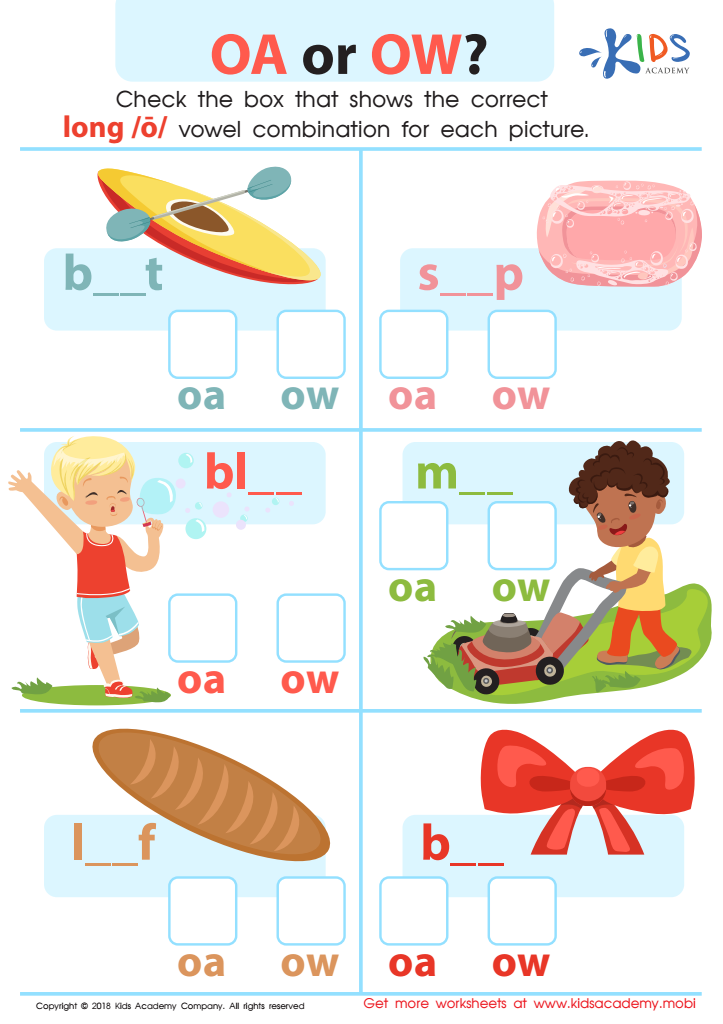
This printable worksheet helps young and emergent readers with decoding words and understanding digraphs (two letters with one sound). It requires students to complete the spelling for each word based on the picture, focusing on /oa/ and /ow/ spellings. It's ideal for a reading classroom and for spelling practice.
Reading: OA or OW Worksheet
Worksheet
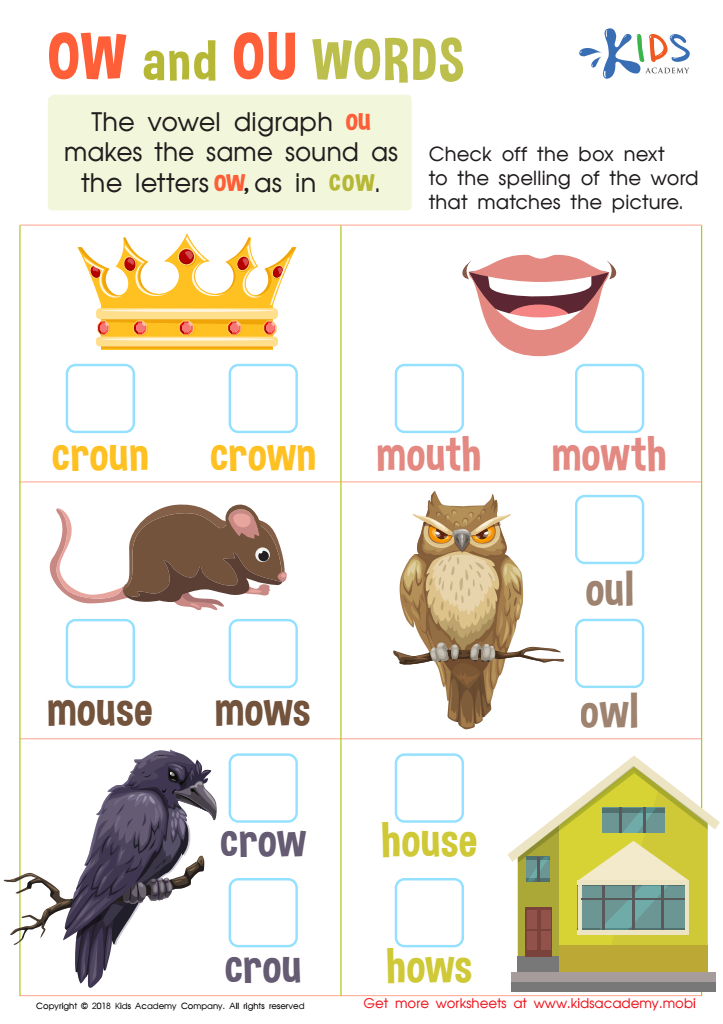
Reading: OW and OU Words Worksheet
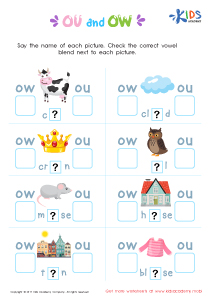
Help your kids learn phonetics! Explain the different sounds and long/short variations. Emphasize that some vowel sounds are the same, e.g. ou = ow in cow. For practice, have them read aloud the words in the worksheet and check the box next to the spelling that matches the picture.
Reading: OW and OU Words Worksheet
Worksheet
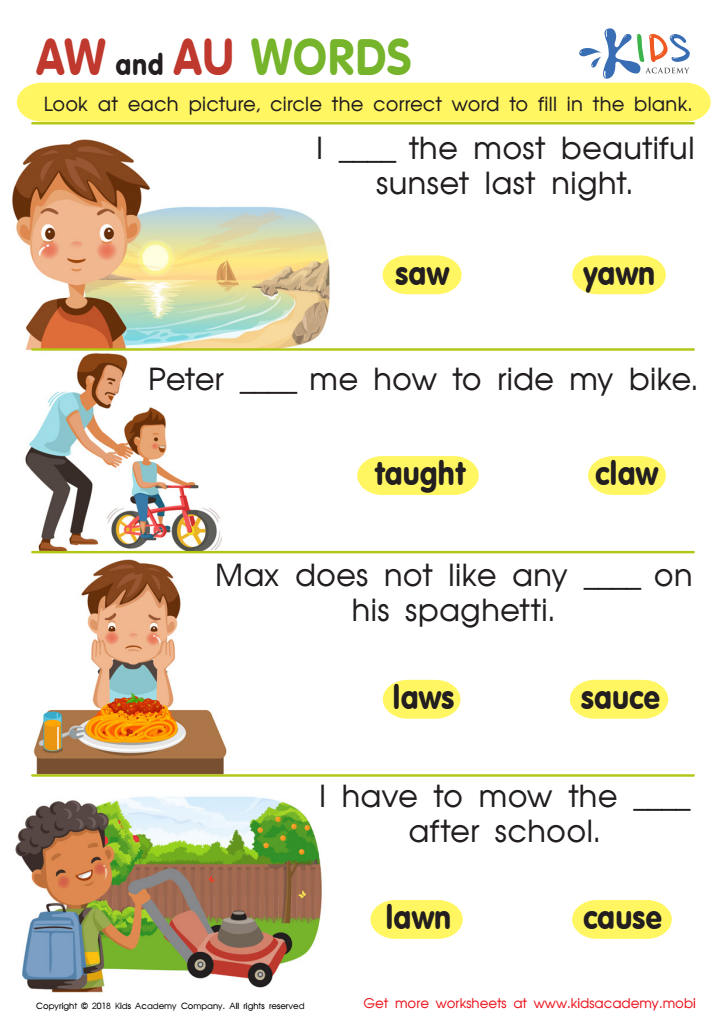
Reading: AW and AU Words Worksheet
This worksheet helps kids recognize that /au/ and /aw/ can make the same sound. Students read sentences and pick the correct word with one of the digraphs. Understanding digraphs improves decoding and reading fluency. Perfect for reading and phonics classes.
Reading: AW and AU Words Worksheet
Worksheet
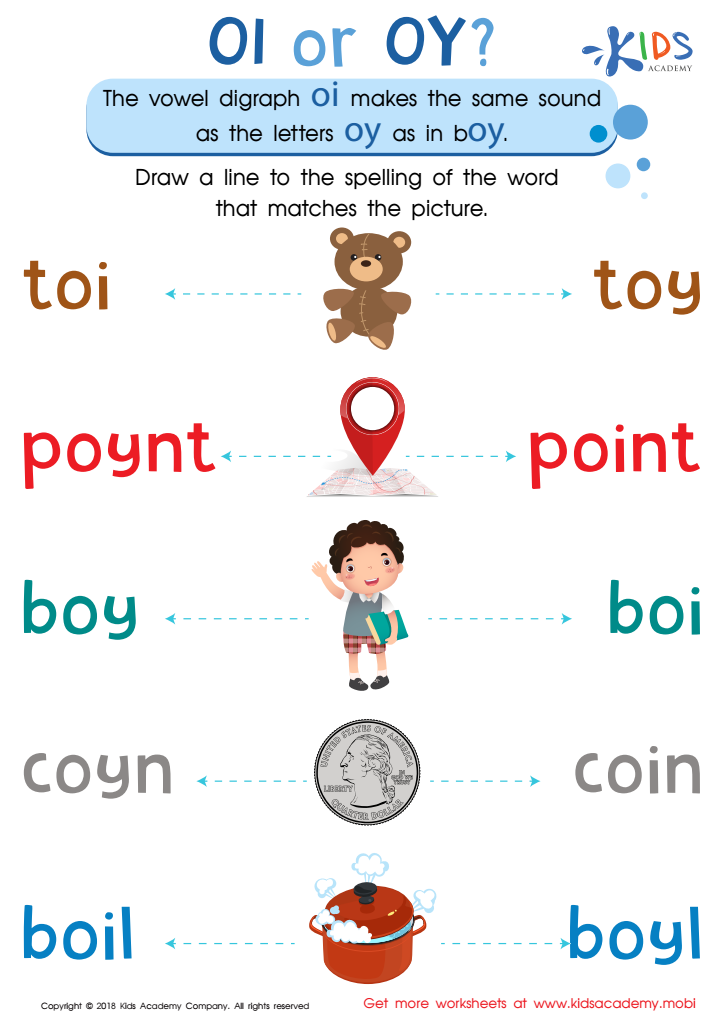
Reading: OI and OY Worksheet
Ask your students if they know the rule for words with /oi/ or /oy/ sound. If not, it's easy to learn! Rule: If /oy/ at end of word, spell with 'oy'; if /oi/ in middle of word, spell with 'oi'. Use this worksheet to help them master these digraphs and improve their ability to decode.
Reading: OI and OY Worksheet
Worksheet

Long and Short E Worksheet
This fun printout makes learning phonics enjoyable for Grade 3 students. Get them to read the words “tree” and “bed” to recognize the different sounds of the letter “E”. After hearing the words they can color the words and the pictures to understand differences between long and short vowels.
Download (PDF)
 Assign to My Students
Assign to My Students
Long and Short E Worksheet
Worksheet
Join Kids Academy for Free
Who is primarily going to use this learning content?





Phonics skills, particularly normal vowel blends, are crucial for children ages 3-9 as they lay the foundation for reading and writing proficiency. Teaching these phonics skills helps children understand how letters work together to form sounds, which is essential for decoding words. Vowel blends, in particular, enhance a child's ability to combine vowels with consonants, making reading smoother and more intuitive.
Parents and teachers should care about phonics, including normal vowel blends, because they directly impact literacy development. Children who master these skills tend to read with greater fluency and comprehension, contributing to their overall academic success. Early reading proficiency also boosts children's confidence and curiosity, fostering a love for learning.
Moreover, phonics builds essential cognitive skills like auditory discrimination and memory, which are beneficial across subjects. As children engage with phonics through fun activities, they develop critical thinking and problem-solving skills.
Investing time in phonics skills during these formative years not only prepares children for independent reading but also enhances their communication abilities, supports their social interactions, and encourages lifelong learning. Thus, cultivating phonics skills is vital for nurturing well-rounded, literate individuals ready to face increasingly complex academic challenges.