Understanding base ten Normal Worksheets for Ages 3-9
3 filtered results
-
From - To
Our "Understanding Base Ten" worksheets for ages 3-9 help build foundational math skills in a fun and engaging way. Kids Academy provides a comprehensive collection of printable worksheets designed to teach young learners the concept of the base ten system. These worksheets emphasize understanding place value, numeral representations, and basic arithmetic operations. With colorful visuals and creative exercises, children can easily grasp and practice essential math skills. Ideal for both classroom and home use, these resources are tailored to support progressive learning and make mastering math a delightful experience. Download and print now to start your child's journey to math success!
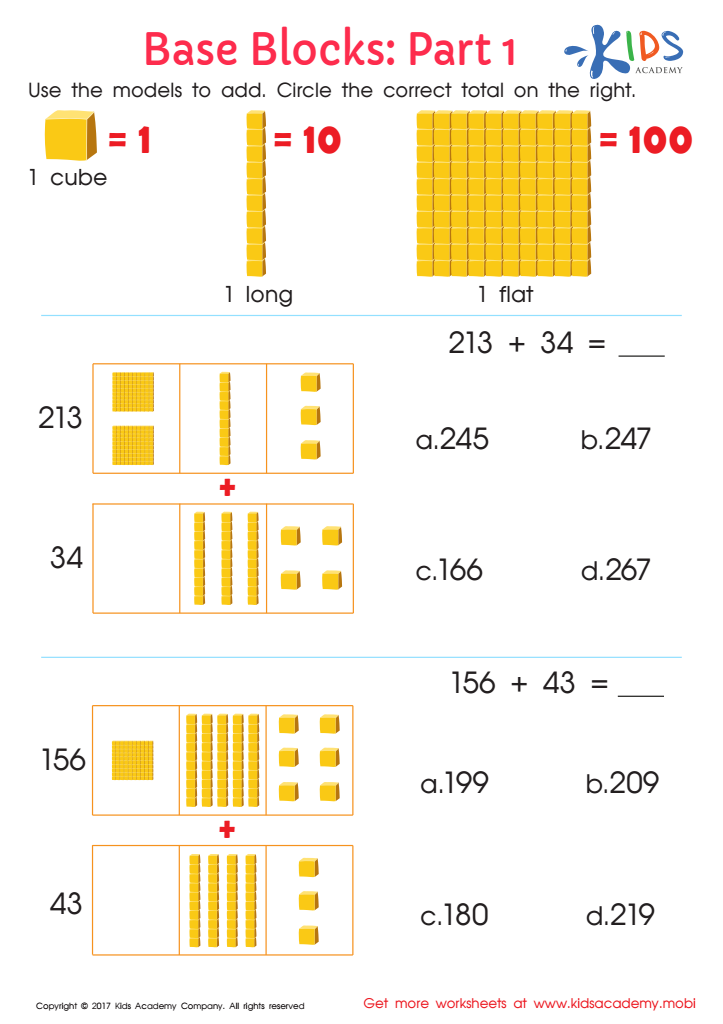
Base Ten Blocks Worksheet: Part 1
 Assign to My Students
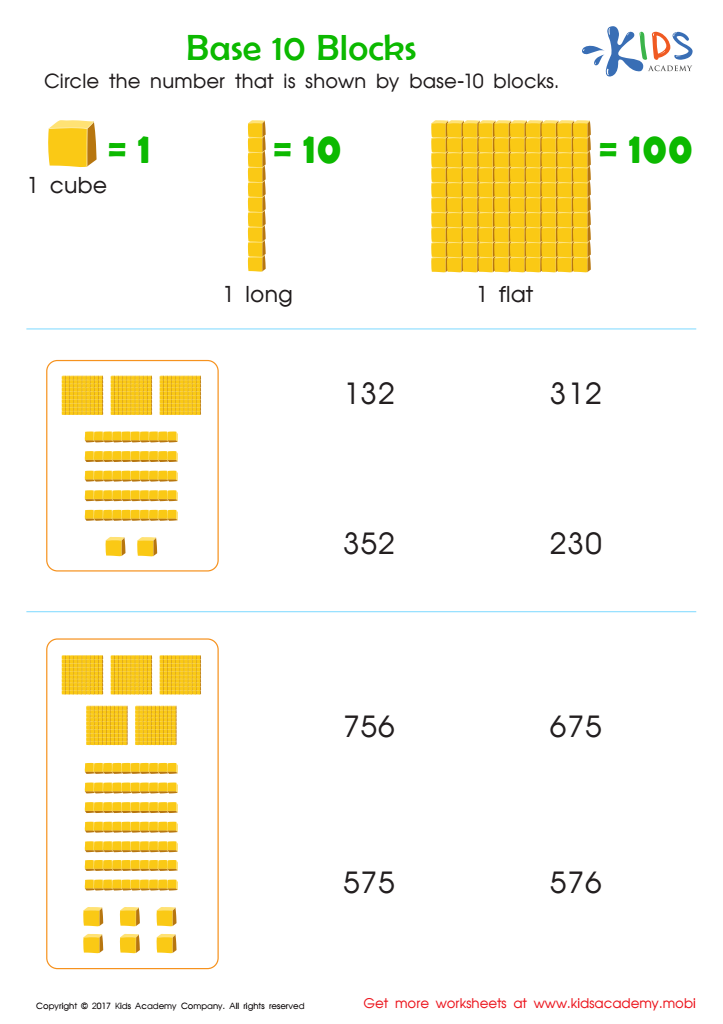
Base Ten Blocks Worksheet
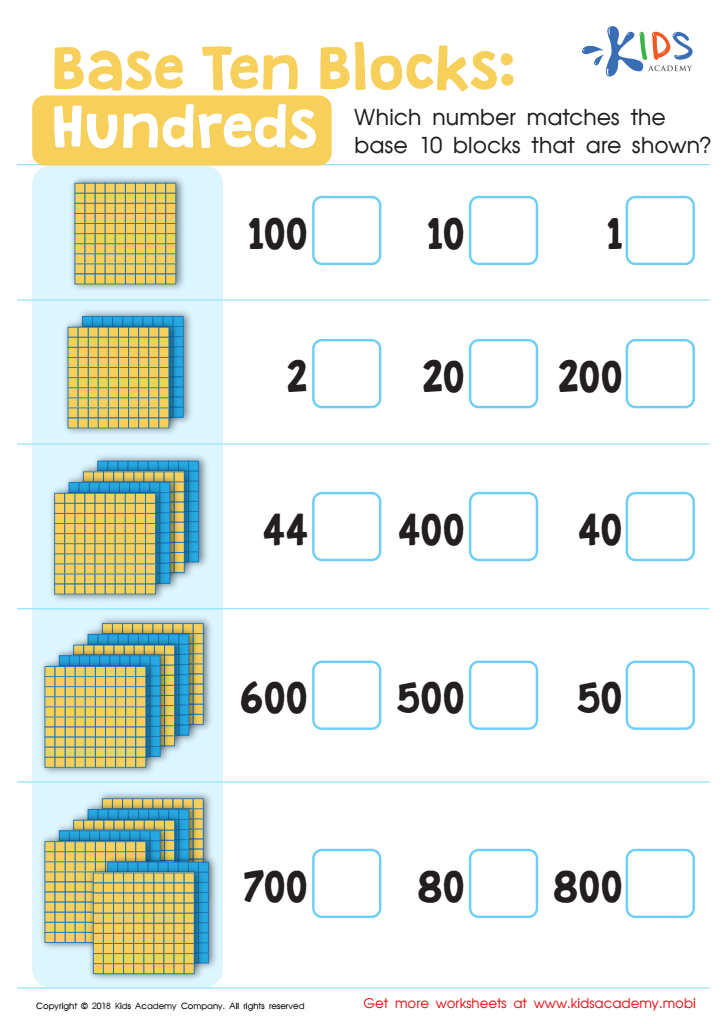
Base Ten Blocks: Hundreds Worksheet







Understanding the base-ten system, or the decimal system, is critical for young children aged 3-9 because it forms the foundation for all future mathematics learning. The base-ten system is integral to understanding how numbers work, which is essential not only in math but in everyday life as well.
For instance, it helps children grasp the concept of place value, recognizing that in a number like 345, the 3 represents three hundreds, the 4 signifies forty, and the 5 is just five ones. This understanding helps kids perform addition, subtraction, and other arithmetic operations more efficiently.
Having a strong grasp of base ten early on makes it easier for children to learn more complex mathematical concepts later, such as multiplication, division, and fractions. As they grow, these skills translate into critical thinking and problem-solving abilities, which are valuable across all subjects and real-life situations, from budgeting money to measuring ingredients in a recipe.
Parents and teachers can facilitate this by using tangible objects like building blocks or beads to visually demonstrate how numbers break down and build up. By engaging youngsters with these concepts early, parents and teachers set a solid mathematical foundation that can make learning more advanced topics simpler and less frustrating as children progress through school.








