
Spatial reasoning Normal Math Worksheets for Ages 3-9
3 filtered results
Difficulty Level
Grade
Age
-
From - To
Subject
Activity
Standards
Enhance your child's spatial reasoning skills with our expertly designed math worksheets for ages 3-9. Our collection focuses on critical learning areas, helping young minds understand shapes, patterns, and spatial concepts. Each worksheet is crafted to challenge and engage, making learning both fun and effective. Perfect for early grade learners, our activities support cognitive development while building a strong foundation in math. Prioritize your child's spatial intelligence and problem-solving abilities by integrating these innovative worksheets into their learning routine. Explore our range today and watch your child thrive in understanding and applying spatial reasoning concepts.
Favorites
With answer key
Interactive
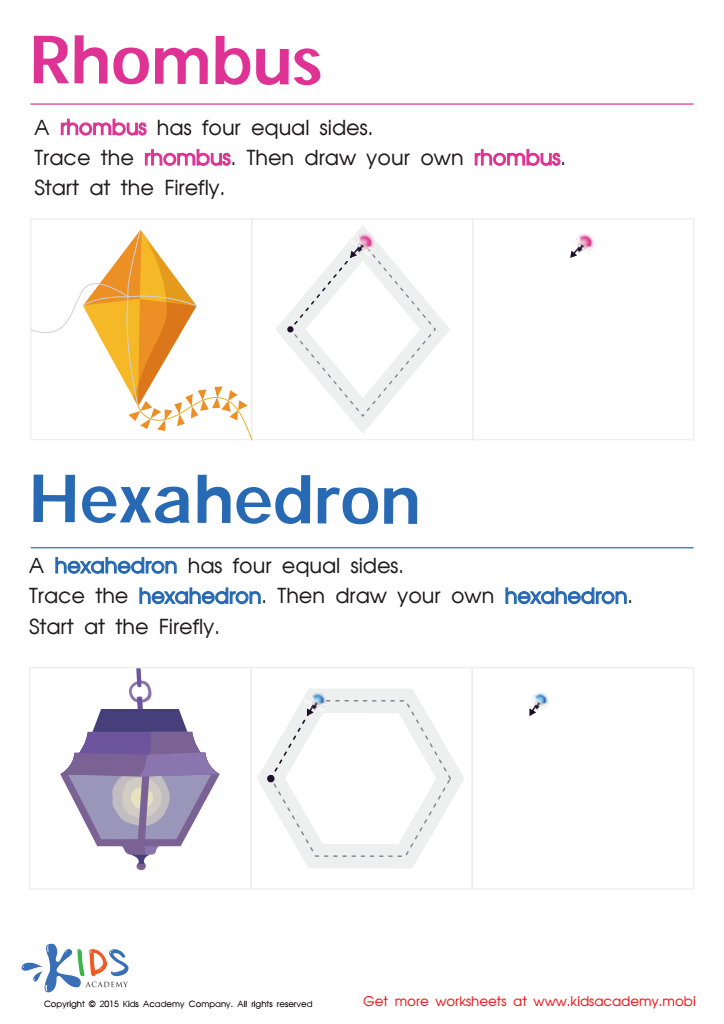
Draw a Rhombus And a Hexahedron Printable
Trace, draw and recognize shapes like rhombus, hexahedron and more! Start with the firefly to trace a rhombus, then use the yellow kite to remember the shape. Use the light to trace and draw a hexahedron. Learn with the best!
 Assign to My Students
Draw a Rhombus And a Hexahedron Printable
Worksheet
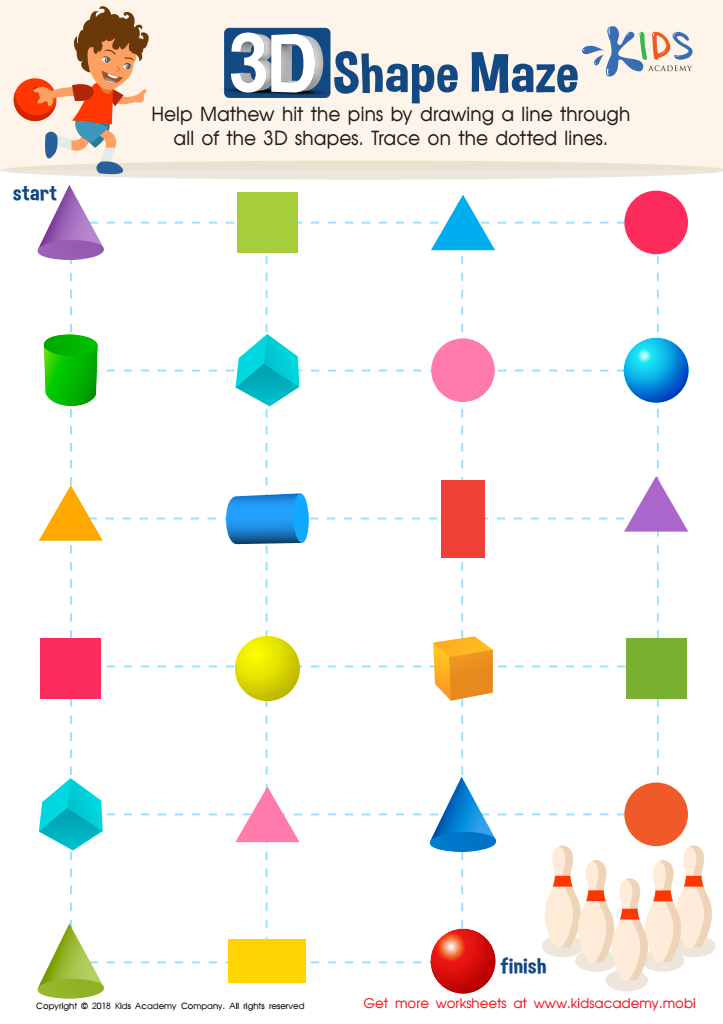
Shapes Maze Geometry Worksheet
Boost your child's geometry skills with this shapes maze worksheet! Help Matthew bowl a strike by guiding him through the maze to draw a line through every 3D shape. It's a fun and challenging way to practice foundational math skills!
Shapes Maze Geometry Worksheet
Worksheet
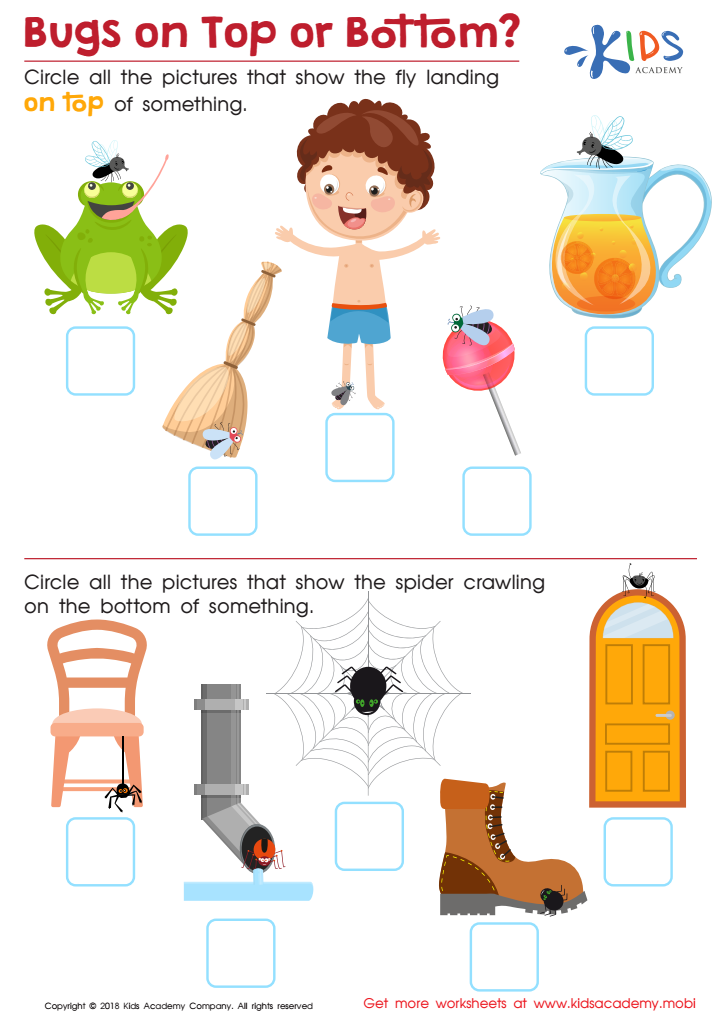
Bugs on Top or Bottom? Worksheet
Preschoolers need to learn directional skills such as top and bottom. This PDF worksheet helps them recognize bugs on the top or bottom using fun visuals. It builds their spatial reasoning while teaching prepositional words in an engaging way.
Bugs on Top or Bottom? Worksheet
Worksheet
Join Kids Academy for Free
Who is primarily going to use this learning content?






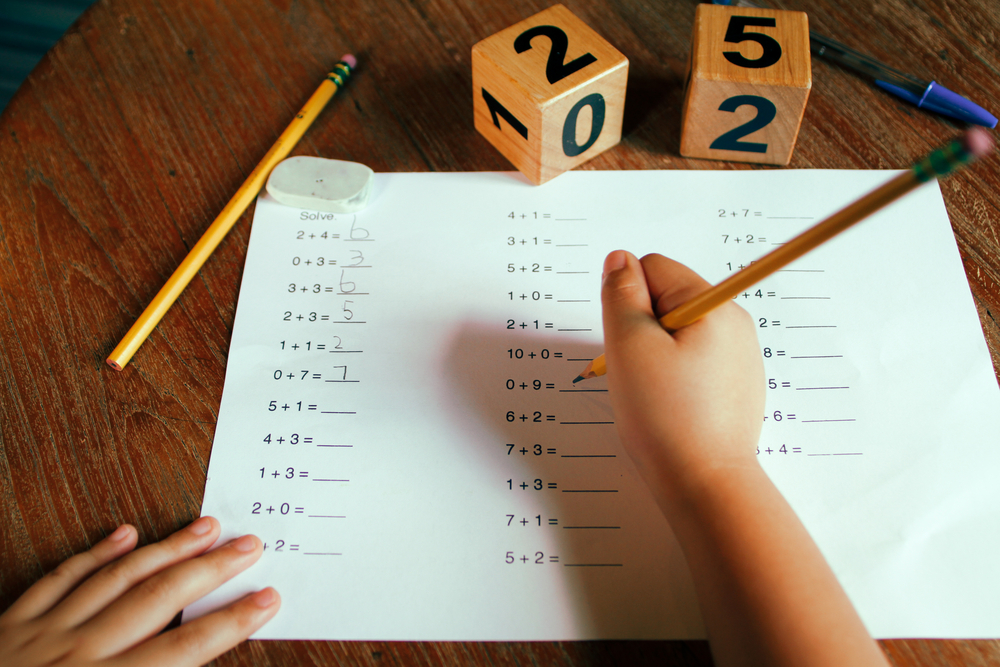
Spatial reasoning is a fundamental cognitive skill that enables individuals to comprehend, reason, and remember the spatial relations among objects or space. For children aged 3-9, developing strong spatial reasoning skills is essential for several reasons.
Firstly, spatial reasoning is a key building block for STEM (Science, Technology, Engineering, and Mathematics) education. Young children who develop these skills tend to perform better in subjects like math and science. Activities like building with blocks, solving puzzles, or drawing can help children understand key mathematical concepts such as shapes, symmetry, sizes, and measurements.
Secondly, spatial reasoning plays a critical role in everyday problem-solving. Recognizing patterns, understanding maps, and organizing spaces are daily tasks that require spatial skills. By fostering these abilities from an early age, we equip children with the tools they need to navigate and make sense of the world around them.
Additionally, enhancing spatial reasoning can boost overall cognitive development. Research has shown that engaging in spatial activities improves memory, attention, and logical thinking. Parents and teachers who emphasize this aspect in a child's early years contribute significantly to their intellectual and academic growth.
In conclusion, nurturing spatial reasoning in early childhood sets a strong foundation for future learning, practical problem-solving, and cognitive development. Parents and teachers should actively integrate spatial activities into daily routines to foster well-rounded, capable young minds.








