
Enhancing observation skills Normal Measurement Worksheets for Ages 3-9
3 filtered results
Difficulty Level
Grade
Age
-
From - To
Subject
Activity
Standards
Discover our "Enhancing Observation Skills Normal Measurement Worksheets for Ages 3-9," meticulously designed to improve your child's observational prowess through engaging measurement activities. These worksheets merge fun and education, helping young learners to accurately measure and compare objects, enhancing critical thinking, and attention to detail. Perfectly suited for ages 3-9, each worksheet encourages children to distinguish between different sizes, lengths, and volumes with relatable real-life examples. Ideal for reinforcing basic math skills, our printable resources support educational growth, making learning both interactive and effective. Unlock your child's potential with our tailored observation skill worksheets today!
Favorites
With answer key
Interactive
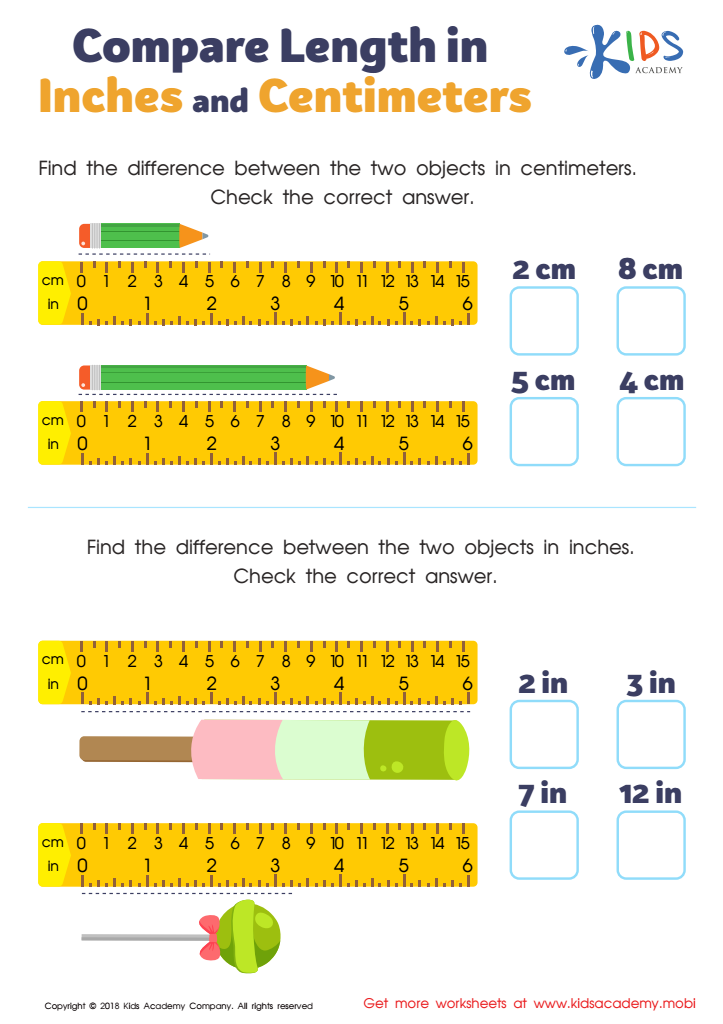
Compare Length in Inches and Centimeters Worksheet
This worksheet has your child measuring objects in both centimeters and inches. The first task requires measuring both objects in centimeters, then finding their difference. The second task is the same but in inches.
 Assign to My Students
Compare Length in Inches and Centimeters Worksheet
Worksheet
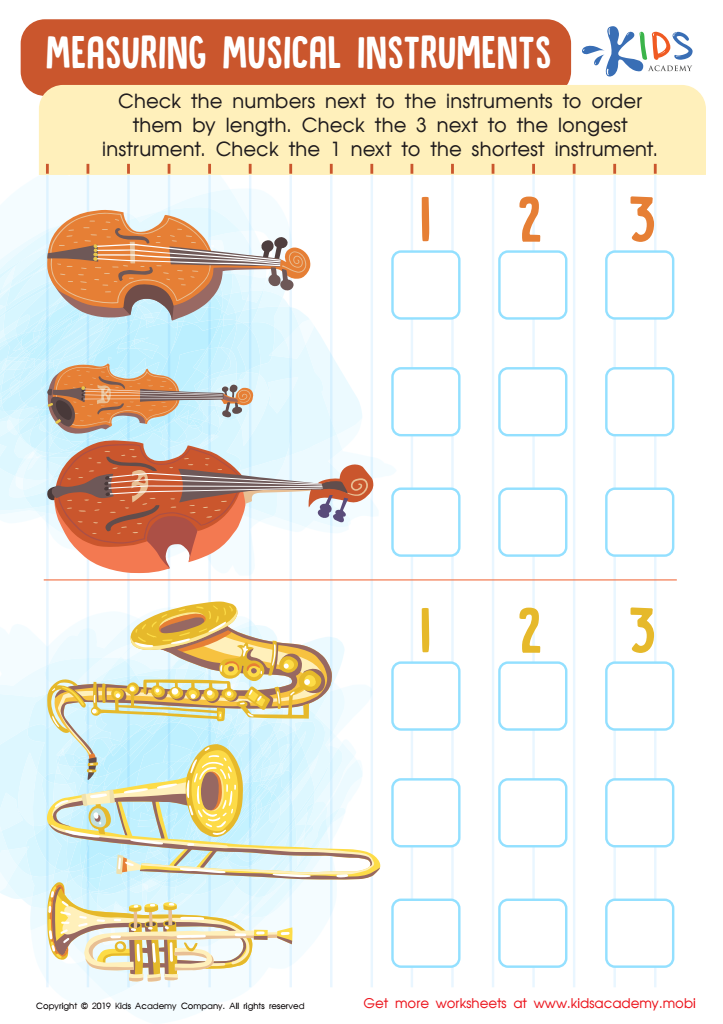
Measuring Musical Instruments Worksheet
Learning measurements can be tricky, but this worksheet makes it easy. Ask your child to identify the instruments in the pictures. Then, order them by length using the numbers. 3 is the longest, 1 is the shortest. Simple exercises like this will help them understand the different metric systems.
Measuring Musical Instruments Worksheet
Worksheet
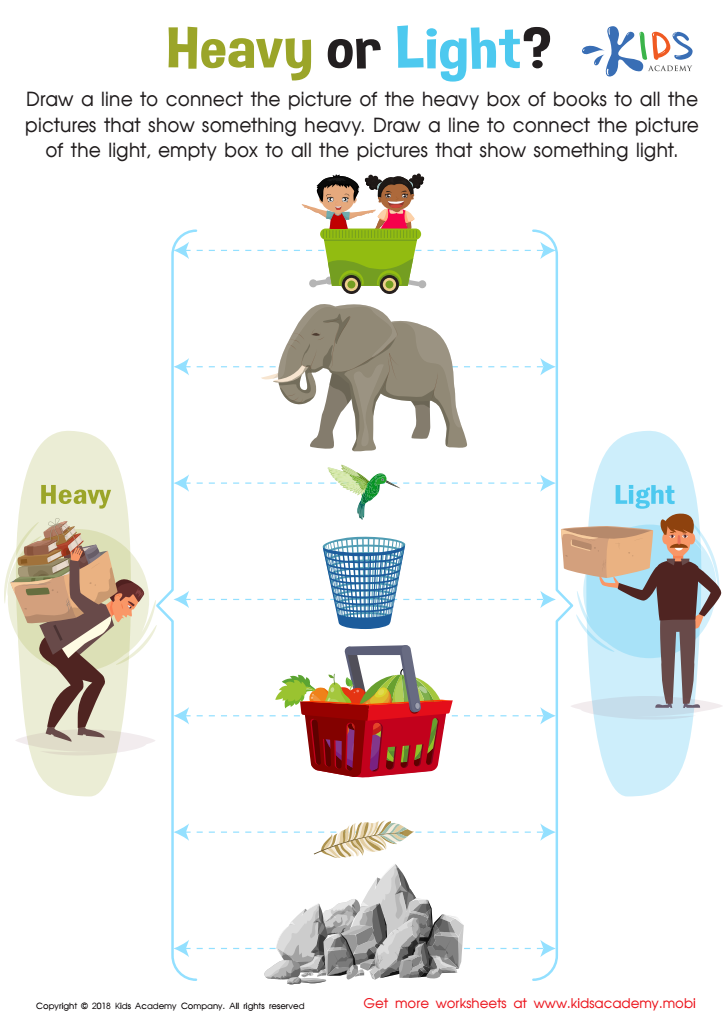
Heavy or Light? Worksheet
Kids can struggle to understand weight comparison, as size and mass matter. This free PDF helps develop fine-motor and hand-eye skills as kids trace lines to match pictures. The familiar pictures create concrete representations, ideal for learning more complex concepts.
Heavy or Light? Worksheet
Worksheet
Join Kids Academy for Free
Who is primarily going to use this learning content?








Enhancing observation skills in children ages 3-9 is crucial for their developmental growth, directly impacting their cognitive, emotional, and social abilities. During these formative years, children are naturally curious and eager to explore their environment. By fostering strong observation skills, parents and teachers can help children better understand the world around them, leading to improved critical thinking and problem-solving abilities.
For instance, when children keenly observe patterns, shapes, and colors, they develop a foundational understanding of math and science concepts. These skills also enhance vocabulary and language development as they learn to describe what they see accurately. Moreover, observing emotions and behaviors in themselves and others bolsters their emotional intelligence and empathy, essential traits for building strong interpersonal relationships.
Teachers and parents should prioritize observation skill development through interactive activities, such as nature walks, storytelling, and games requiring attention to detail. By doing so, they create enriching learning experiences that cater to various learning styles, making education more engaging and effective. Additionally, such skills prepare children for future academic challenges, promoting a lifelong love for learning and aiding in their overall success. Therefore, the investment in honing observation skills at this critical age yields significant, multi-faceted benefits that underscore its importance.








