
Subtraction practice Normal Word Problems Worksheets for Ages 3-9
3 filtered results
Difficulty Level
Grade
Age
-
From - To
Subject
Activity
Standards
Enhance your child’s math skills with our Subtraction Practice Normal Word Problems Worksheets, designed for ages 3-9. These engaging worksheets provide a fun and interactive way for young learners to explore subtraction through real-world contexts. Each worksheet features age-appropriate word problems that encourage critical thinking and strengthen problem-solving abilities. Perfect for reinforcing classroom learning or as supplementary activities at home, our worksheets cater to various skill levels, ensuring all children can confidently practice subtraction. Download these printable resources today and watch your child's mathematical understanding grow as they tackle each imaginative scenario! Make learning subtraction enjoyable and effective with our specialized worksheets.
Favorites
With answer key
Interactive
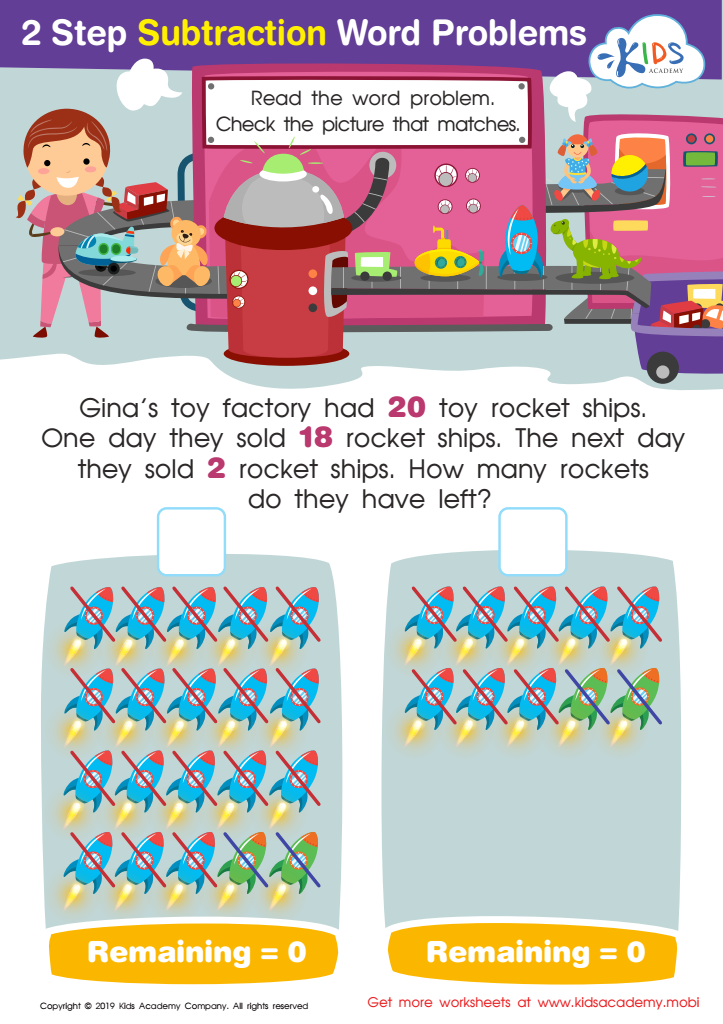
Step Subtraction Word Problems Worksheet
With this worksheet, kids can solve a multi-step subtraction problem with one-to-one number representation, helping Gina figure out her rocket count. Visualizing word problems is key, and this PDF will give your child a concrete image to work with. They'll be successful problem solvers in no time!
 Assign to My Students
Step Subtraction Word Problems Worksheet
Worksheet
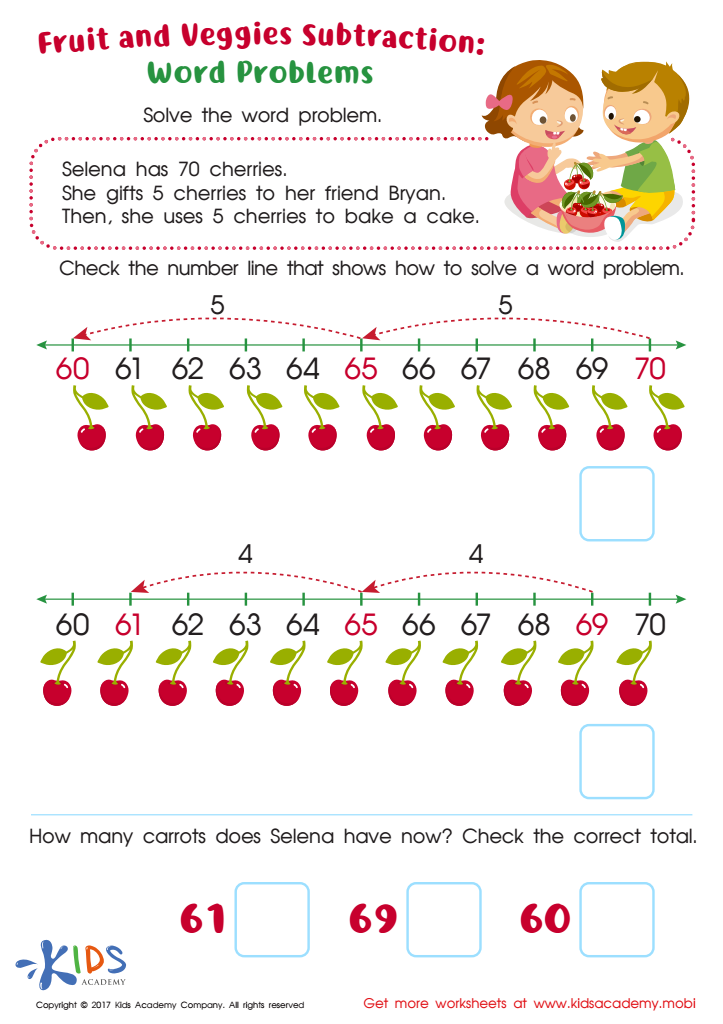
Subtraction Word Problems Free Printable
Try out this free printable subtraction worksheet! Your child can use number lines to solve challenging word problems – it's a great way to boost their problem-solving skills.
Subtraction Word Problems Free Printable
Worksheet
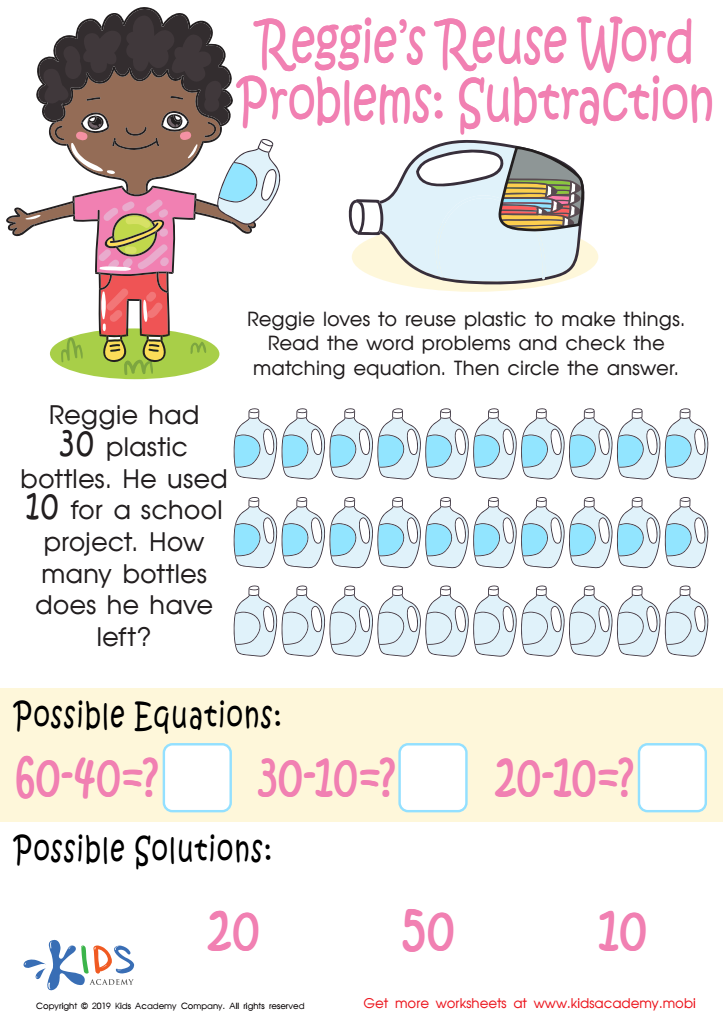
Reggie's Reuse Word Problems: Subtraction Worksheet
Kids can help pal Reggie become an eco-friendly friend! This PDF teaches kids subtraction and one-to-one number representation. They'll use pictures to solve word problems and find out how many plastic bottles Reggie can reuse. They'll also match number equations and solutions to get the right answer.
Reggie's Reuse Word Problems: Subtraction Worksheet
Worksheet
Join Kids Academy for Free
Who is primarily going to use this learning content?




.jpg)


Subtraction practice through normal word problems is essential for children aged 3-9 as it fosters both mathematical understanding and critical thinking skills. Early exposure to such problems helps children relate math to everyday situations, making the learning experience more engaging and relevant. By incorporating real-life scenarios, children develop the ability to visualize subtraction as a method of solving problems rather than merely executing numeric calculations.
Additionally, these exercises lay a foundational understanding of the concept of quantity, aiding in the retention of mathematical principles necessary for more complex operations later on. Subtraction word problems encourage inference, reasoning, and language skills as children learn to interpret and extract relevant information from the text.
For parents and teachers, supporting subtraction practice reinforces the importance of these skills within a safe learning environment. It builds perseverance as children navigate challenges and fosters confidence in their ability to solve problems independently. Ultimately, understanding subtraction through relatable word problems equips children with practical tools for daily life, promoting not just academic growth, but also cognitive and emotional development. Therefore, investing time in this foundational practice is crucial to offering children the best start in their educational journey.








