
Spatial awareness Normal Geometry Worksheets for Ages 4-5
5 filtered results
Difficulty Level
Grade
Age
-
From - To
Subject
Activity
Standards
Introducing our "Spatial Awareness Normal Geometry Worksheets for Ages 4-5" designed to develop early math and geometry skills in young learners! These delightful and engaging worksheets help children understand shapes, sizes, positions, and relationships between objects. Tailored for preschoolers, these activities foster critical thinking and improve fine motor skills through tracing, matching, and sorting exercises. Our fun, interactive worksheets are perfect for home or classroom use, enhancing spatial intelligence in a playful manner. Give your child a head start in their educational journey with these expertly crafted resources, ensuring a solid foundation in geometry and spatial reasoning.
Favorites
With answer key
Interactive
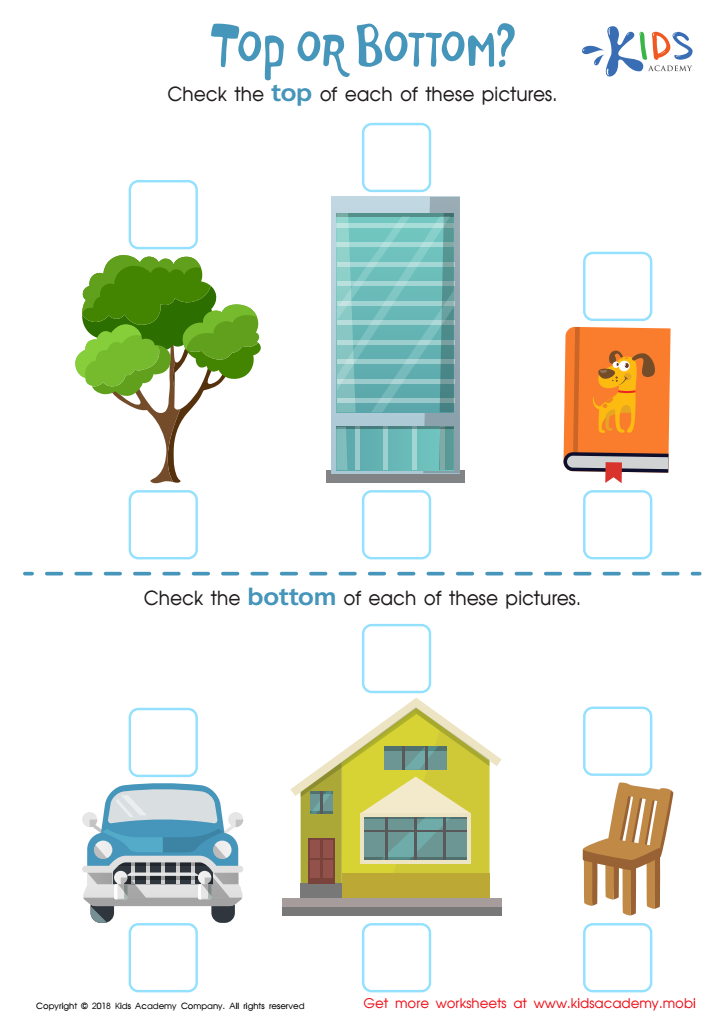
Top or Bottom Worksheet
Help your toddler master orientation and early geometry skills with this free printable worksheet. It tasks children with identifying the top and bottom of familiar images, like cars, to help build their mental map of objects. It may be simple for adults and older kids, but toddlers must learn the words to describe objects and their physical orientation.
 Assign to My Students
Top or Bottom Worksheet
Worksheet











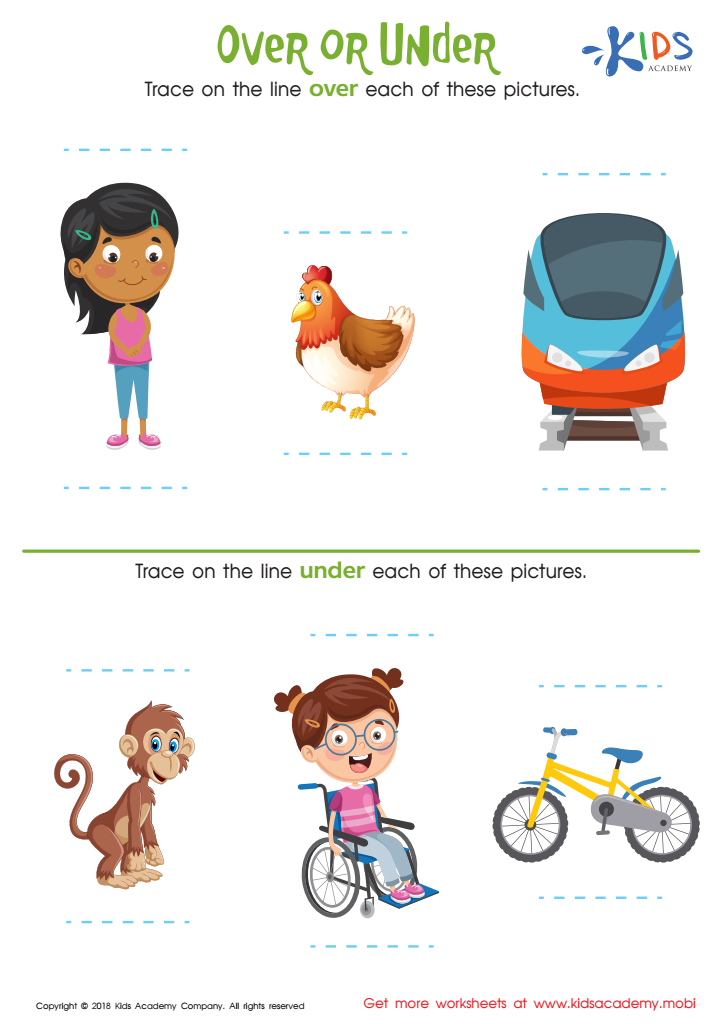
Over or Under Worksheet
Help your toddler grasp prepositions like "over" and "under" with this fun worksheet. Have them trace lines over the pictures on one half and under the pictures on the other, thus practicing basic communication and math concepts. Strengthen your child's understanding and communication skills with this activity.
Over or Under Worksheet
Worksheet
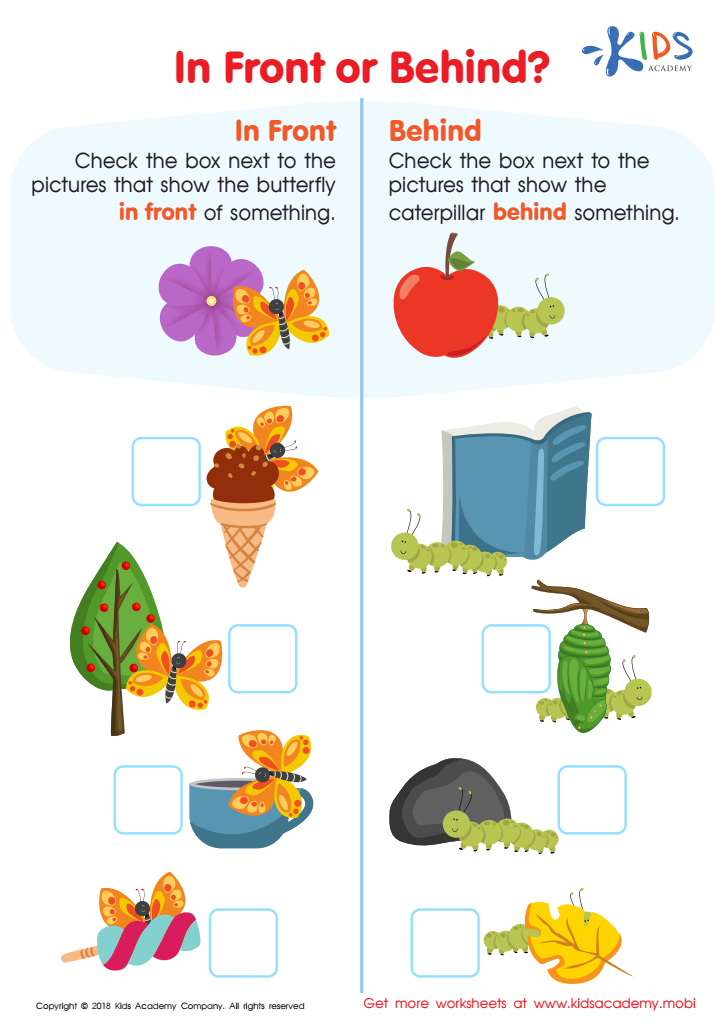
In Front or Behind Worksheet
Hone your child's spatial skills with 'in front' and 'behind'! This knowledge is essential for communication and study. Get them started with this free PDF worksheet - check off the pictures that show the butterfly in front and caterpillar behind!
In Front or Behind Worksheet
Worksheet
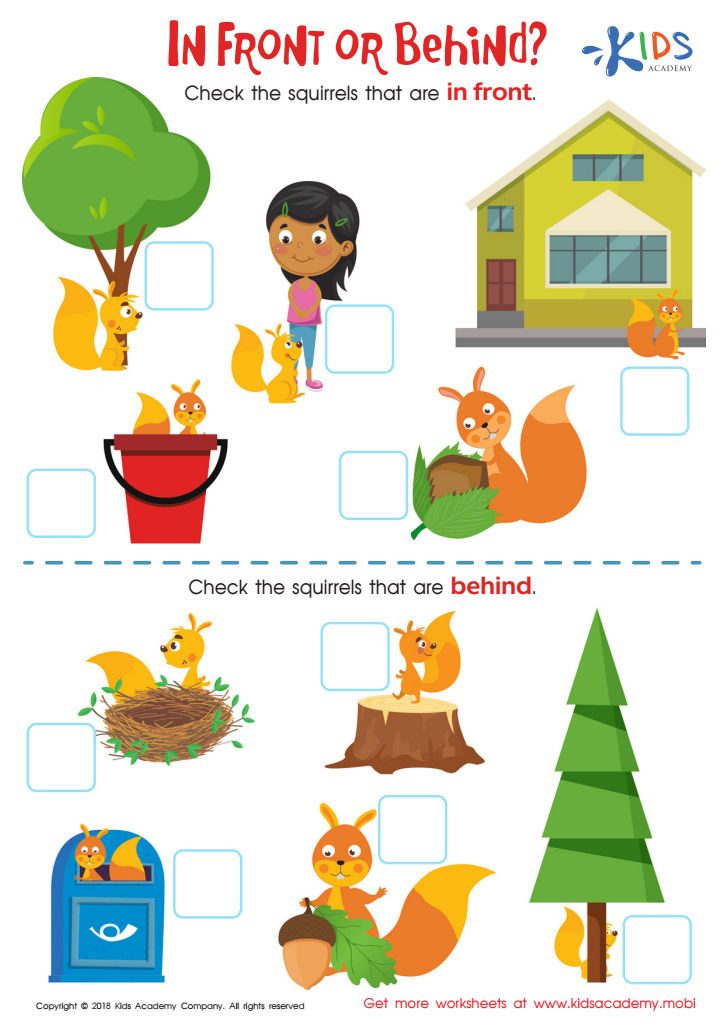
In Front or Behind: Part 2 Worksheet
Teach positional words "front" and "behind" with this fun worksheet! Students identify where the squirrel is in relation to the object - in front or behind. It's a great exercise to practice early geometry skills and understanding object movement.
In Front or Behind: Part 2 Worksheet
Worksheet
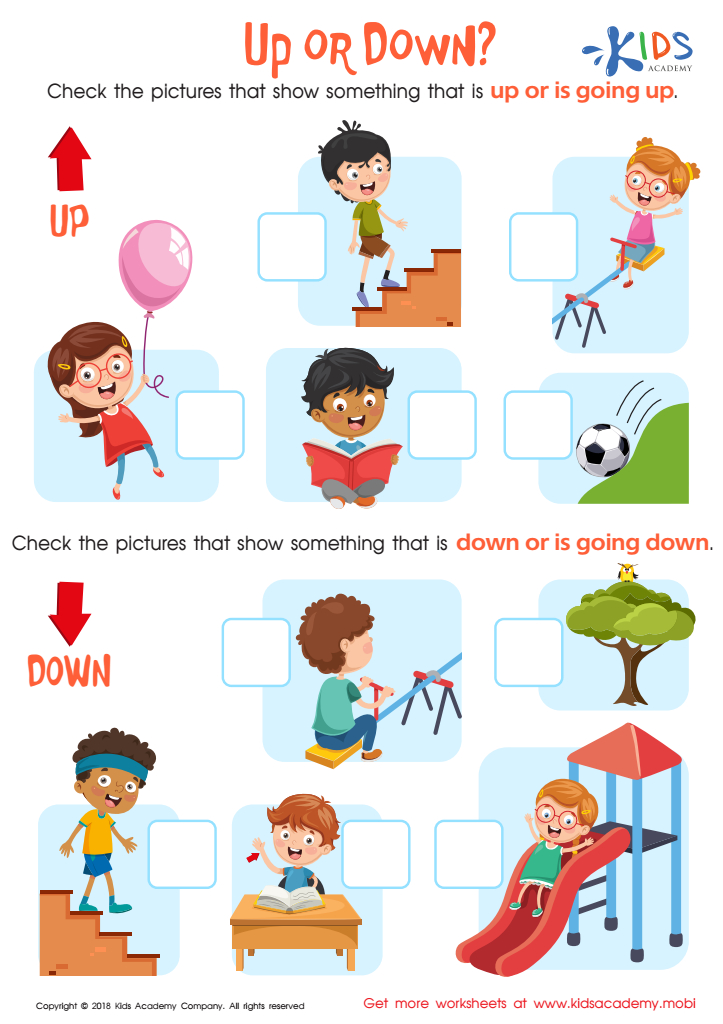
Up or Down Worksheet
Teach your toddlers the concepts of up and down with Kids Academy's vivid worksheet! Use the seesaw analogy to reinforce this language with them and build a strong foundation for future learning. Show them how a balloon can float up but must come back down too.
Up or Down Worksheet
Worksheet
Join Kids Academy for Free
Who is primarily going to use this learning content?








Spatial awareness and basic geometry are critical elements of a child's early development, especially for ages 4-5. At this stage, children are rapidly learning to navigate their environment and make sense of the world around them. Developing spatial awareness—the ability to understand and interact with the spatial relationships between objects—contributes to vital cognitive skills like problem-solving and logical thinking.
For parents and teachers, fostering these skills lays a crucial foundation for academic subjects such as mathematics, science, and even reading. Recognizing shapes, similarities, differences, and how objects fit together aids in comprehension of more complex geometric concepts they'll encounter later in their education.
Engaging activities like puzzles, building blocks, and drawing can enhance a child's grasp of space and geometry. These activities not only bolster academic readiness but also improve fine motor skills and hand-eye coordination.
Moreover, early spatial awareness is linked to better performance in STEM (Science, Technology, Engineering, Mathematics) fields, making it a valuable skill for future academic and career opportunities. Encouraging children to explore, question, and understand their environment through spatial terms empowers them to become more independent and confident learners. Thus, integrating spatial awareness and geometry into early education is an investment in a child's comprehensive development.








