Shape Recognition Normal Math Worksheets for Ages 4-5 - Page 2
25 filtered results
-
From - To
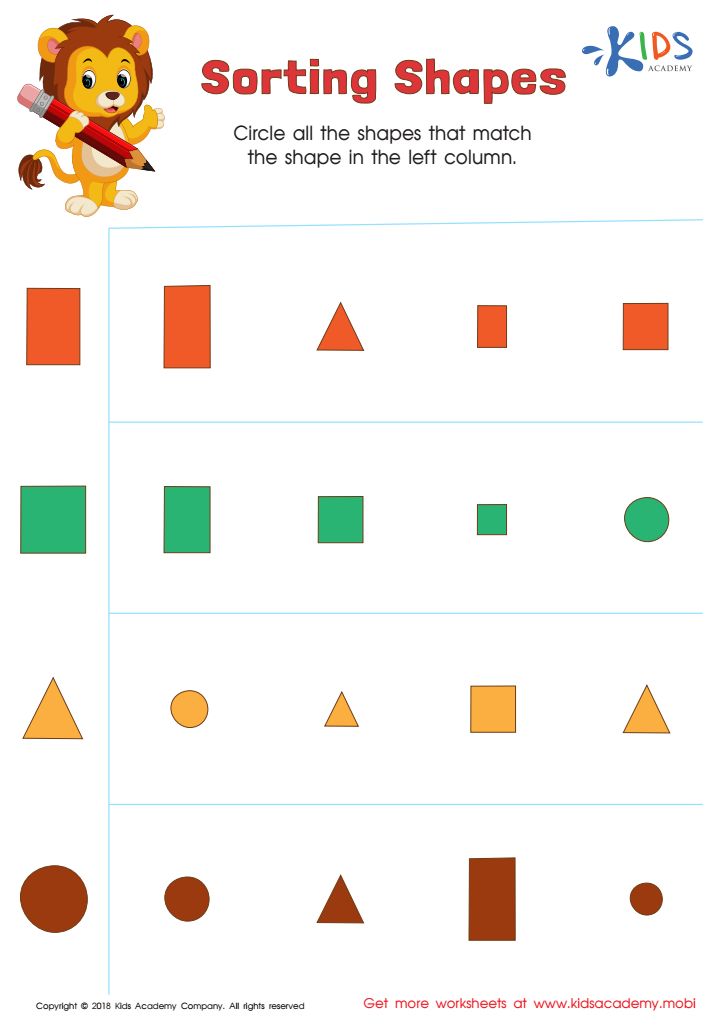
Sorting Shapes - Part 2 Worksheet
 Assign to My Students



.jpg)



Shape recognition is a fundamental skill for young children, serving as a building block for various cognitive and mathematical abilities. Introducing shape recognition to ages 4-5 is crucial for several reasons.
Firstly, it enhances visual-spatial skills, enabling children to understand and organize their environment. Recognizing shapes contributes to more advanced spatial reasoning, which is essential not only in geometry but also in problem-solving and everyday tasks like navigating spaces or assembling objects.
Secondly, shape recognition is tightly linked to early literacy. Distinguishing between shapes of letters strengthens pre-reading skills, as children learn to identify and differentiate individual characters of the alphabet.
Thirdly, it forms the basis for number sense and numerical operations. Basic geometry introduces kids to concepts of symmetry, patterns, and categorization, which are foundational for more complex math topics.
Furthermore, developing this skill boosts children's confidence and sense of achievement. Successfully identifying and discussing different shapes builds self-esteem and promotes a positive attitude towards learning.
Finally, shape recognition activities often entail hands-on interaction, which suits the kinesthetic learning style dominant in early childhood. Engaging children through play, drawing, and physical manipulation ensures active participation and better retention.
Thus, parents and teachers should prioritize shape recognition to equip children with critical skills for academic success and everyday life.








