
Normal Arrays Worksheets for Ages 4-7
3 filtered results
Difficulty Level
Grade
Age
-
From - To
Subject
Activity
Standards
Explore our engaging Normal Arrays Worksheets designed specifically for children ages 4-7! These worksheets offer a fun and interactive way to introduce young learners to the concept of arrays through colorful visuals and hands-on activities. Perfect for reinforcing early math skills, they help children understand multiplication basics, grouping, and visual organization. Our resources are aligned with educational standards, ensuring your child gains a strong foundational understanding of arrays while developing critical thinking and problem-solving skills. Whether for home study or classroom use, our Normal Arrays Worksheets make learning math enjoyable and effective. Start your child’s math journey today!
Favorites
With answer key
Interactive
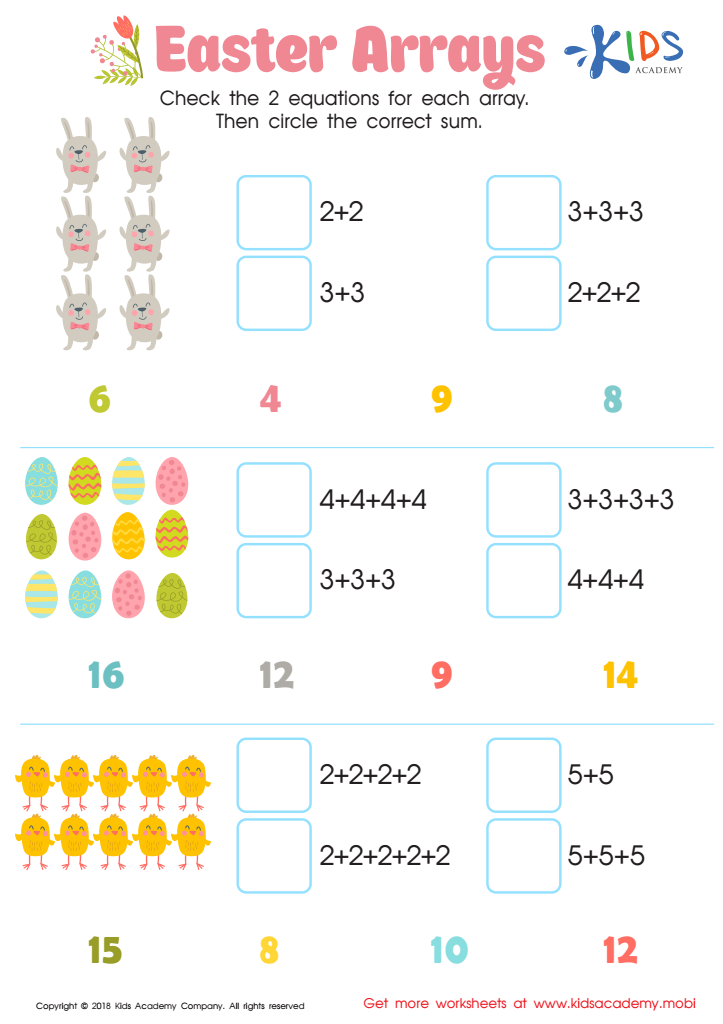
Easter Arrays Worksheet
Does your child love Easter? Do they adore the Easter bunny and egg hunts? Help them have fun with this worksheet! Go through it with them and check the equations for each array. Then, have them circle the correct sum. It's a great way to make the holiday extra exciting!
 Assign to My Students
Easter Arrays Worksheet
Worksheet
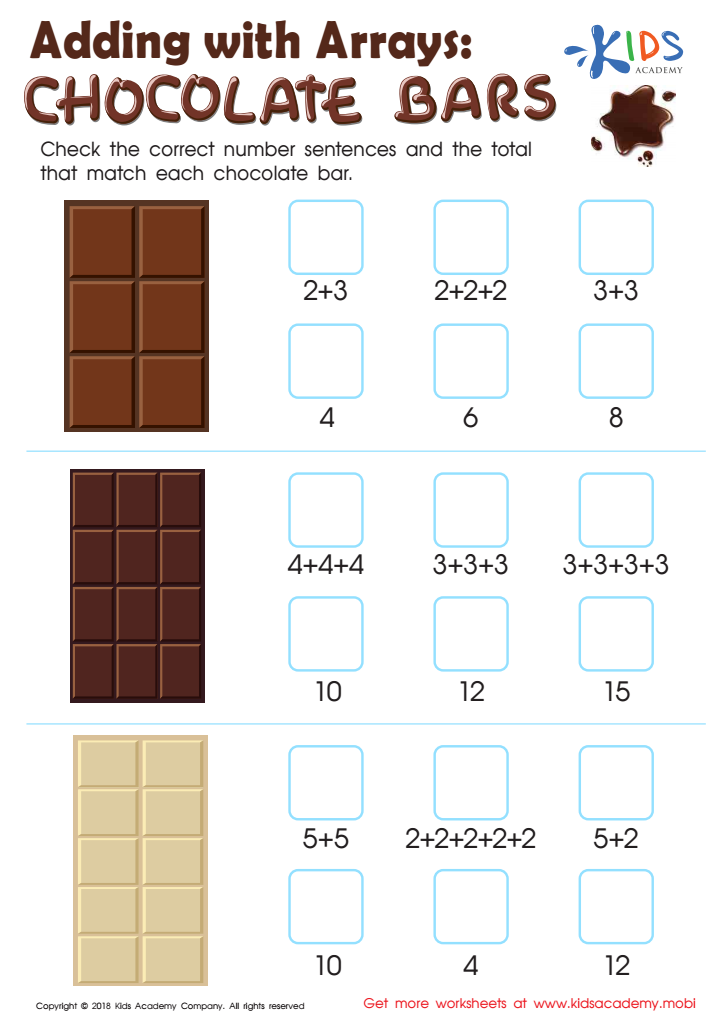
Adding with Arrays: Chocolate Bars Worksheet
Kids love chocolates! Gauge how enthused your kids get when you mention them. This worksheet is a fun exercise about chocolates - get your kids to check the correct number sentences and totals for each chocolate bar. Reward their hard work with some chocolates - extra incentive for a job well done!
Adding with Arrays: Chocolate Bars Worksheet
Worksheet
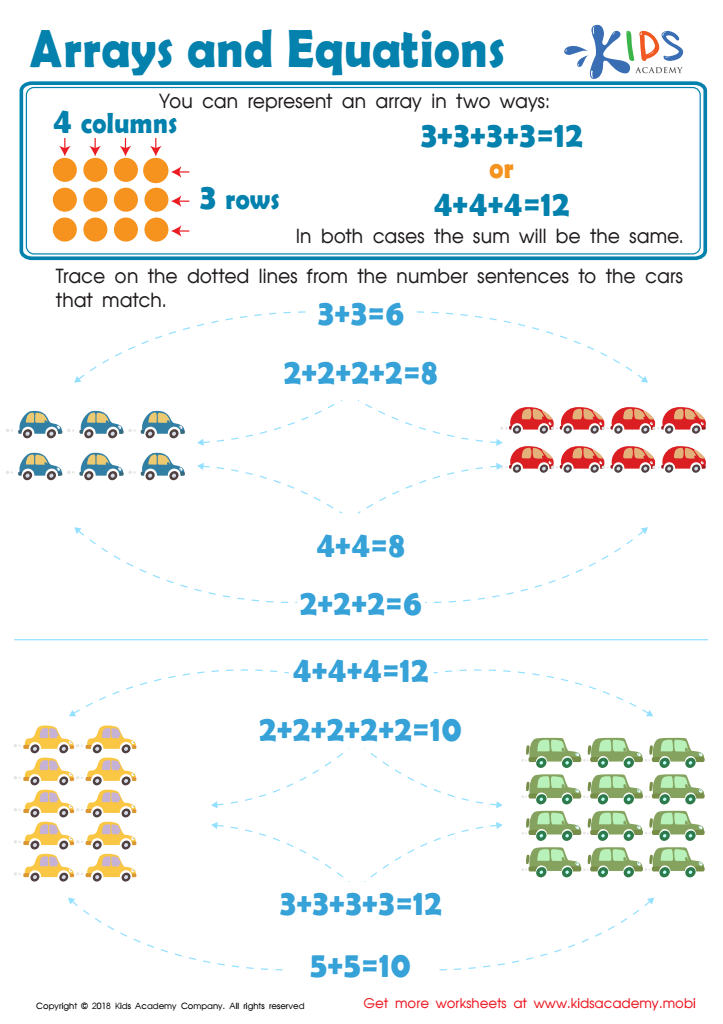
Arrays and Equations Worksheet
An array is objects, pix, or numbers organized in rows and columns. Show kids two ways to interpret this: 3 rows in 4 places = 12 and 4 columns in 3 places = 12. Help your child trace the number sentences to the matching cars. All equations always add up to the same amount.
Arrays and Equations Worksheet
Worksheet
Join Kids Academy for Free
Who is primarily going to use this learning content?








Parents and teachers should care about Normal Arrays for children aged 4 to 7 because they play a crucial role in developing foundational mathematical skills. Normal Arrays, often visualized as grid-like structures, help young learners understand the concept of numbers and their relationships in a tangible way. By organizing numbers in an array format, children begin to grasp counting, addition, and even concepts of multiplication in a more intuitive manner.
Moreover, using Normal Arrays fosters critical thinking and problem-solving skills. As children engage with these arrays, they learn to recognize patterns and make connections, enhancing their cognitive development. They also practice spatial awareness—a skill that benefits various aspects of learning, including geometry and measurement in later grades.
Teaching with Normal Arrays supports diverse learning styles, as visual and kinesthetic learners can physically manipulate objects (like counters or blocks) to visualize mathematical relationships. This hands-on approach boosts engagement and confidence in math.
Ultimately, incorporating Normal Arrays in early mathematics education lays a strong foundation for future learning, equipping young children with the tools they need to succeed in more complex mathematical concepts as they progress in their education. Therefore, both parents and teachers should prioritize this important instructional strategy.








