
Reading analog clocks Normal Math Worksheets for Ages 4-7
3 filtered results
Difficulty Level
Grade
Age
-
From - To
Subject
Activity
Standards
Unlock your child's time-telling skills with our engaging "Reading Analog Clocks" Normal Math Worksheets designed specifically for ages 4-7. These worksheets provide a fun and interactive way for young learners to grasp the basics of reading analog clocks, helping them develop essential time management skills. With colorful illustrations and age-appropriate challenges, your child will enjoy mastering the concepts of hours and minutes. Tailored to support early math education, our resources encourage learning through play, making concepts easy to understand. Perfect for use at home or in the classroom, these worksheets are an excellent tool for educational growth. Start your child's journey into time today!
Favorites
With answer key
Interactive
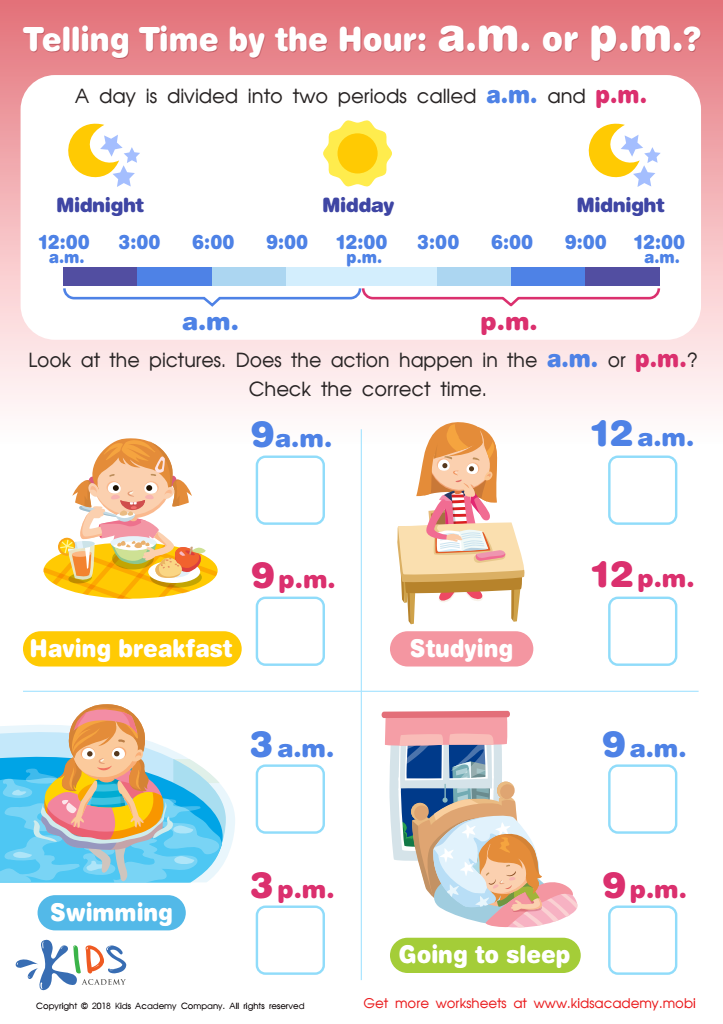
Tilling Time by the Hour: a.m. or p.m.? Worksheet
Can your child tell the time? This worksheet will help them learn. Explain a.m and p.m. and look at the pictures together. Ask your child if the activities happen in the a.m or p.m and help them check the correct time.
 Assign to My Students
Tilling Time by the Hour: a.m. or p.m.? Worksheet
Worksheet
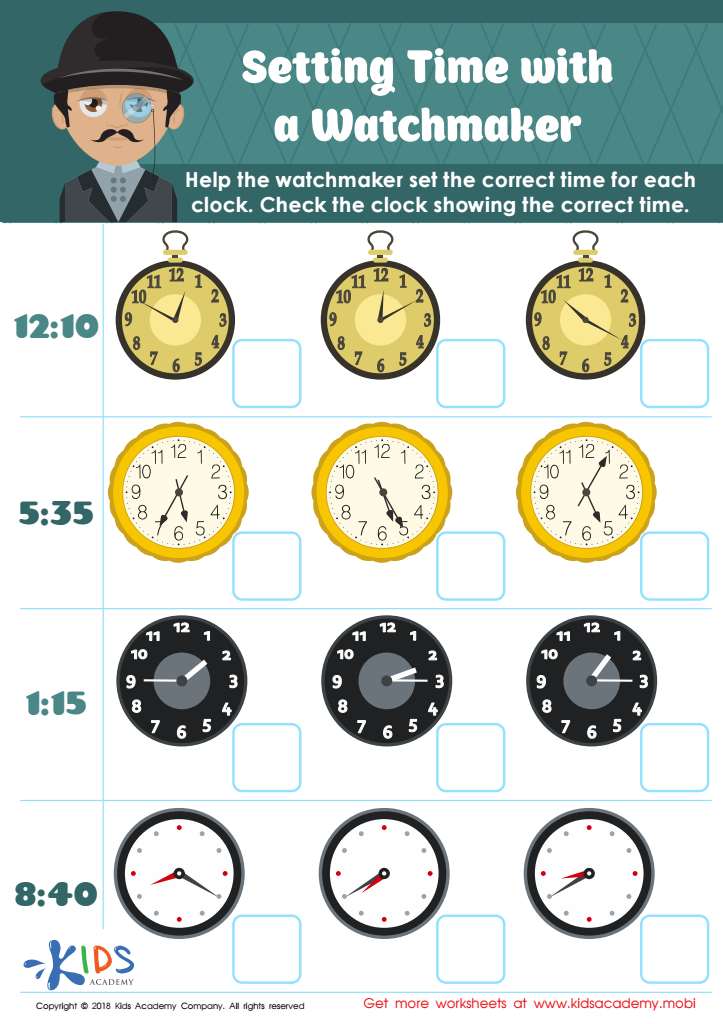
Setting Time with Watchmaker Worksheet
Can your kids tell the time? If so, this worksheet should be easy. Help them set the time for each clock: look at the time written on the left side and find the clock on the right side that matches.
Setting Time with Watchmaker Worksheet
Worksheet
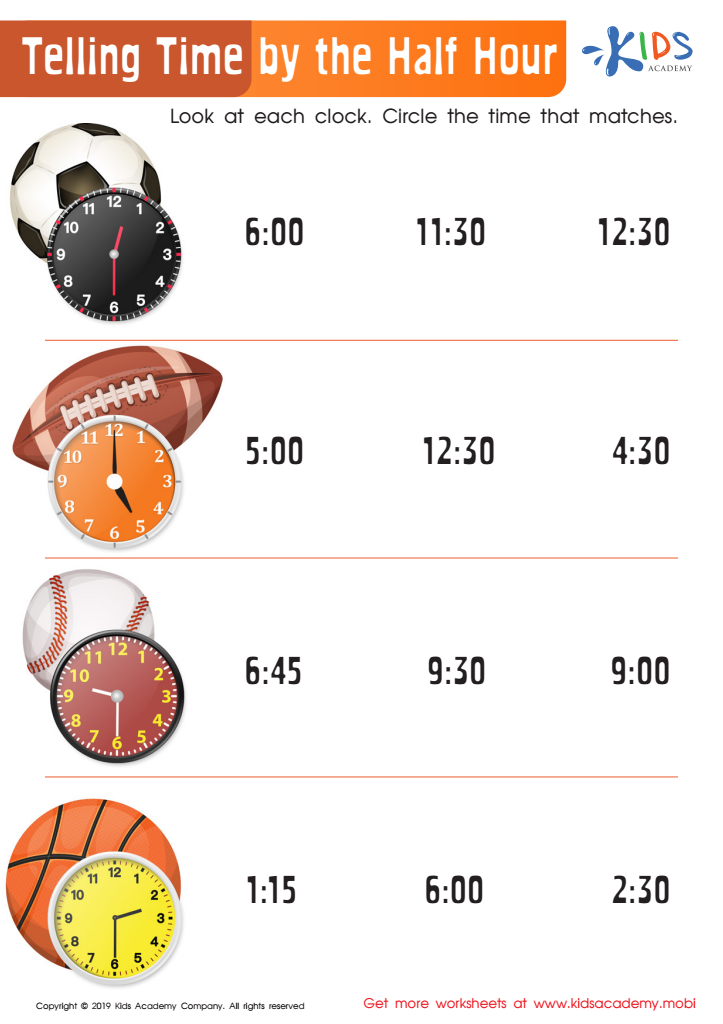
Telling Time by the Half Hour Worksheet
Teach kids to tell time with this worksheet! Four clocks are labeled with different times; help your child circle the right one. It's a great way to teach them to read analog and digital clocks, watches, and written times. Easy and fun learning!
Telling Time by the Half Hour Worksheet
Worksheet
Join Kids Academy for Free
Who is primarily going to use this learning content?







Teaching children to read analog clocks is crucial for several reasons. At ages 4-7, children are developing foundational math skills and cognitive abilities. Understanding analog clocks reinforces essential concepts such as time measurement, which is fundamental in everyday life. It helps children grasp concepts like hours, minutes, and the passage of time, which is vital for routine activities, school schedules, and social interactions.
Moreover, learning to read analog clocks cultivates critical thinking and problem-solving skills. Children must analyze the position of the hands, improve their focus, and enhance spatial awareness, all of which contribute to overall cognitive development. Analog clocks also promote interactivity: unlike digital clocks, which can be presented passively, analog clocks engage children in active learning as they visually interpret the clock's face.
In addition, learning to read an analog clock fosters independence and self-regulation—as children begin to manage their own time. This can translate into improved organizational skills that benefit them in school and later in life. Overall, encouraging children to learn this skill not only enriches their mathematical experiences but also equips them with necessary life skills for time management, responsibility, and awareness.








