
Time recognition Normal Math Worksheets for Ages 4-7
5 filtered results
Difficulty Level
Grade
Age
-
From - To
Subject
Activity
Standards
Welcome to our "Time Recognition Normal Math Worksheets" designed specifically for children aged 4-7! These engaging worksheets help young learners grasp the concept of time through fun activities and colorful graphics. With a focus on clock recognition and understanding daily routines, your child will master essential skills like reading analog and digital clocks. Each worksheet features age-appropriate exercises that foster critical thinking and improve mathematical understanding. Available for easy printing, these resources are perfect for home or classroom learning, making them an invaluable tool for early education. Start your journey to time mastery today and watch your child's confidence soar!
Favorites
With answer key
Interactive
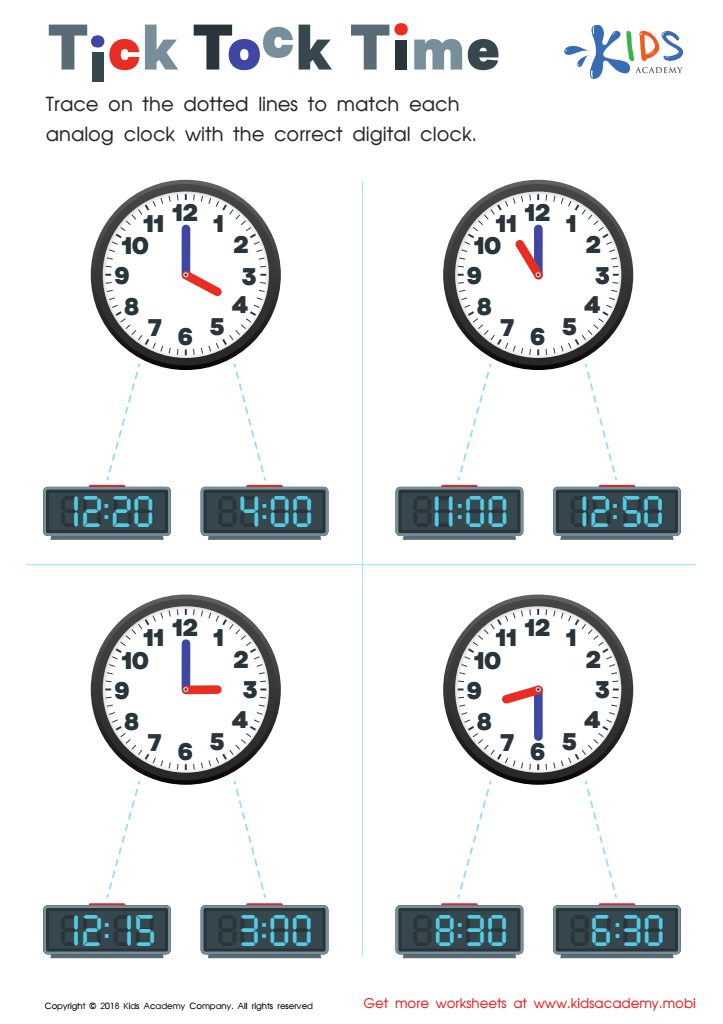
Tick Tock Time Worksheet
Trace the dotted lines on this worksheet to match analog and digital clocks! It's a great way to help your kids learn time-telling. They'll get better at converting analog to digital, and vice versa. Get your children to try it - it's a fun way to practice!
 Assign to My Students
Tick Tock Time Worksheet
Worksheet
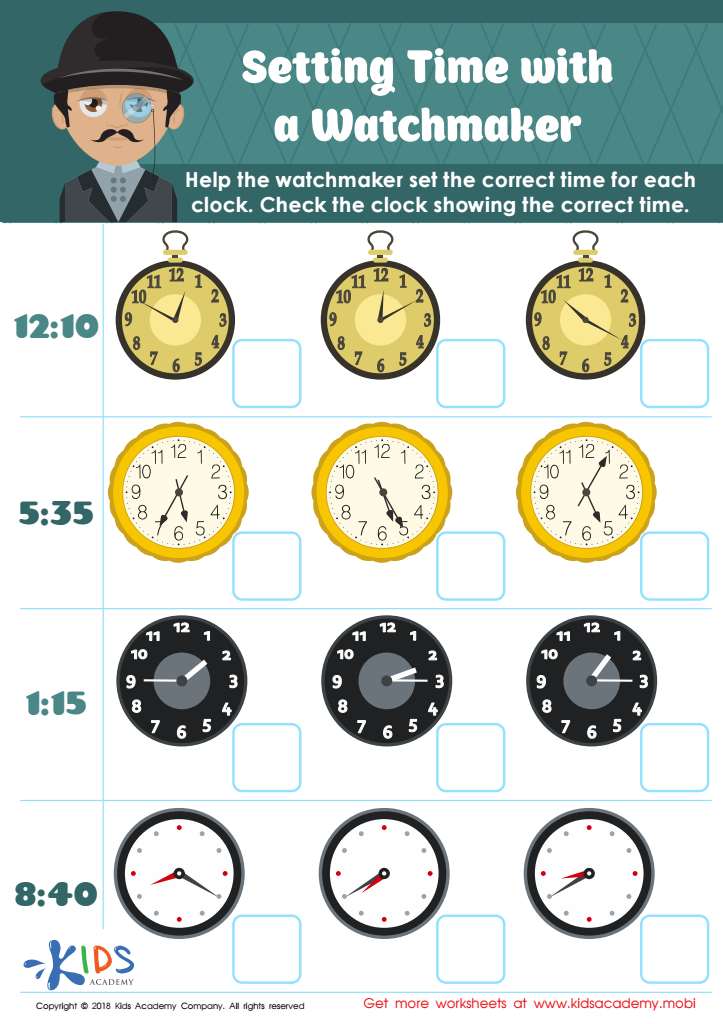
Setting Time with Watchmaker Worksheet
Can your kids tell the time? If so, this worksheet should be easy. Help them set the time for each clock: look at the time written on the left side and find the clock on the right side that matches.
Setting Time with Watchmaker Worksheet
Worksheet
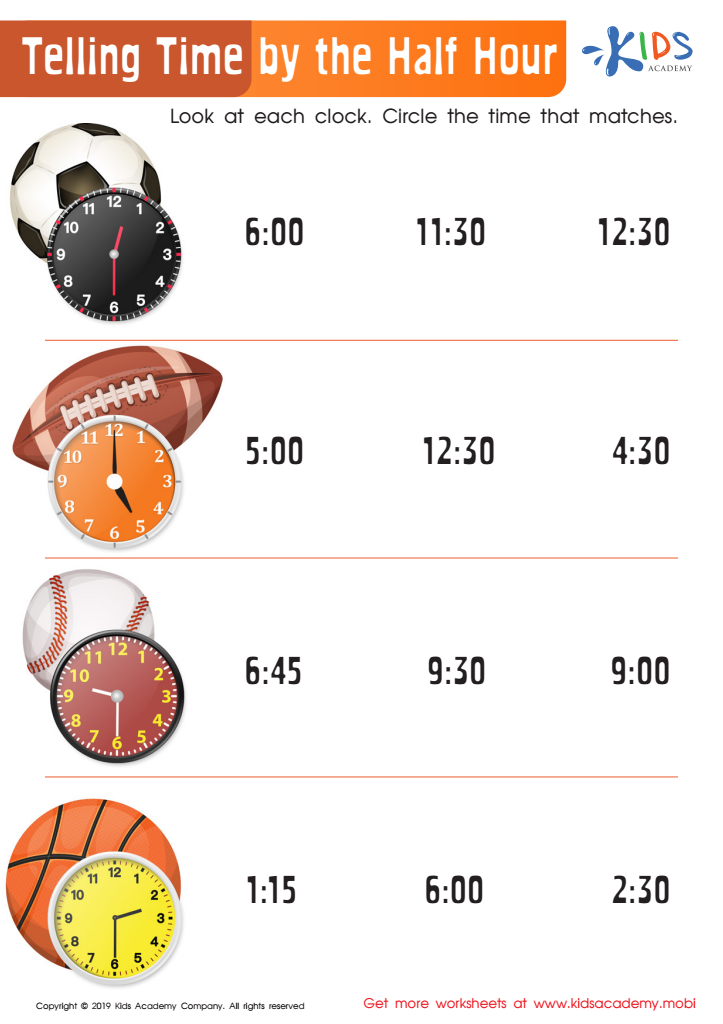
Telling Time by the Half Hour Worksheet
Teach kids to tell time with this worksheet! Four clocks are labeled with different times; help your child circle the right one. It's a great way to teach them to read analog and digital clocks, watches, and written times. Easy and fun learning!
Telling Time by the Half Hour Worksheet
Worksheet
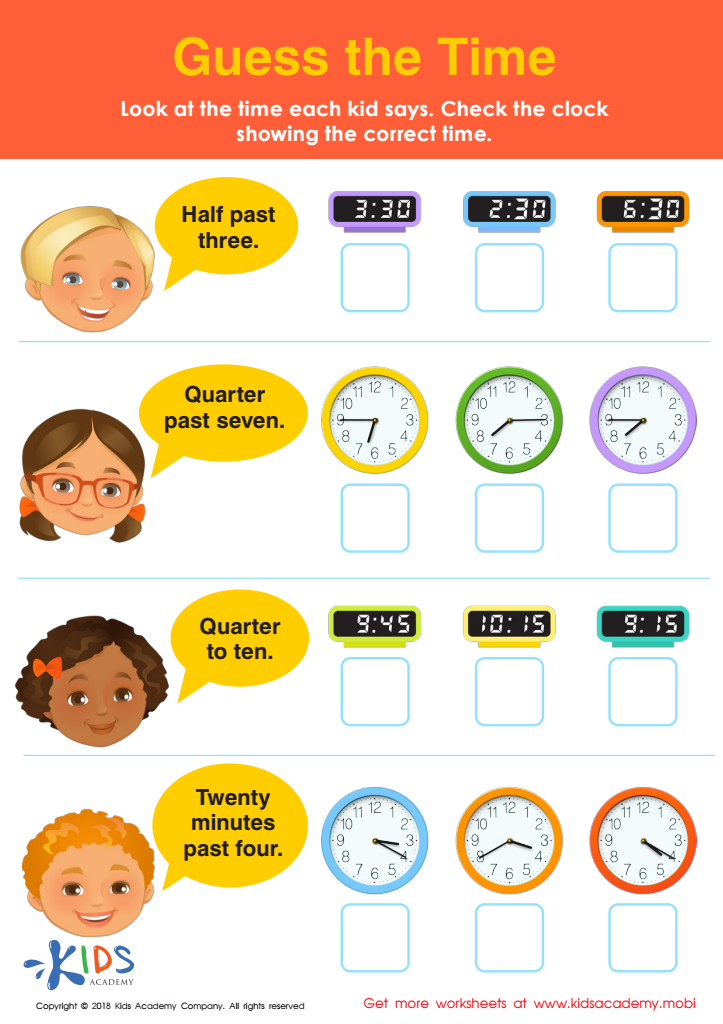
Guess the Time Worksheet
Help students tell the time accurately with this fun exercise. Read the time each person says and find the corresponding clock. Check the options on the left and have students guess the right time. This worksheet is sure to sharpen their time-telling skills.
Guess the Time Worksheet
Worksheet
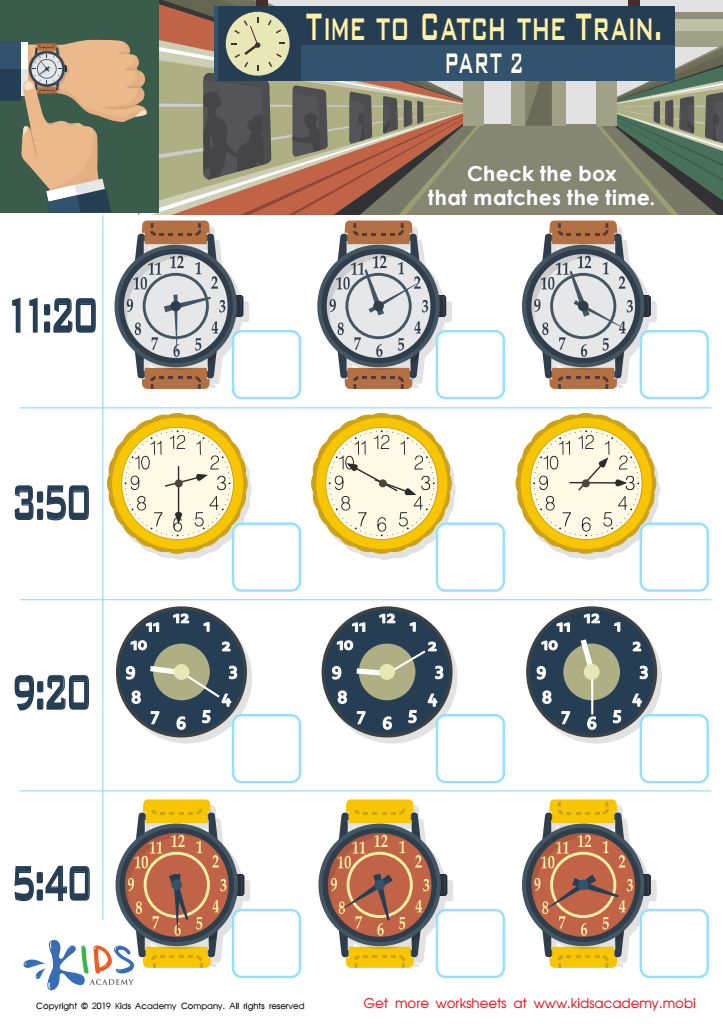
Time to Catch the Train Part 2 Worksheet
Teach your kids the importance of telling time and how to do it. Explain that there are multiple ways to show the time, such as written on the left side or watches in the picture. Guide them to check the box that matches the time. Knowing the time is essential to get things done and create order. Ensure your kids understand this and they will reap the benefits.
Time to Catch the Train Part 2 Worksheet
Worksheet
Join Kids Academy for Free
Who is primarily going to use this learning content?






Time recognition and understanding are essential skills for children aged 4-7, forming the foundation for their mathematical and cognitive development. First, time awareness helps children establish routines, promoting self-discipline and responsibility. Grasping concepts such as hours, minutes, and daily schedules helps them understand the flow of their day, enhancing their ability to plan and anticipate activities.
Additionally, learning to recognize and read clocks engages critical thinking skills. It fosters problem-solving abilities—children learn to estimate how long tasks will take, calculate time intervals, and relate time to events. These skills extend beyond math; they’re applicable in everyday life, such as managing homework, preparing for events, or even getting ready for school.
Furthermore, time recognition serves as a bridge to understanding other mathematical concepts. It introduces them to patterns and sequences, laying the groundwork for more complex subjects such as addition and subtraction.
For parents and teachers, fostering these skills is crucial for academic success and building confidence. Encouraging time-related activities, like using a clock for timing games or counting down to an event, makes learning engaging and helps children develop practical life skills. Investing time in this foundational subject ultimately benefits a child’s overall development and daily functioning.








