
Understanding multiplication Normal Math Worksheets for Ages 4-8
3 filtered results
Difficulty Level
Grade
Age
-
From - To
Subject
Activity
Standards
Discover the joy of learning multiplication with our “Understanding Multiplication Normal Math Worksheets” tailored for children ages 4-8. These engaging worksheets provide clear and interactive exercises designed to introduce young learners to basic multiplication concepts. Through visual aids, fun illustrations, and practical exercises, children can explore multiplication in a stress-free environment. Our carefully crafted activities not only reinforce early math skills but also encourage critical thinking and problem-solving. Ideal for classrooms or at-home learning, these worksheets make mastering multiplication enjoyable while laying a solid foundation for future math success. Start your child's multiplication journey today with our vibrant and effective resources!
Favorites
With answer key
Interactive
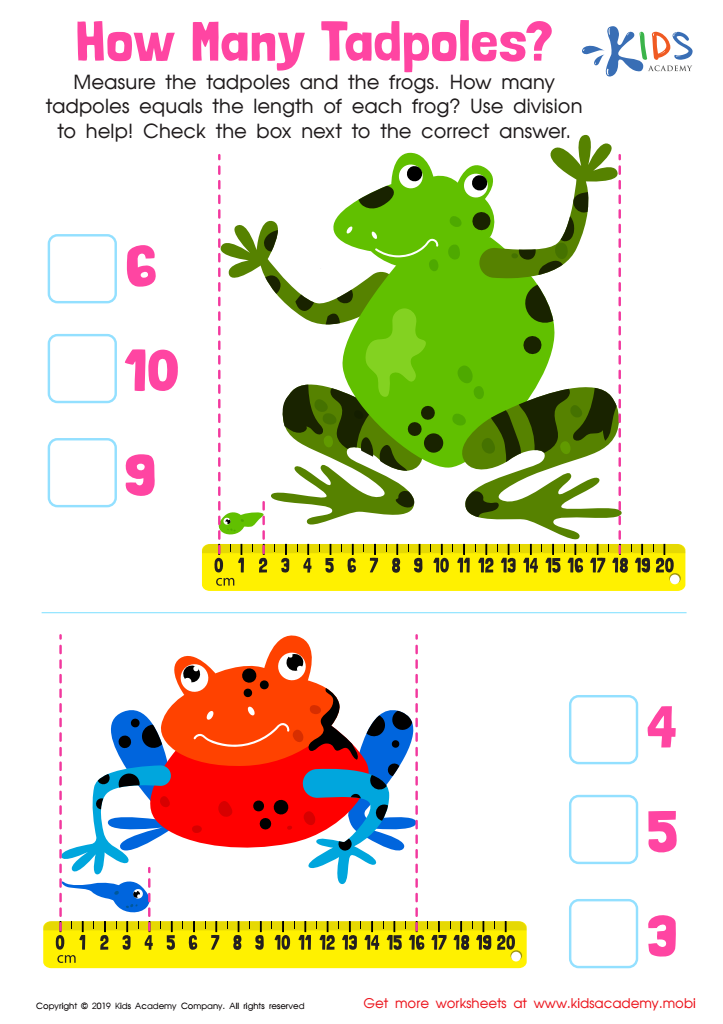
How Many Tadpoles Worksheet
Kids love tadpoles! They'll have fun using them to work out the measurements of their frog friends. By dividing the length of the frogs by the length of the tadpoles, children can deduce how many tadpoles it takes to equal a frog. With the use of 'how many' and 'each' they'll solve math problems without realizing it!
 Assign to My Students
How Many Tadpoles Worksheet
Worksheet
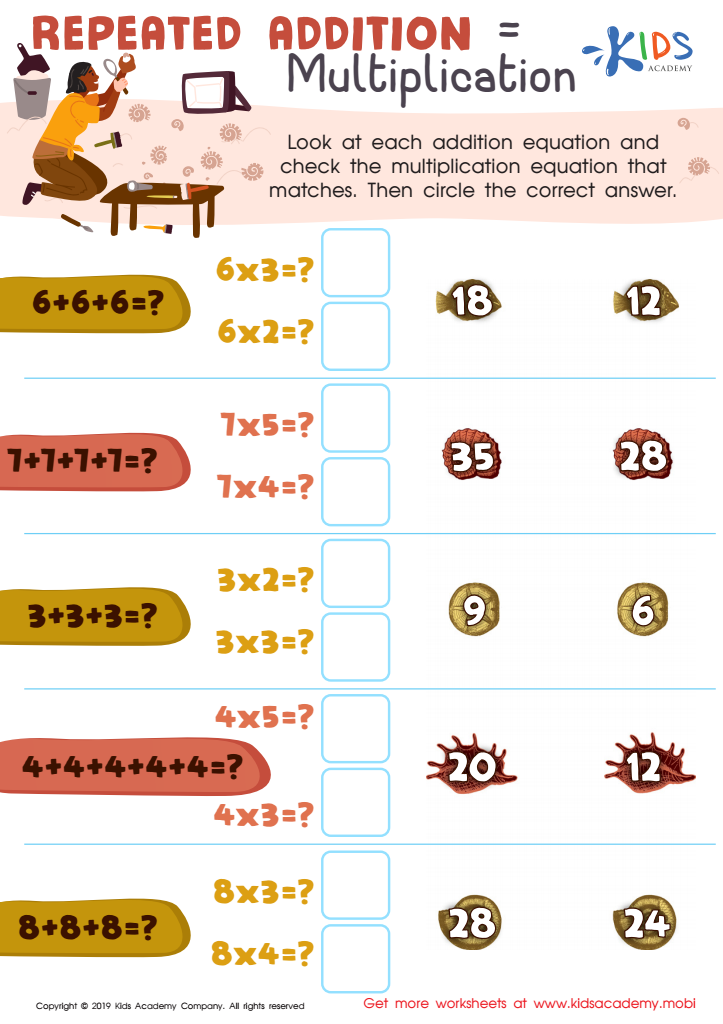
Repeated Addition = Multiplication Worksheet
If your child is having trouble with math, worksheets like this can help them get more practice. Addition, subtraction, and multiplication go together. Look over each addition equation and pick the matching multiplication equation, then circle the correct answer. This can give your child the necessary practice to understand mathematics better.
Repeated Addition = Multiplication Worksheet
Worksheet
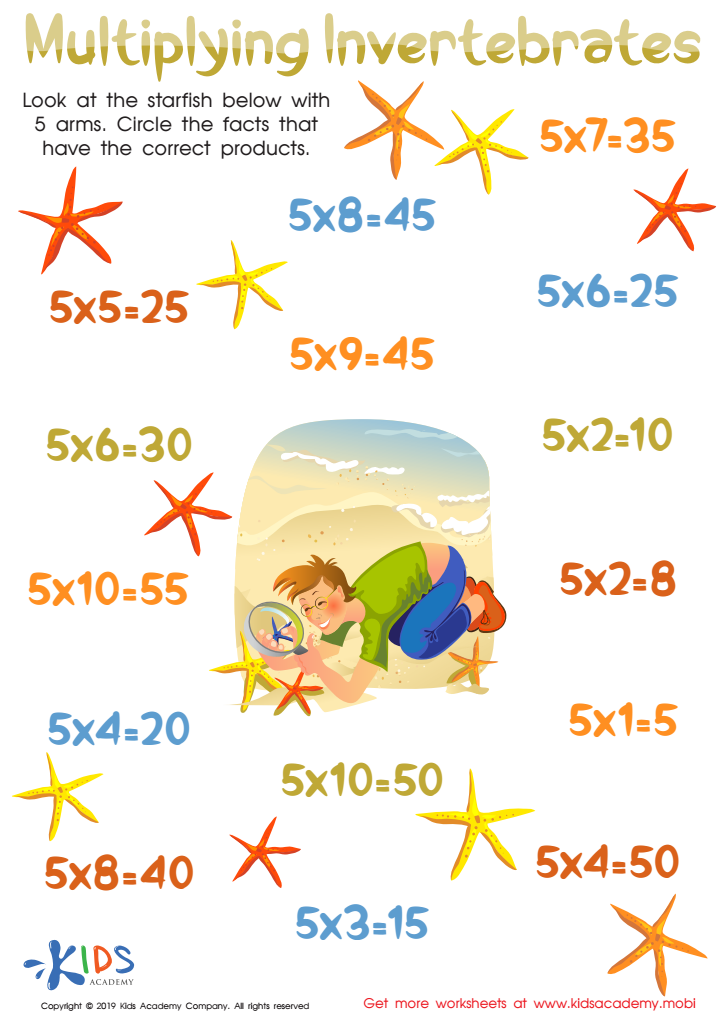
Multiplying Invertebrates Worksheet
Explain to your kids an invertebrate is an animal without a backbone. Examples: squid, jellyfish, octopus. Now, look at the starfish in the picture and help your kids circle the correct facts.
Multiplying Invertebrates Worksheet
Worksheet
Join Kids Academy for Free
Who is primarily going to use this learning content?




.jpg)

Understanding multiplication at an early age is crucial for children's mathematical development. For children aged 4-8, foundational concepts in math, including multiplication, create a building block for more complicated mathematical operations in later years. Learning multiplication enhances cognitive skills, problem-solving abilities, and logical reasoning.
Parents and teachers should care because introducing multiplication through engaging methods at this age can spark enthusiasm and a positive attitude towards math. This is the period when children form attitudes about their mathematical abilities. Early exposure, using visual aids, games, and storytelling, helps contextualize multiplication, making it relevant and relatable.
Furthermore, mastering multiplication tables aids memory retention and prepares children for more complex math such as division and fractions. Recognizing patterns in multiplication also meets various learning styles, catering to visual, auditory, and kinesthetic learners.
Teaching multiplication basics plants the seeds for future benchmark assessments and standardized testing importance. Ultimately, a strong foundation in multiplication not only empowers children academically but also instills confidence in their abilities, equipping them with skills that extend beyond the classroom. It's not just about learning numbers; it’s about fostering a love for learning and developing a strong mathematical mindset.








