Shape Recognition Normal Community Worksheets for Ages 4-8
4 filtered results
-
From - To
Unlock your child's potential with our Shape Recognition Community Worksheets, perfect for ages 4-8. These engaging and educational printables introduce young learners to essential geometric shapes through activities linked to everyday community objects. Watch as they explore their surroundings while mastering these foundational skills in a fun, comprehensive way. Our expertly designed worksheets foster early cognitive development and visual-spatial awareness, allowing kids to confidently recognize shapes. Ideal for parents and educators alike, these resources seamlessly blend learning and play to create a joyful educational experience for your child. Ignite curiosity and shape the future with our unique worksheets!
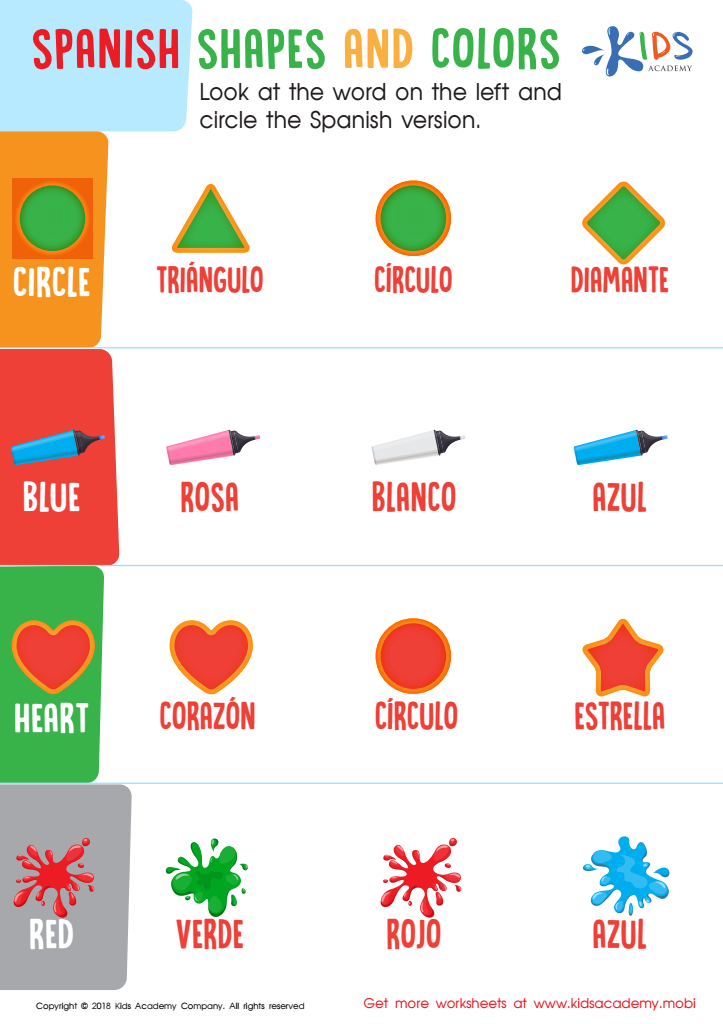
Spanish Shapes and Colors Worksheet
 Assign to My Students

Let's Check! Assessment Worksheet

Playground Worksheet

Take a Look - Part 1 Worksheet








Understanding shape recognition is crucial for children aged 4-8 as it lays the groundwork for various cognitive and mathematical achievements. This developmental milestone goes beyond mere ability to identify and name shapes; it forms the basis for future skills in geometry, spatial awareness, and problem-solving.
Shape recognition enhances a child's visual perception, allowing them to understand how different forms combine to create patterns and structures. This understanding is fundamental not just in mathematics, but in everyday contexts like reading and interpreting information. For instance, recognizing the difference between a square and a rectangle helps children differentiate letters and numbers, facilitating early literacy and numeracy.
Additionally, engaging with shapes supports fine motor development. Activities like drawing, tracing, and constructing shapes improve hand-eye coordination and dexterity, essential for tasks like writing. Socially, shape activities can encourage collaborative play, fostering essential interpersonal skills like cooperation and communication.
Therefore, parents and teachers should prioritize shape recognition. By integrating fun, hands-on activities, such as puzzles, drawing exercises, and interactive games, they can stimulate children's curiosity and support their holistic development. Investing in shape recognition now equips children with the foundational tools important for academic success and everyday problem-solving skills.