
Science knowledge application Normal Worksheets for Ages 5-7
3 filtered results
Difficulty Level
Grade
Age
-
From - To
Subject
Activity
Standards
Unlock your child's potential with our "Science Knowledge Application Normal Worksheets for Ages 5-7". Designed to ignite curiosity, these engaging worksheets fuse learning with fun, covering essential topics like plants, animals, weather, and more. They foster critical thinking and problem-solving skills through hands-on activities and simple experiments. Perfect for classrooms or home study, our worksheets align with educational standards to support science learning in a structured yet enjoyable format. Watch young minds thrive as they explore the wonders of science, building a strong foundation for future academic success. Download now and start the learning adventure today!
Favorites
With answer key
Interactive
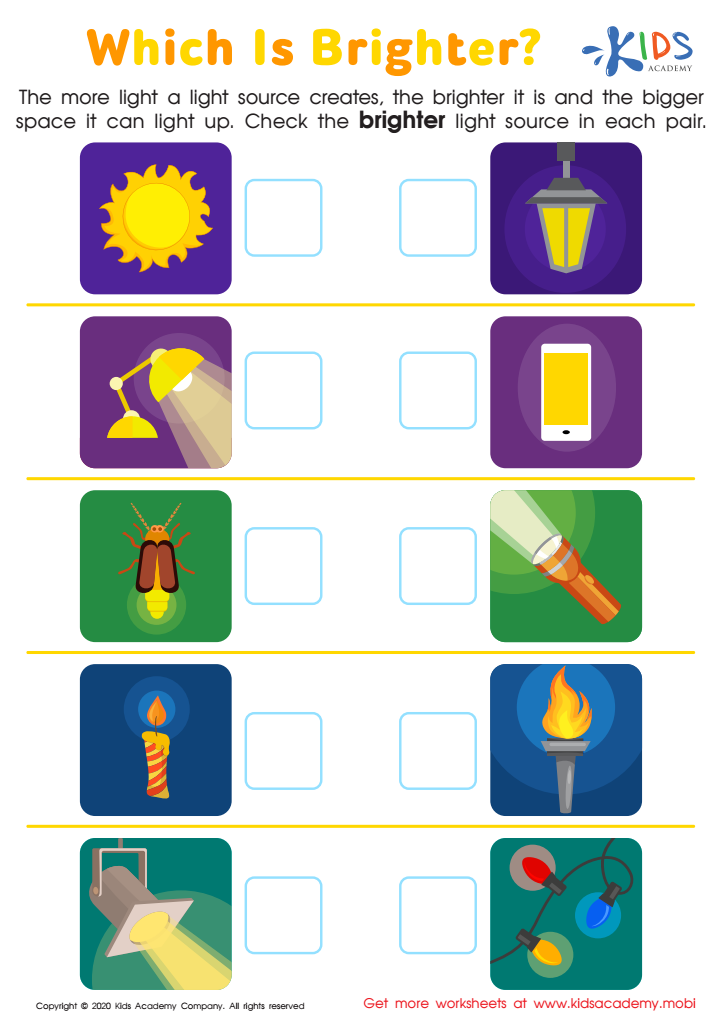
Which Is Brighter? Worksheet
Before the exercise, ask students to recall sources of light. Use this worksheet to explain that the brighter the light source, the more space it can light up. Identify the different light sources in the pictures, then check the brighter light source in each pair. The biggest natural source of light is the sun.
 Assign to My Students
Which Is Brighter? Worksheet
Worksheet
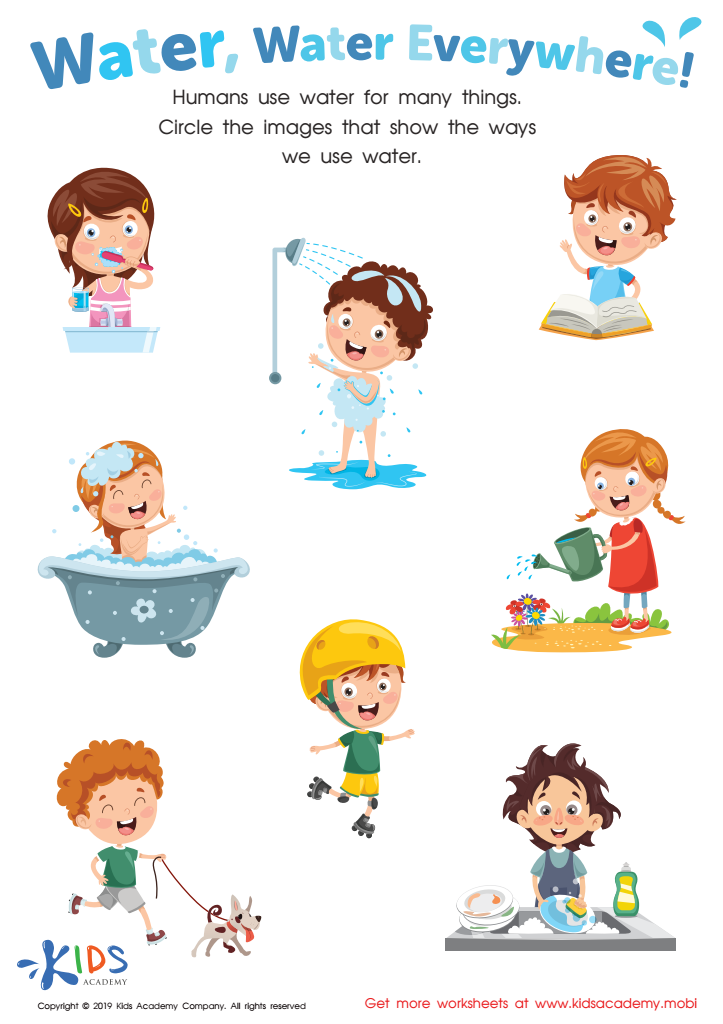
Water, Water Everywhere! Worksheet
Ask your kids how we use water daily. Point out how vital it is to the environment, as many living things couldn't exist without it. Show them this worksheet with kids doing different things that involve water. Ask them to identify what each one is doing, then help them circle the images which show the ways we use the water.
Water, Water Everywhere! Worksheet
Worksheet
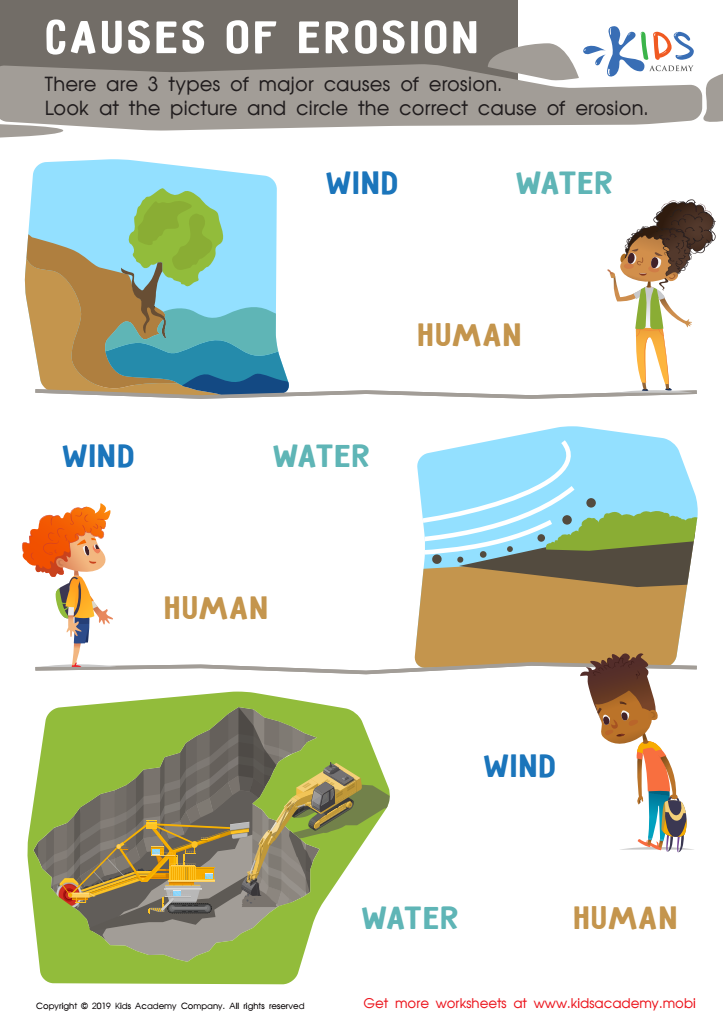
Causes of Erosion Worksheet
Earth is a habitable planet for humans and all life forms, providing us with what we need to survive. However, erosion caused by air, water or man can destroy or crumble parts of its surface. Teach kids the three causes of erosion and help them circle the correct one on a worksheet.
Causes of Erosion Worksheet
Worksheet
Join Kids Academy for Free
Who is primarily going to use this learning content?







The application of science knowledge is crucial for children aged 5-7 because it lays the foundation for lifelong learning and critical thinking. At this early age, children's brains are extraordinarily receptive to exploring the world around them. By introducing basic scientific concepts, parents and teachers foster natural curiosity, encouraging children to ask questions, observe, and experiment.
Building an interest in science early on has been shown to have multiple benefits. It develops essential problem-solving skills as children learn to hypothesize and recognize cause and effect. Understanding science also strengthens their ability to think logically and critically, enabling them to approach challenges in structured and creative ways. Moreover, science education instills a sense of wonder and the drive to discover ‘why’ and ‘how’, keeping their imaginations lively and active.
Incorporating science at a young age also supports other areas of learning. For example, measuring and mixing during a simple experiment can enhance math skills, while documenting observations can improve literacy. Science can be a method to integrate various disciplines, teaching children to view knowledge as interconnected.
Importantly, fostering a positive attitude towards science early helps to break stereotypes and build a diverse future workforce in STEM fields. By nurturing young scientists, parents and teachers can enable a future generation that is informed, curious, and capable of innovative thinking.








