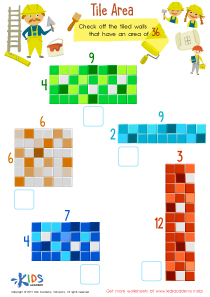
Understanding comparisons Normal Numbers Worksheets for Ages 5-8
3 filtered results
-
From - To
Discover a delightful way to help your child grasp the concept of number comparisons with our expertly designed worksheets for ages 5-8. These fun and engaging resources are crafted to enhance mathematical skills by encouraging young learners to compare quantities, identify greater and smaller numbers, and understand numerical order. Featuring vibrant illustrations and age-appropriate challenges, these worksheets make learning enjoyable and effective. Ideal for parents and teachers, they provide ample opportunities for practice, ensuring children build a strong foundational understanding of comparisons. Enhance your child’s numeracy skills today with our comprehensive number comparison worksheets.
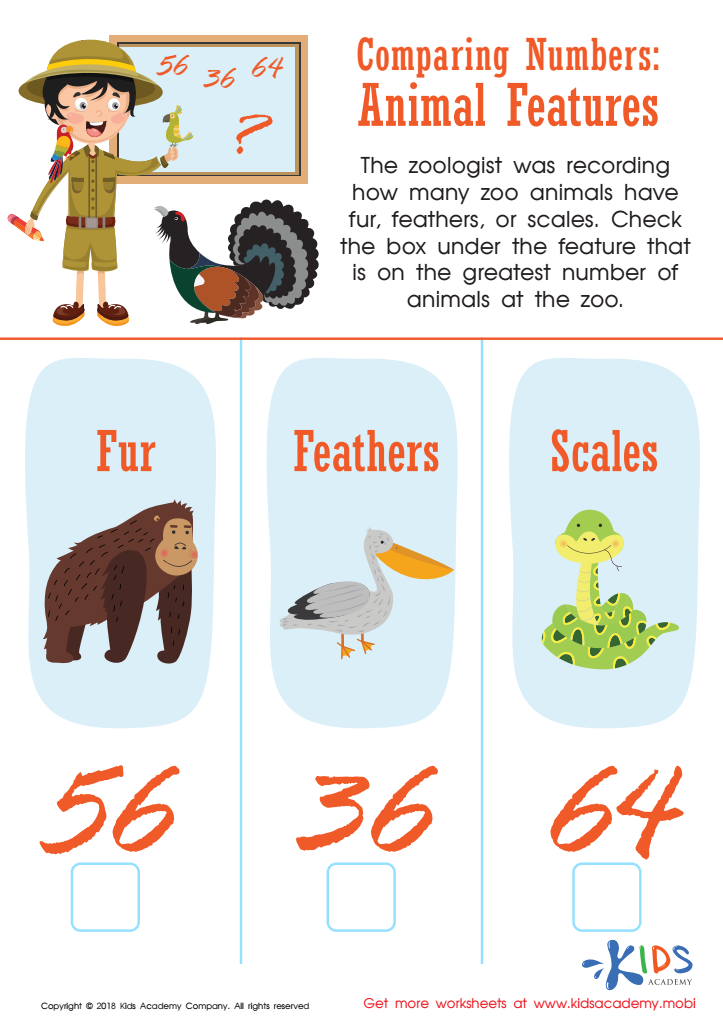
Animal Features Worksheet
 Assign to My Students
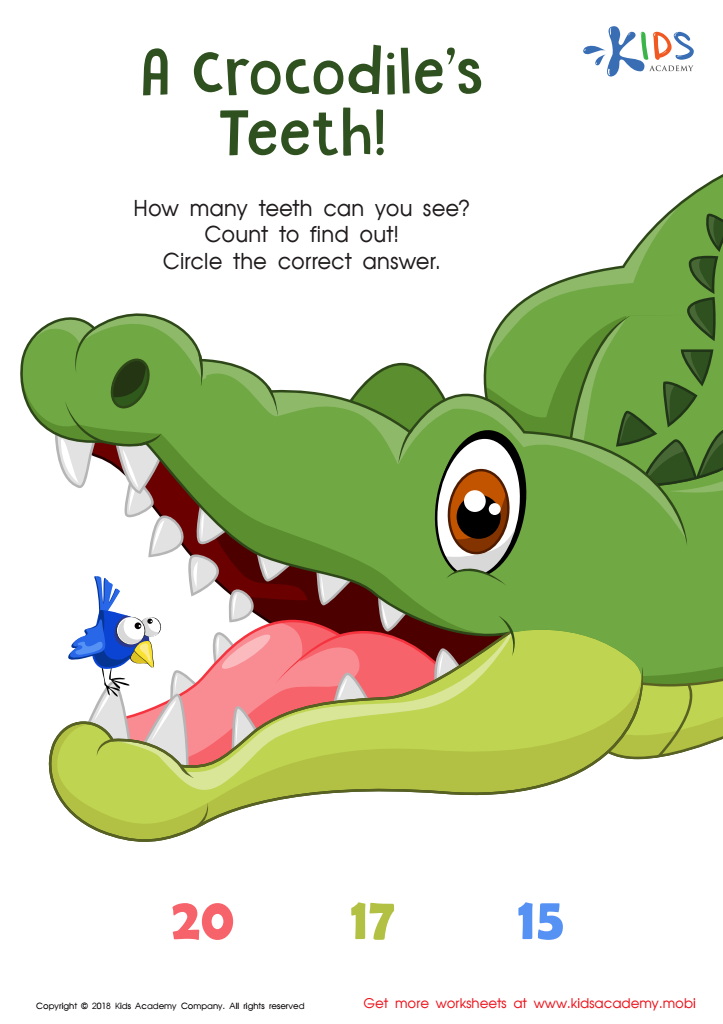
A Crocodile's Teeth Worksheet
Matching: Classifying Toys by Size Worksheet








Understanding comparisons and normal numbers for children aged 5-8 is a crucial step in early mathematics education for several compelling reasons. Firstly, comprehension of comparisons - such as recognizing which number is larger, smaller, equal, or different - lays the foundational cognitive skills for quantitative reasoning and problem-solving. It helps young learners to navigate everyday activities, such as counting objects, measuring distances, or recognizing patterns.
Secondly, familiarity with normal numbers, also known as cardinal numbers (1, 2, 3, etc.), allows children to engage fluently in more complex mathematical operations later in their education. These numbers are essential for basic arithmetic - addition, subtraction, multiplication, and division - enabling the gradual build-up of mathematical knowledge.
Moreover, grasping these concepts boosts a child’s self-esteem and confidence in their ability to understand and manipulate numbers, fostering a positive attitude towards mathematics. This is important because early math skills are strong predictors of later academic achievement, not just in STEM fields but across all disciplines.
Teachers and parents play a pivotal role in ensuring that children develop these skills through playful learning, engaging activities, and appropriate challenges. This nurturing environment helps instill a love for learning and a curiosity about how the world works, which are vital for lifelong education success.