Understanding base ten Normal Math Worksheets for Ages 5-9
3 filtered results
-
From - To
Discover our engaging "Understanding Base Ten Normal Math Worksheets" designed for children ages 5-9! These worksheets take young learners on a fun journey to grasp the fundamentals of the base ten number system, fostering essential math skills. With colorful illustrations and interactive activities, kids will effortlessly learn to group objects, understand place value, and improve their counting abilities. Each worksheet is tailored to enhance critical thinking while keeping children entertained. Perfect for classroom or home use, our resources provide educators and parents with the tools needed to support their child's math development. Explore our collection and empower your child's learning today!
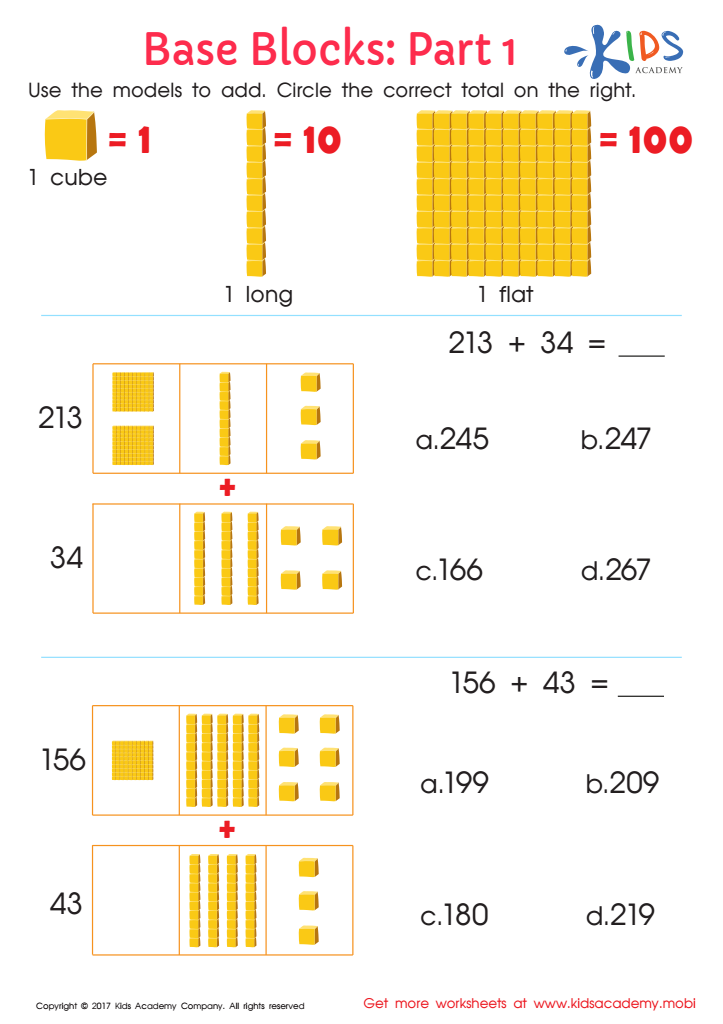
Base Ten Blocks Worksheet: Part 1
 Assign to My Students
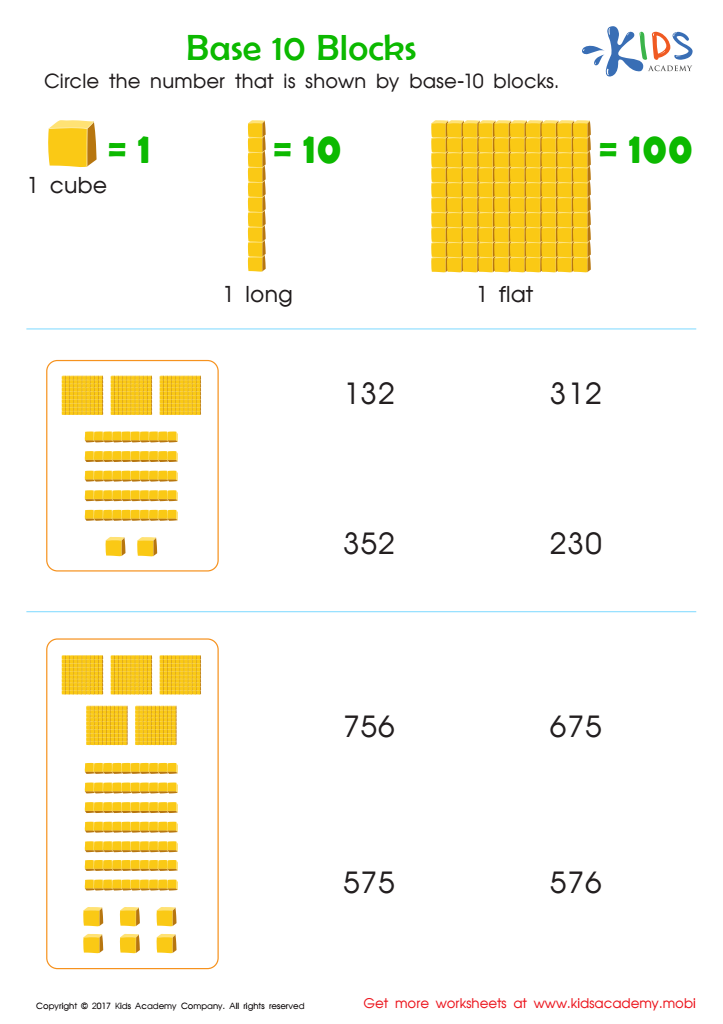
Base Ten Blocks Worksheet
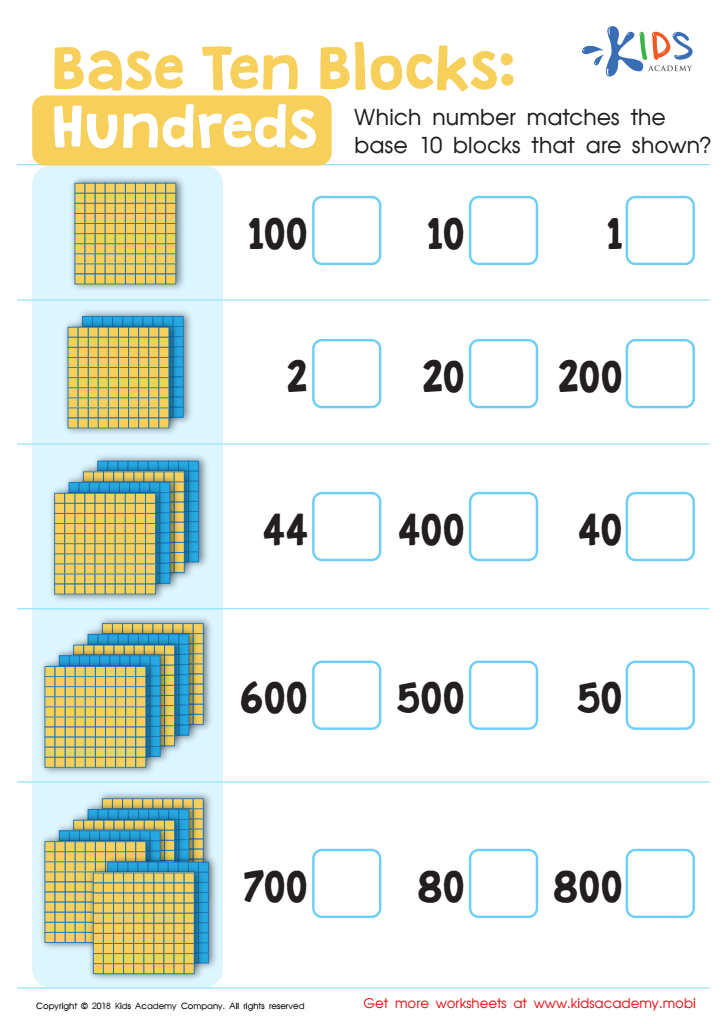
Base Ten Blocks: Hundreds Worksheet







Understanding base ten is crucial for students aged 5-9 as it forms the foundation for their future mathematical learning. Base ten introduces children to our numbering system, which relies on units, tens, hundreds, and so forth. Grasping this concept enhances their ability to perform arithmetic operations, leading to improved problem-solving skills and mathematical fluency.
Parents and teachers should care about this because strong early math skills correlate with later academic success. By familiarizing children with base ten concepts, such as place value and grouping, educators can help them develop essential skills for addition, subtraction, and ultimately, more complex operations.
Additionally, understanding base ten supports children in reasoning about numbers in real-life contexts, encouraging practical applications and critical thinking. When children comprehend how numbers function within the base ten system, they are better equipped to tackle word problems and spatial relationships, enhancing overall cognitive development.
Moreover, supporting children in mastering base ten concepts fosters confidence and a positive attitude toward math, reducing math anxiety. By investing time in early mathematical education focused on base ten, parents and teachers empower children, setting them on a path for lifelong learning and achievement in mathematics.








