
Letter formation Normal Tracing Letters Worksheets for Ages 6-7
3 filtered results
Difficulty Level
Grade
Age
-
From - To
Subject
Activity
Standards
Enhance your child's handwriting with our Letter Formation Normal Tracing Letters Worksheets, designed specifically for ages 6-7. Perfect for young learners, these worksheets provide engaging, age-appropriate practice to develop proper letter formation skills. With clear guides and ample tracing space, children will improve their fine motor skills and build confidence in writing. Ideal for classroom use or at-home practice, these printable worksheets make learning fun and effective. Help your child master the alphabet one letter at a time and pave the way for better writing skills with Kids Academy's tracing letters worksheets.
Favorites
With answer key
Interactive

Letter P Tracing Page
Trace the lines from the red dot to learn to write "P"! Then practice this letter with the fun activities: complete the word "Pig" and "Pumpkin". Check out Kids Academy to get more free ABC worksheets.
 Assign to My Students
Letter P Tracing Page
Worksheet
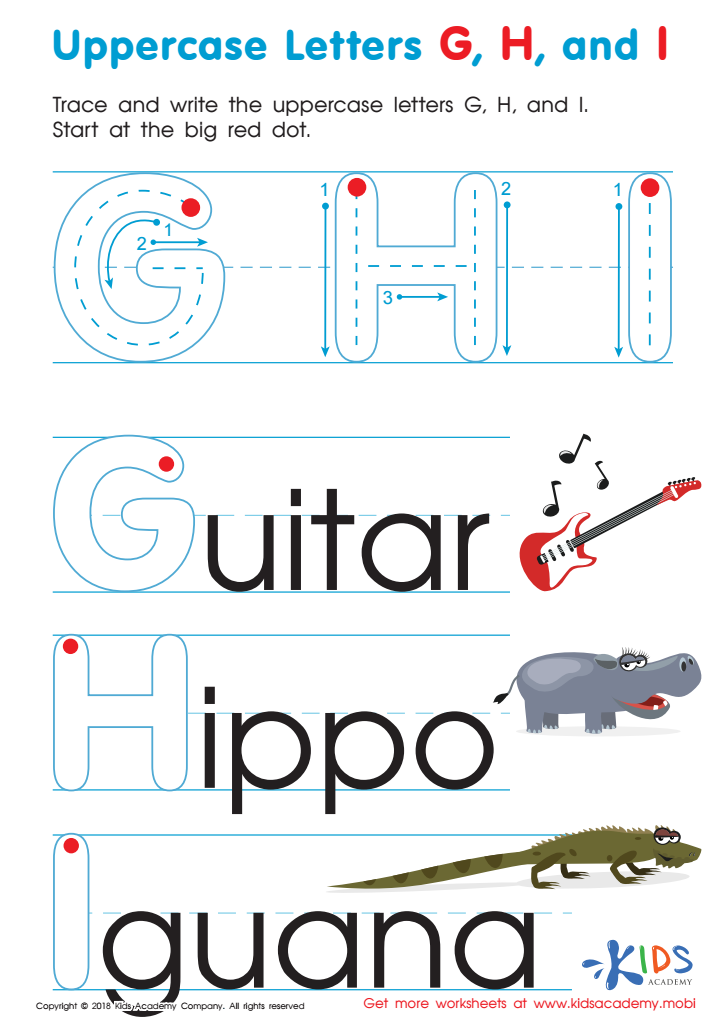
Uppercase Letters G, H, and I Worksheet
Trace each letter with the big red dot, connecting them to sounds as you go. Then write G to I. Congrats on a job well done! Rock on with a cute hippo and iguana while working on this delightful kindergarten worksheet!
Uppercase Letters G, H, and I Worksheet
Worksheet

Letter G Tracing Page
Get ready to trace the letter "G" – with a big red spot as the starting point, trace the lines and watch the letter appear. Uppercase and lowercase letters are both easy and fun to write. Give it a go and finish the word "go". Play the guitar and say "hello" to a funny ghost!
Letter G Tracing Page
Worksheet
Join Kids Academy for Free
Who is primarily going to use this learning content?







Letter formation is a fundamental skill essential for young learners, particularly those aged 6-7. At this developmental stage, children's fine motor skills are still being honed, and establishing proper letter formation can significantly enhance their reading and writing abilities. Normal tracing letters serve as valuable practice by providing visual and kinesthetic reinforcement of correct letter shapes, sizes, and orientations.
One primary reason parents and teachers should prioritize letter formation is that it lays the groundwork for legible handwriting. When children form letters correctly, it reduces confusion for both the writer and the reader, streamlining communication and reducing errors. Additionally, correct letter formation promotes cognitive development by reinforcing letter recognition, a key component in emerging literacy skills. As children become adept at forming letters, they divert less cognitive energy to the mechanics of writing and can better focus on composition and ideas.
Moreover, developing good habits early on helps prevent the need for corrective measures later. Relearning how to write correctly can be frustrating and time-consuming. Therefore, investing time in proper letter formation techniques, such as normal tracing letters, is crucial. This targeted practice builds confidence and a solid foundation for more advanced literacy skills, ultimately fostering a lifelong love for learning and effective communication.








