
Addition skills Normal Addition Facts Worksheets for Ages 6-7
3 filtered results
Difficulty Level
Grade
Age
-
From - To
Subject
Activity
Standards
Enhance your child's understanding of addition with our engaging Normal Addition Facts Worksheets designed specifically for ages 6-7. These worksheets focus on building foundational addition skills through a variety of exercises that make learning fun and effective. With colorful illustrations and interactive problems, children will enjoy practicing basic addition facts while developing confidence in their math abilities. The worksheets cater to different learning styles and ensure that young learners can grasp concepts at their own pace. Perfect for home use or in the classroom, our addition skills worksheets provide the ideal tools for fostering crucial numeracy skills in early learners. Start your child's math journey today!
Favorites
With answer key
Interactive
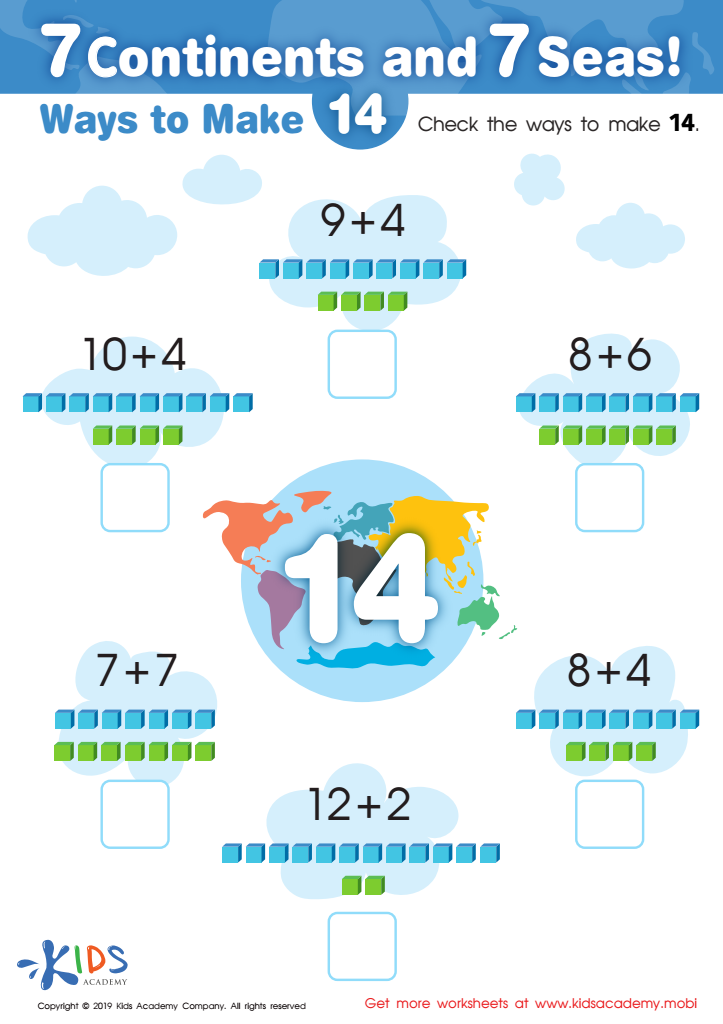
7 Continents and 7 Seas Worksheet
Remind kids of the continents and show them how different numbers can add up to the same figure. Give examples, like 2+2 =4, and 3+1 =4. Ask if they can provide other examples, then work through the simple additions in this worksheet with them. Ask them to circle all equations that make 14.
 Assign to My Students
7 Continents and 7 Seas Worksheet
Worksheet
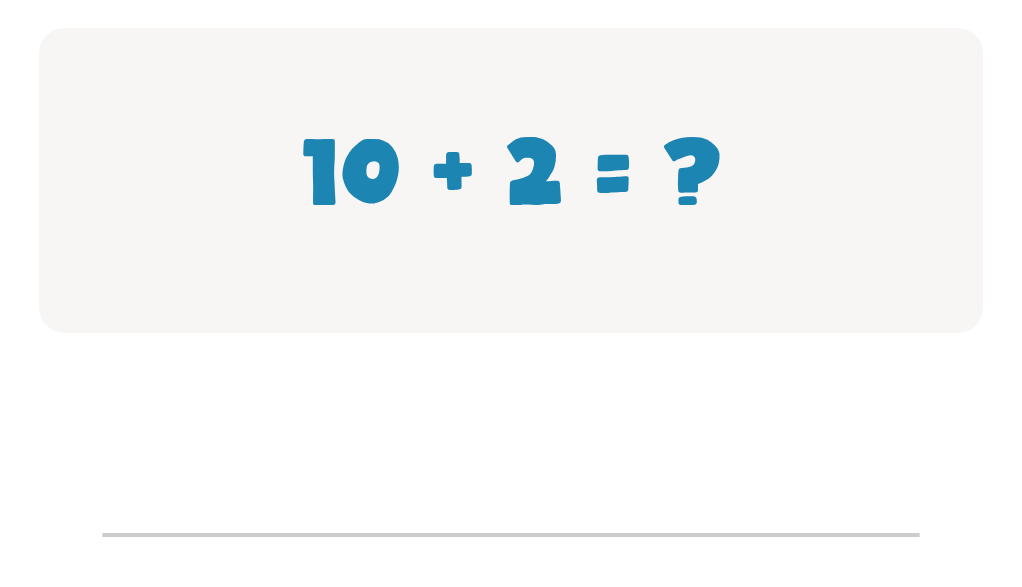

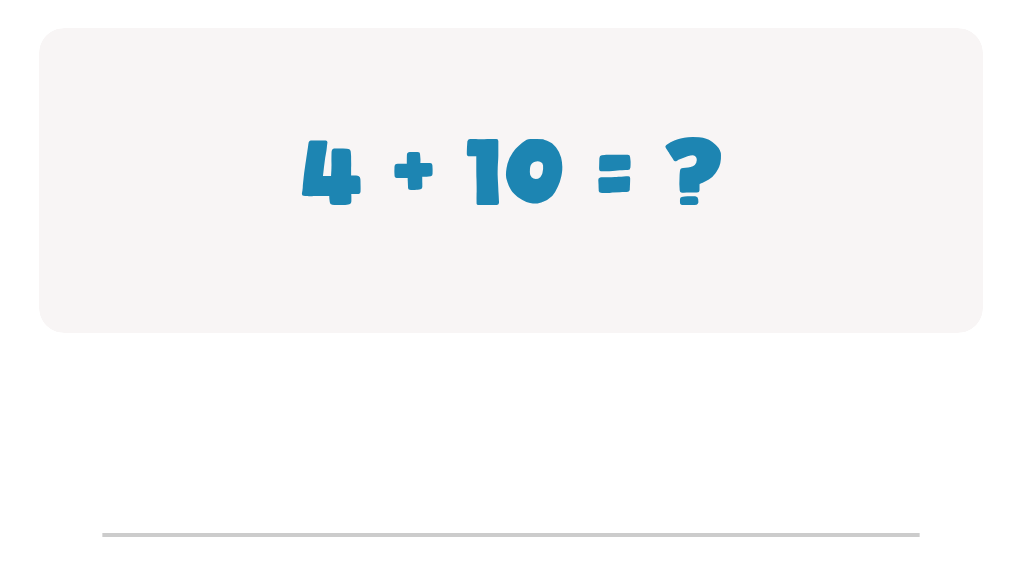
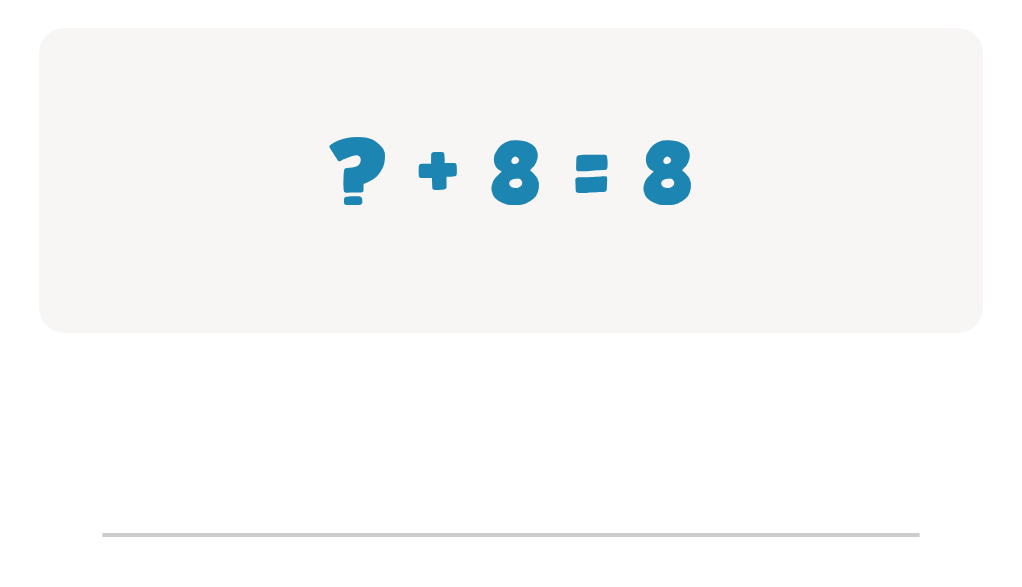

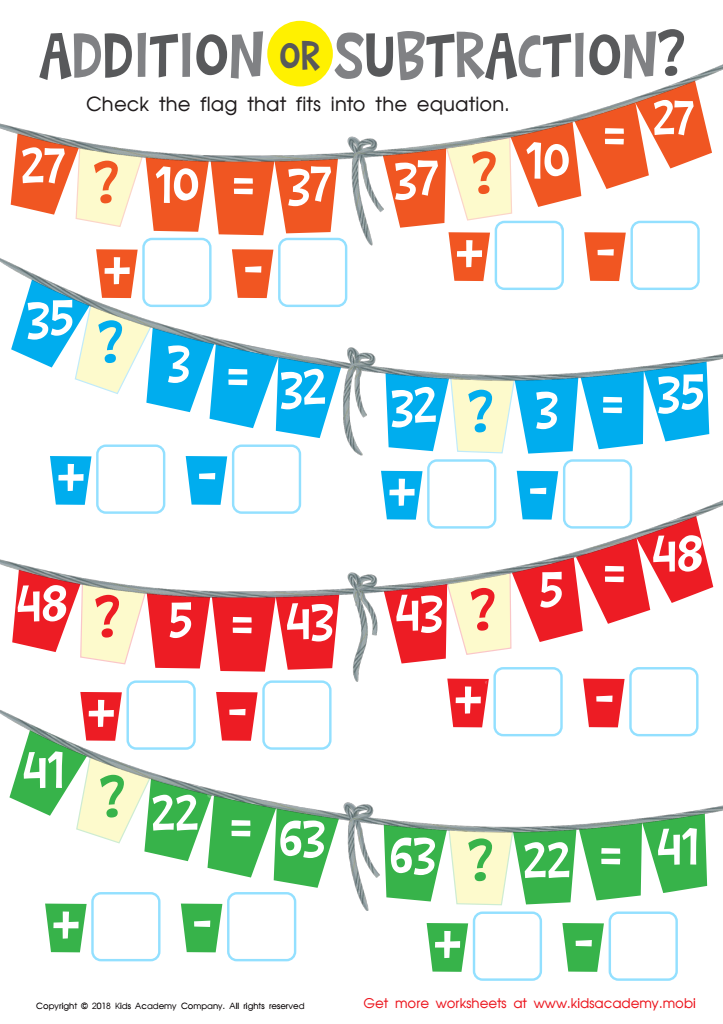
Addition or Subtraction? Worksheet
Help your math whiz's number skills advance with these colorful flag equations! With the free PDF, they'll learn to solve addition and subtraction facts by following the correct orders of operation. And the best part? They'll develop a deeper understanding of how the different operations work together within equations. Give it a try and watch their skills soar!
Addition or Subtraction? Worksheet
Worksheet
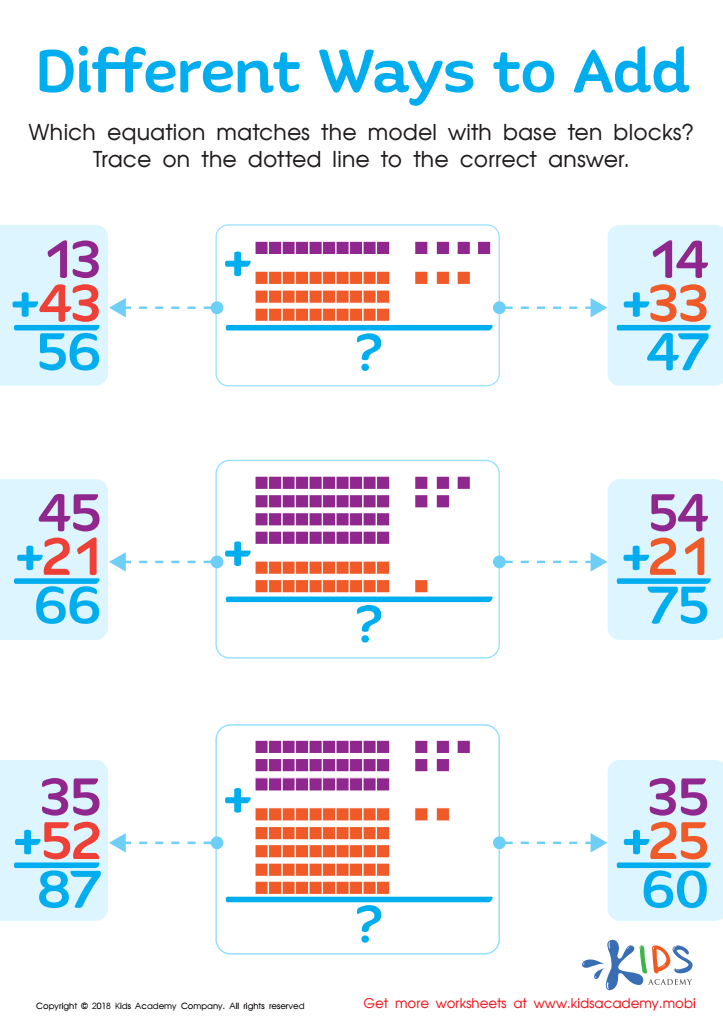
Different Ways to Add Worksheet
This worksheet enhances math skills by having students match equations to base ten pictures and tracing lines. It not only helps with fine motor skills, but also encourages number sense, with various ways to add and build upon existing math knowledge.
Different Ways to Add Worksheet
Worksheet
Join Kids Academy for Free
Who is primarily going to use this learning content?




.jpg)



Parents and teachers should prioritize the development of addition skills, particularly with normal addition facts for children ages 6-7, because these foundational abilities are crucial for academic success. Mastery of basic addition lays the groundwork for more complex mathematical concepts, such as subtraction, multiplication, and eventually, division. Children who struggle with foundational skills may find it increasingly difficult to cope with higher-level math as they progress through school.
Moreover, gaining fluency in addition facts boosts a child's confidence in their mathematical abilities. A solid grasp of these skills will enable them to tackle problem-solving challenges and understand mathematical relationships better. It also aids in everyday situations—like budgeting, cooking, and shopping—where basic addition is used repeatedly.
In addition to academic success, the development of addition skills significantly contributes to critical thinking skills and cognitive development. By helping children practice and internalize these facts, parents and teachers not only build their knowledge but also encourage a positive, curious attitude towards learning. Engaging activities, games, and repetition can make learning these skills enjoyable, reinforcing their effectiveness while fostering a sense of achievement. Investing in these skills at an early age sets a strong foundation for lifelong learning and problem-solving abilities.








