
Spatial awareness Normal Geometry Worksheets for Ages 6-7
3 filtered results
Difficulty Level
Grade
Age
-
From - To
Subject
Activity
Standards
Enhance your child's spatial awareness and geometry skills with our expertly crafted worksheets, targeted for ages 6-7. These engaging activities help young learners understand shapes, space, and their relations, through fun, educational exercises involving puzzles and various visual aids. Designed by educators, they support foundational math skills crucial for academic success in a fun and interactive manner. Encourage independent learning and problem-solving while nurturing an interest in geometry. Discover a wide array of free, printable resources at Kids Academy to help your child master essential spatial concepts confidently and effectively.
Favorites
With answer key
Interactive
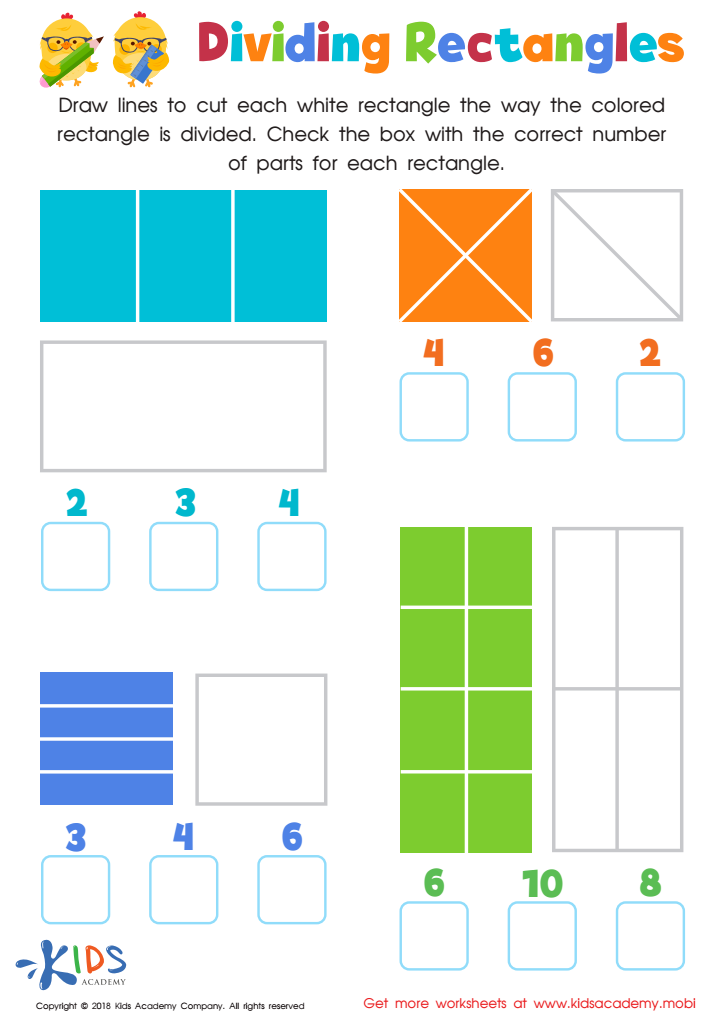
Dividing Rectangles Worksheet
Ask your child to draw lines to divide the white rectangles like the colored ones. Then, have them count the parts in each and choose the correct number. This worksheet will help them practice counting and dividing.
 Assign to My Students
Dividing Rectangles Worksheet
Worksheet











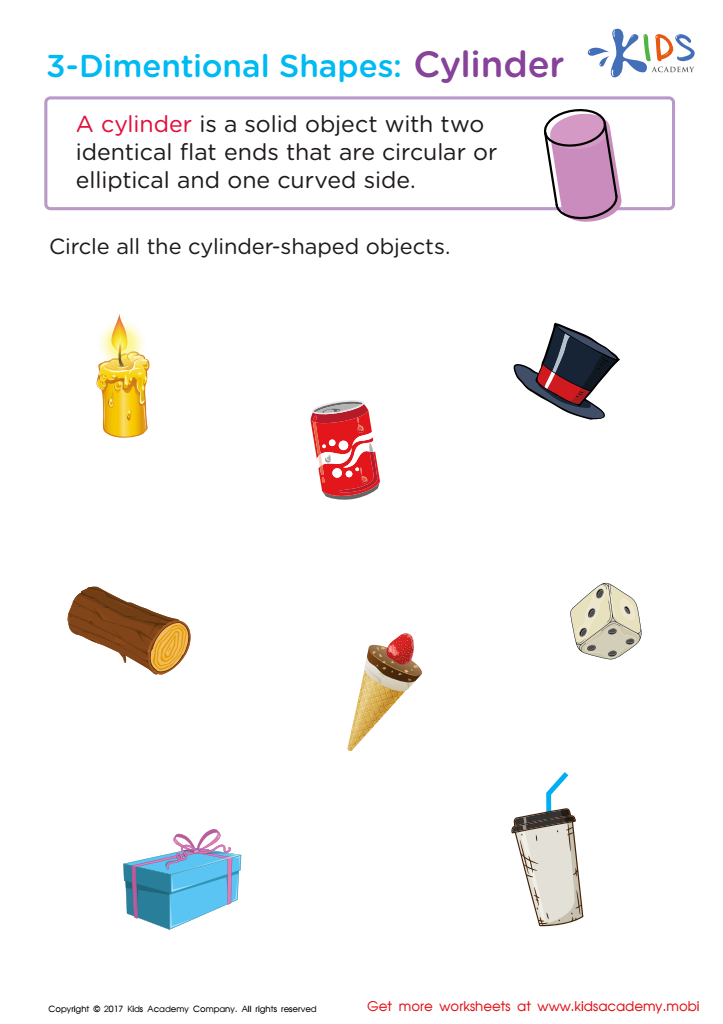
Three–Dimensional Shapes: Cylinder Worksheet
Introduce your toddler to geometry and 3D cylinders with this printable and watch their knowledge grow. It will help them recognize, define, and identify cylinders, as well as differentiate between 3D objects.
Three–Dimensional Shapes: Cylinder Worksheet
Worksheet
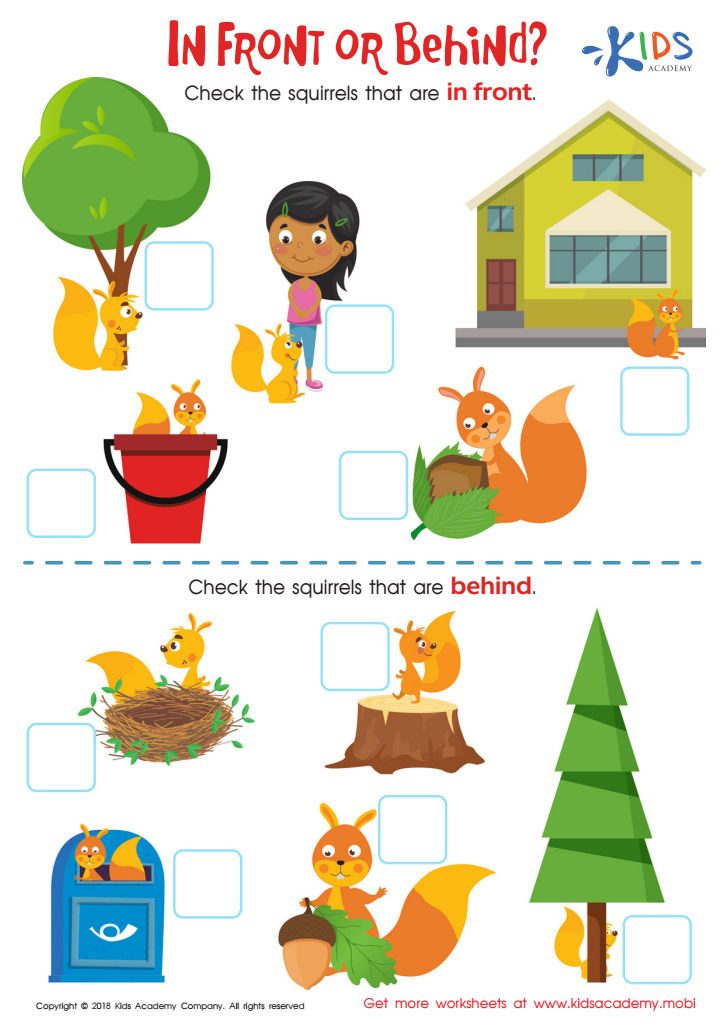
In Front or Behind: Part 2 Worksheet
Teach positional words "front" and "behind" with this fun worksheet! Students identify where the squirrel is in relation to the object - in front or behind. It's a great exercise to practice early geometry skills and understanding object movement.
In Front or Behind: Part 2 Worksheet
Worksheet
Join Kids Academy for Free
Who is primarily going to use this learning content?








Spatial awareness and geometry are foundational skills that significantly impact a child's cognitive development and everyday life abilities, especially around the ages of 6-7. At this stage, children are just beginning to understand and navigate the world around them. Spatial awareness helps them make sense of their surroundings by understanding objects' positions, dimensions, and relationships in space. This comprehension is crucial for everyday tasks such as organizing their rooms, playing sports, or even walking through a crowded area without bumping into things.
Geometry, while often seen as just a school subject, reinforces critical thinking and problem-solving abilities. Children learn to recognize shapes, understand symmetry, and comprehend how different shapes fit together to form new structures. These skills are not only fundamental in mathematics but also in art, science, and various real-life applications.
For parents and teachers, fostering these skills early on equips children with the tools needed to excel academically and socially. Engaging activities like building blocks, puzzles, and drawing can make learning these concepts enjoyable. Moreover, solid spatial and geometrical skills are linked to better performance in STEM (science, technology, engineering, mathematics) fields later in life. Thus, investing time and energy in developing these abilities at a young age sets the foundation for future scholastic success and daily problem-solving prowess.








