
Reading analog clocks Normal Math Worksheets for Ages 6-8
3 filtered results
Difficulty Level
Grade
Age
-
From - To
Subject
Activity
Standards
Help your child master the essential skill of reading analog clocks with our engaging Normal Math Worksheets for ages 6-8. Designed to make learning fun and effective, these worksheets provide a variety of exercises to reinforce time-telling skills. Kids will practice reading hour and minute hands, interpreting time correctly, and solving time-related problems. Perfect for classroom use or additional home practice, our worksheets cater to different learning styles and keep young learners motivated. Ensure your child develops confidence in reading analog clocks with Kids Academy's expertly crafted resources. Explore now and support your child's educational journey!
Favorites
With answer key
Interactive
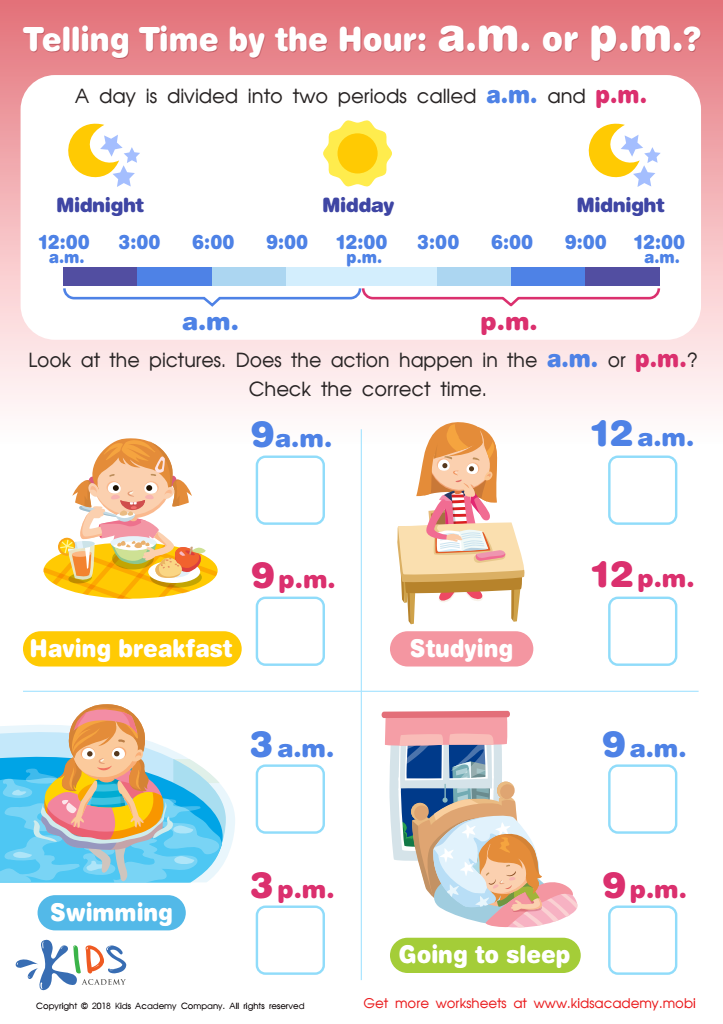
Tilling Time by the Hour: a.m. or p.m.? Worksheet
Can your child tell the time? This worksheet will help them learn. Explain a.m and p.m. and look at the pictures together. Ask your child if the activities happen in the a.m or p.m and help them check the correct time.
 Assign to My Students
Tilling Time by the Hour: a.m. or p.m.? Worksheet
Worksheet
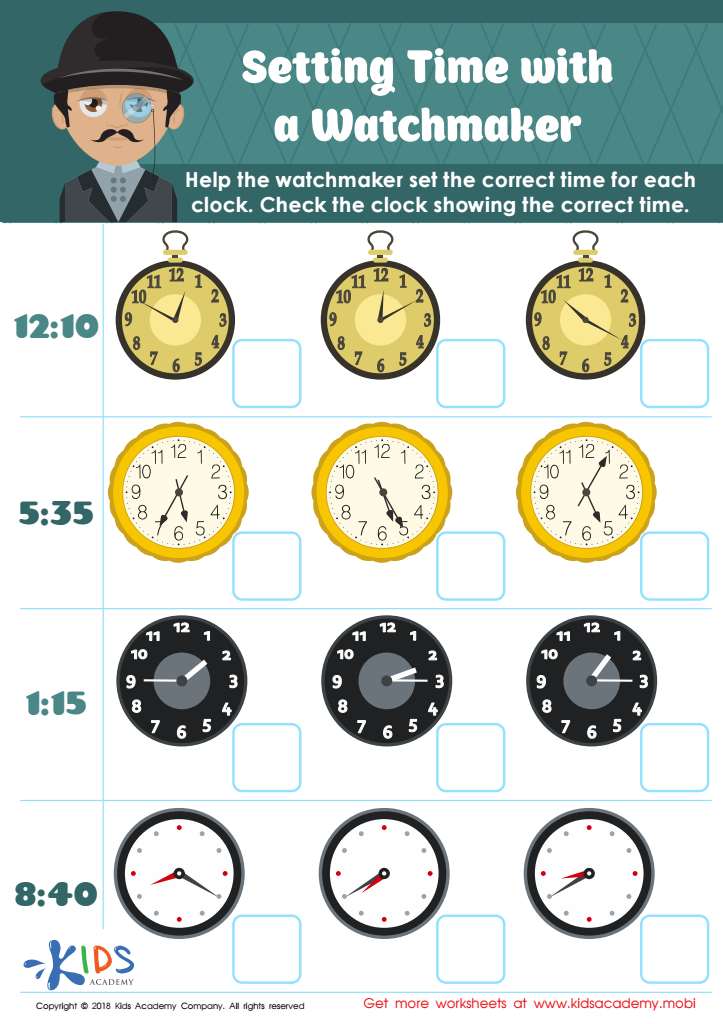
Setting Time with Watchmaker Worksheet
Can your kids tell the time? If so, this worksheet should be easy. Help them set the time for each clock: look at the time written on the left side and find the clock on the right side that matches.
Setting Time with Watchmaker Worksheet
Worksheet
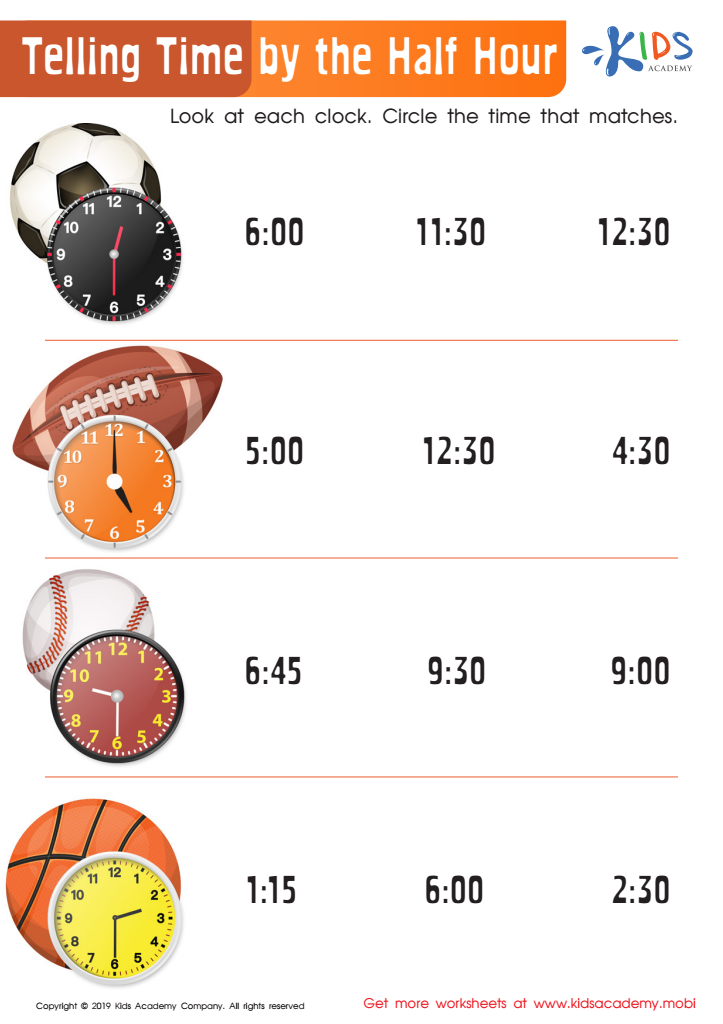
Telling Time by the Half Hour Worksheet
Teach kids to tell time with this worksheet! Four clocks are labeled with different times; help your child circle the right one. It's a great way to teach them to read analog and digital clocks, watches, and written times. Easy and fun learning!
Telling Time by the Half Hour Worksheet
Worksheet
Join Kids Academy for Free
Who is primarily going to use this learning content?








Reading analog clocks is a fundamental skill that offers multiple benefits for children aged 6-8. For parents and teachers, prioritizing this learning can help kids develop critical cognitive abilities and practical life skills.
Firstly, understanding analog clocks teaches children to grasp the concept of time beyond digital representations. This skill is crucial for developing their sense of timing and sequence, which aids in daily activities such as knowing when to wake up, attend school, or go to bed. By learning to read an analog clock, children gain the ability to visualize the circular nature of time, helping to foster their mental arithmetic skills as they calculate minutes and hours using the clock face.
Secondly, the process of reading analog clocks reinforces basic math concepts. Skills such as counting by fives, understanding fractions (e.g., quarter past, half past), and the relationship between numbers are naturally incorporated into this learning experience. This reinforces their numerical understanding in a real-world context, making abstract math concepts more concrete.
Lastly, mastering analog clocks instills a sense of responsibility and independence. When children can tell time on their own, they are better equipped to manage their daily routines and responsibilities without constant adult intervention, promoting self-confidence and time management skills.
Thus, caring about this aspect of learning supports foundational academic skills, practical life applications, and personal growth, making it essential for childhood development.








