
Understanding pollination Normal Math Worksheets for Ages 6-9
3 filtered results
Difficulty Level
Grade
Age
-
From - To
Subject
Activity
Standards
Welcome to our "Understanding Pollination" Normal Math Worksheets for ages 6-9! Engage young learners through fun, interactive activities that blend math skills with the fascinating process of pollination. These worksheets are designed to teach children essential math concepts, such as addition, subtraction, and problem-solving, while they explore the amazing world of plants and bees. With colorful illustrations and age-appropriate exercises, kids will develop their math abilities while gaining a deeper appreciation for nature's vital processes. Perfect for at-home learning or classroom activities, these worksheets inspire curiosity and a love for both math and science! Discover the joy of learning today!
Favorites
With answer key
Interactive
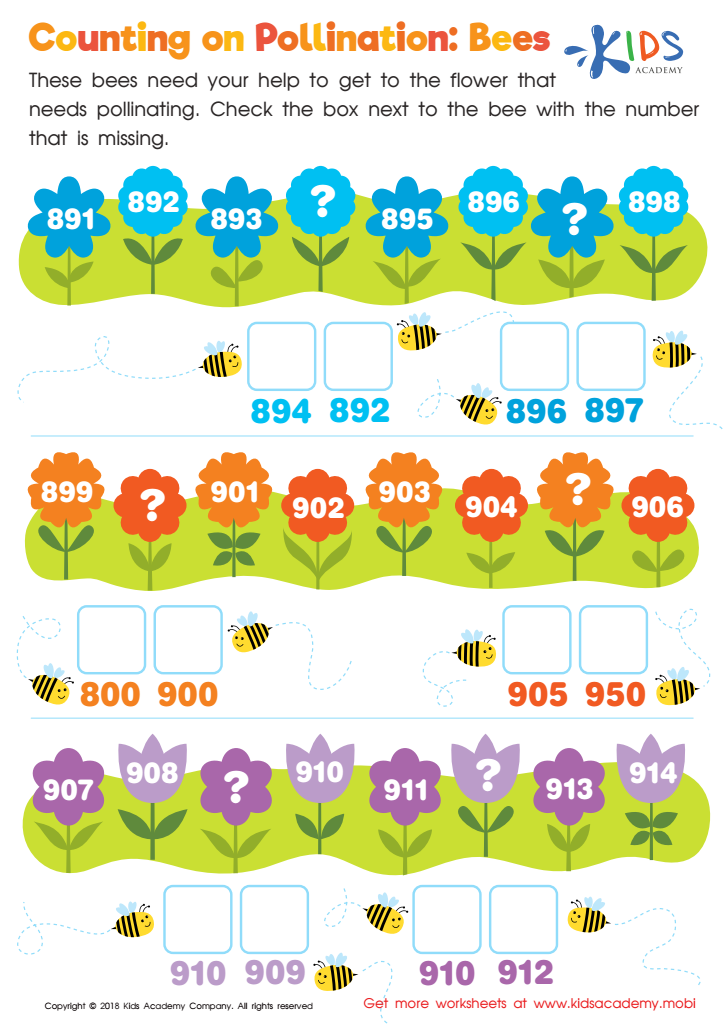
Counting on Pollination: Bees Worksheet
This downloadable worksheet helps kids improve their math skills while having fun - they'll help the bees pollinate the flowers by finding the missing number. It's an entertaining way to practice number patterns, sequences and number line skills, aiding in fast and efficient math computations.
 Assign to My Students
Counting on Pollination: Bees Worksheet
Worksheet
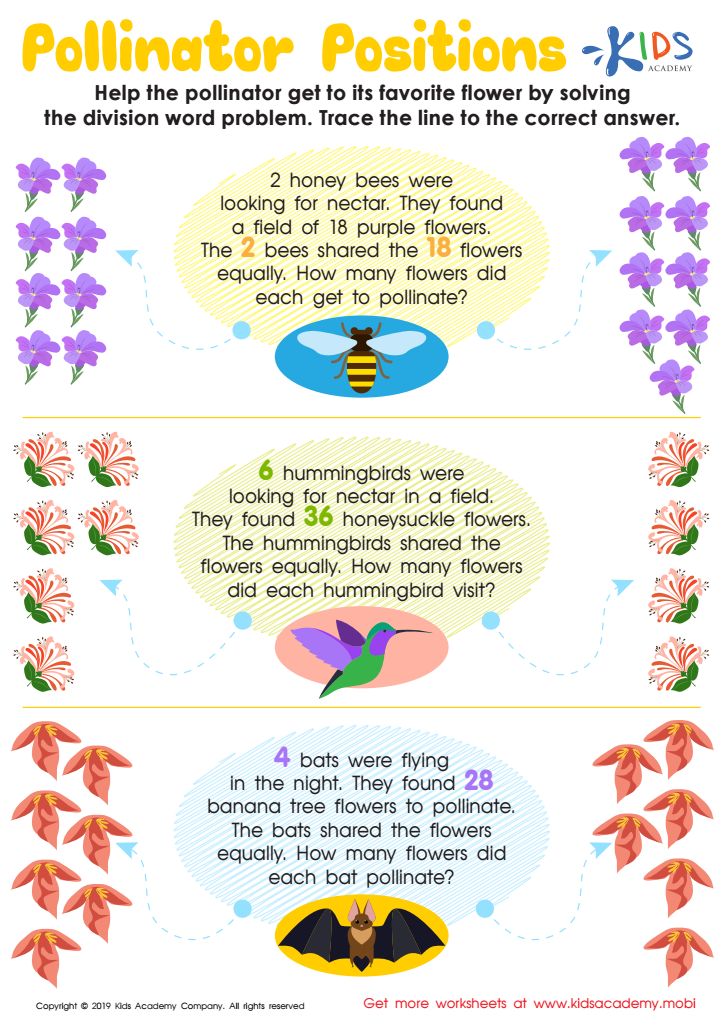
Pollinator Positions Worksheet
Kids will love learning about pollinators and how vital they are. Help their favorite friends get to the right flowers with this fun PDF. Children can solve the problems without even knowing they're doing division; just read the word problems and use the highlighted numbers. Finish by tracing the lines to the correct quotient!
Pollinator Positions Worksheet
Worksheet
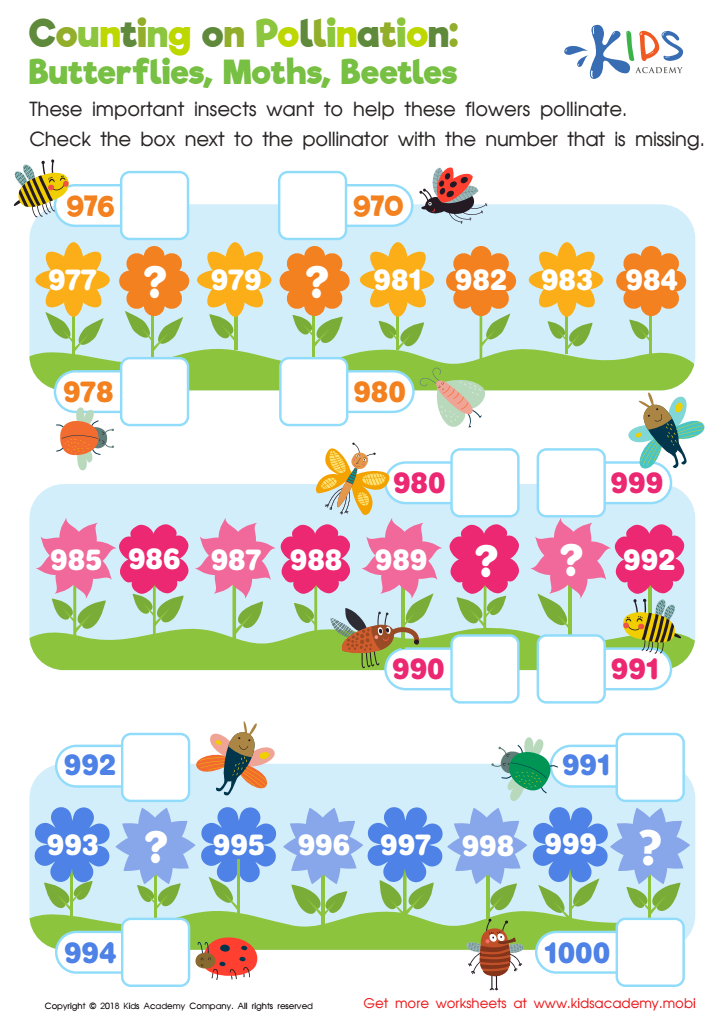
Counting on Pollination: Butterflies, Moths, Beetles Worksheet
A number line can help boost computation accuracy and efficiency. It can also be used with more advanced numbers. Help your child practice by having them identify missing numbers in sequences. This fun worksheet lets them help the pollinators in the process, as they strengthen their number sense.
Counting on Pollination: Butterflies, Moths, Beetles Worksheet
Worksheet
Join Kids Academy for Free
Who is primarily going to use this learning content?



%20(1).jpg)



Parents and teachers should care about understanding pollination in the context of teaching Normal Math to children aged 6-9 because it creates a meaningful interdisciplinary learning experience. Pollination, a vital biological process, can serve as an engaging way to introduce mathematical concepts such as counting, pattern recognition, and basic measurements. For example, children can count different types of flowers and pollinators, or measure the distance between plants, linking nature to math.
Understanding pollination also fosters environmental awareness early on, encouraging children to value nature and contributing to a foundation of ecological literacy. When kids learn about how plants reproduce with the help of bees, butterflies, and other pollinators, they grasp the importance of biodiversity and the role of each living organism—a vital lesson in sustainability.
Moreover, using real-world examples makes abstract math concepts more relatable, enhancing their engagement and retention of knowledge. It sparks curiosity, prompting questions and discussions that can enrich their understanding of both math and science. In a rapidly changing world, nurturing an appreciation for our ecosystem will help develop responsible, informed citizens who care about the environment. Therefore, pollination as a context for Normal Math provides both educational and ecological value.








