Rounding numbers Normal Rounding Worksheets for Ages 6-9
6 filtered results
Difficulty Level
Grade
Age
-
From - To
Subject
Activity
Standards
Discover our engaging "Rounding Numbers Normal Rounding Worksheets" designed specifically for children aged 6-9. These worksheets provide interactive and fun exercises to help young learners master the concept of rounding numbers. With a variety of activities tailored to different learning levels, students will develop their math skills by practicing rounding to the nearest ten and hundred. Each worksheet promotes critical thinking and reinforces numeral understanding through colorful visuals and age-appropriate challenges. Perfect for use in classrooms or at home, these resources make learning rounding enjoyable while ensuring a solid foundation in mathematics. Start rounding off numbers with confidence today!
Favorites
With answer key
Interactive
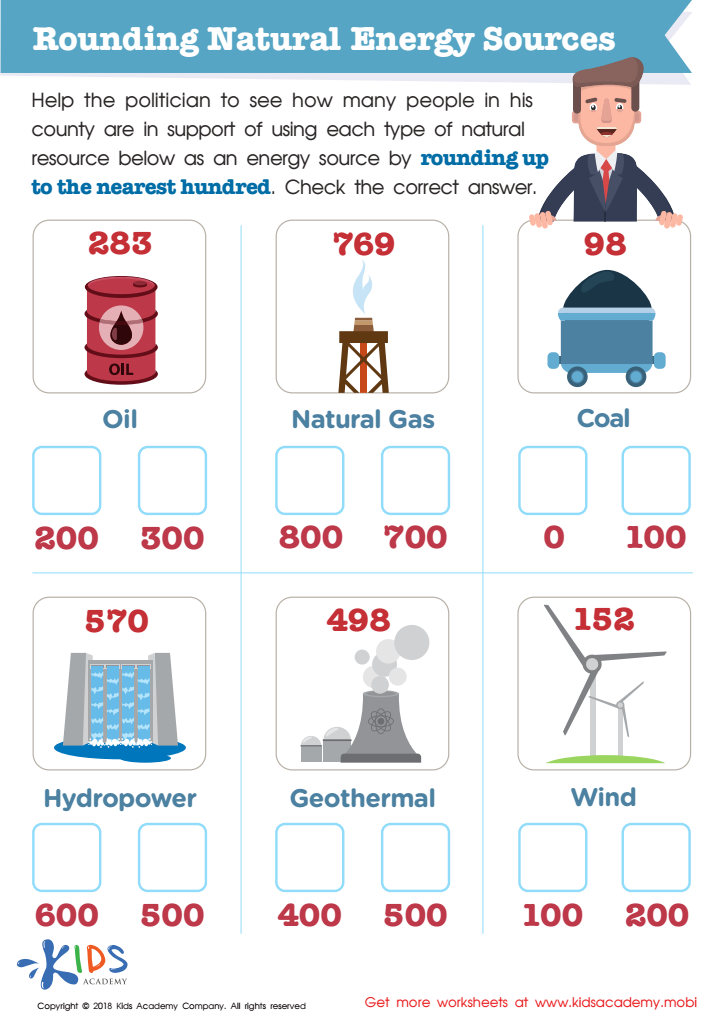
Rounding Natural Energy Sources Worksheet
Ask your kids what policies they would love to see if a politician is voted into power. Then, have them help the politician in this worksheet, downloading the PDF and rounding up the number of people to the nearest hundred in support of using different natural resources as an energy source. Guide them to the correct answer.
 Assign to My Students
Rounding Natural Energy Sources Worksheet
Worksheet
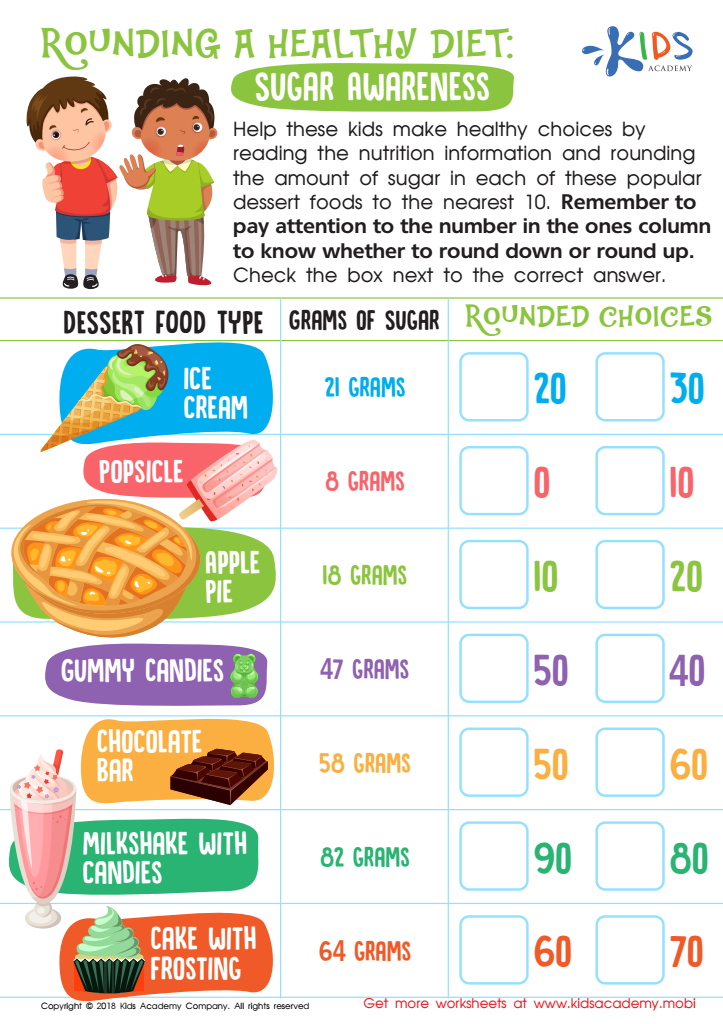
Rounding Healthy Diet Worksheet
Kids Academy understands the value of making math relevant. Check out this energizing rounding worksheet which merges math concepts with health class! Kids get to be aware of sugary treats and work out how many grams of sugar they contain. To complete, they view each item and round the number to the nearest 10. Remind them to focus on the ones column to decide if the number rounds up or down.
Rounding Healthy Diet Worksheet
Worksheet
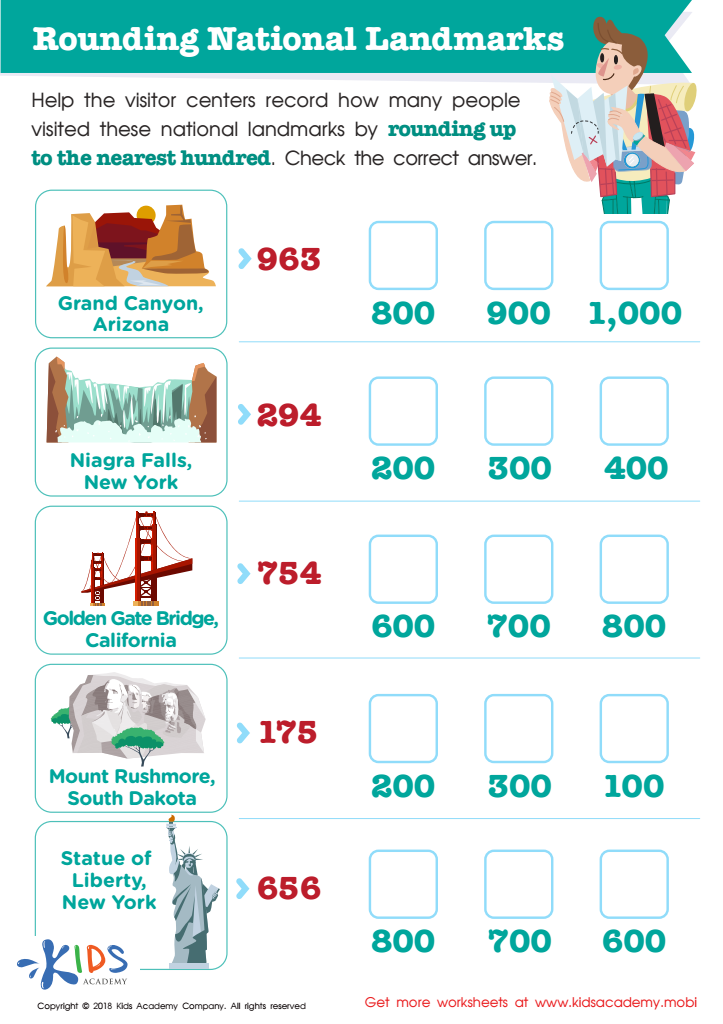
Rounding National Landmarks Worksheet
Does your city have tourist attractions? Help your kids count visitors to these national landmarks by rounding up to the nearest hundred. Then check the correct answer from the provided options. Or explore tourist centres in another state with your family.
Rounding National Landmarks Worksheet
Worksheet
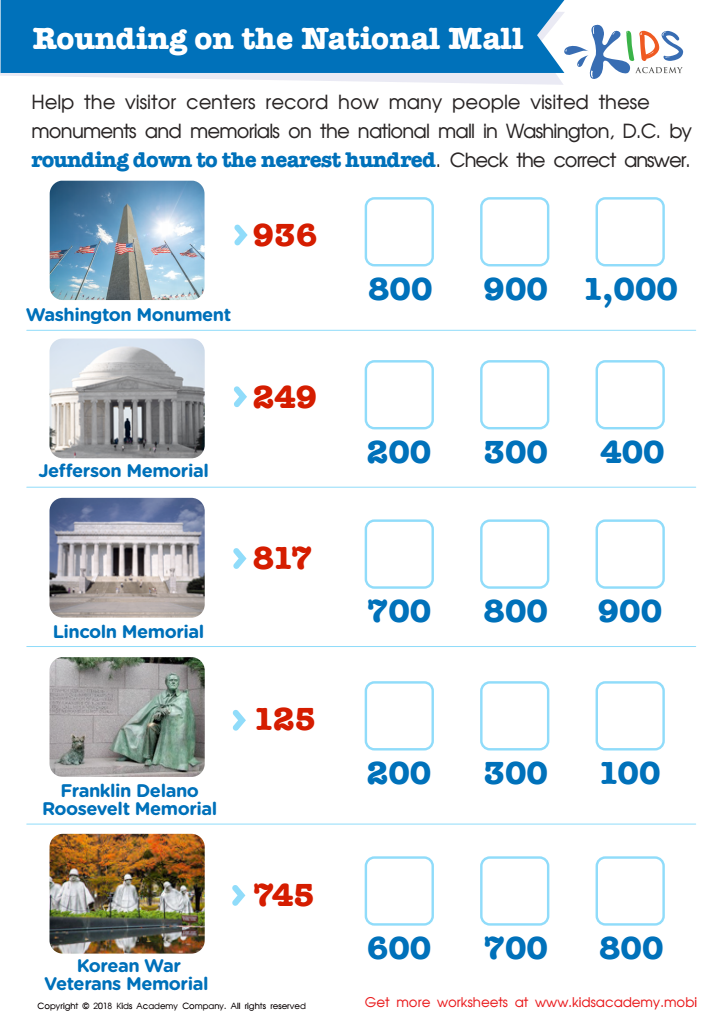
Rounding on the National Mall Worksheet
Math and social studies come together in this worksheet. Learners must round numbers to record attendance at Washington D.C. monuments and memorials. Remind them to round down to the nearest hundred. Extend the lesson by talking about each monument - a great way to teach or refresh your child's knowledge of these national landmarks!
Rounding on the National Mall Worksheet
Worksheet
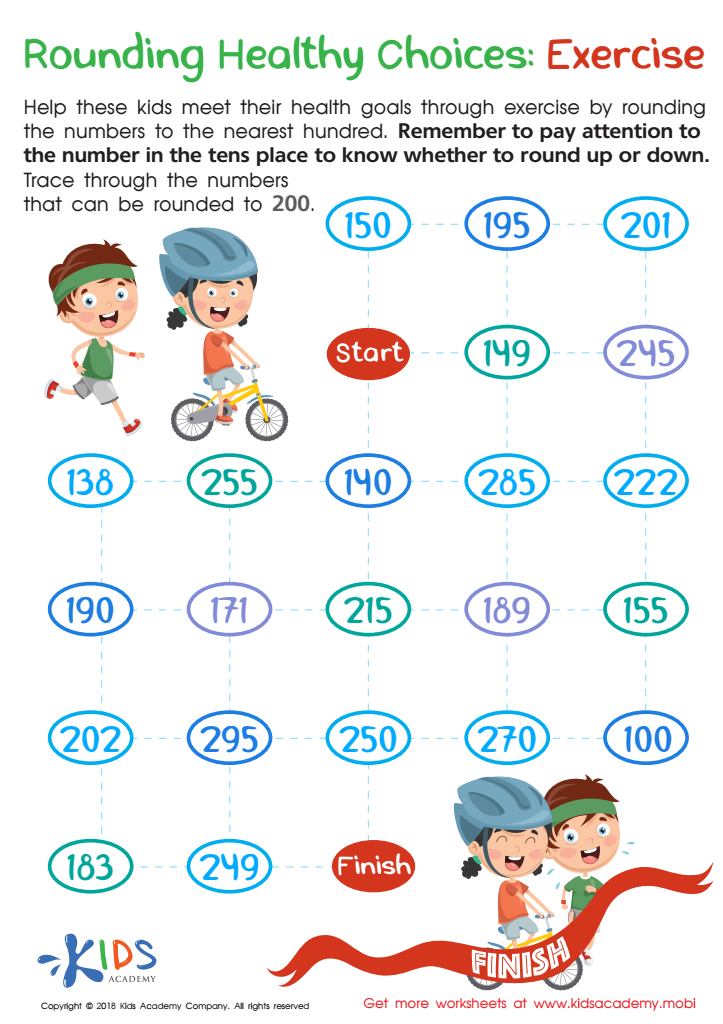
Rounding Healthy Choices Exercise Worksheet
Tired of boring math worksheets? Check out this fun rounding maze printout! Help the kids reach their goals by going from start to finish. To move through the maze, they must find numbers to round to 200. Teach them to pay close attention to the tens place to know whether to round up or down. Have fun and reach the finish line to complete the maze!
Rounding Healthy Choices Exercise Worksheet
Worksheet
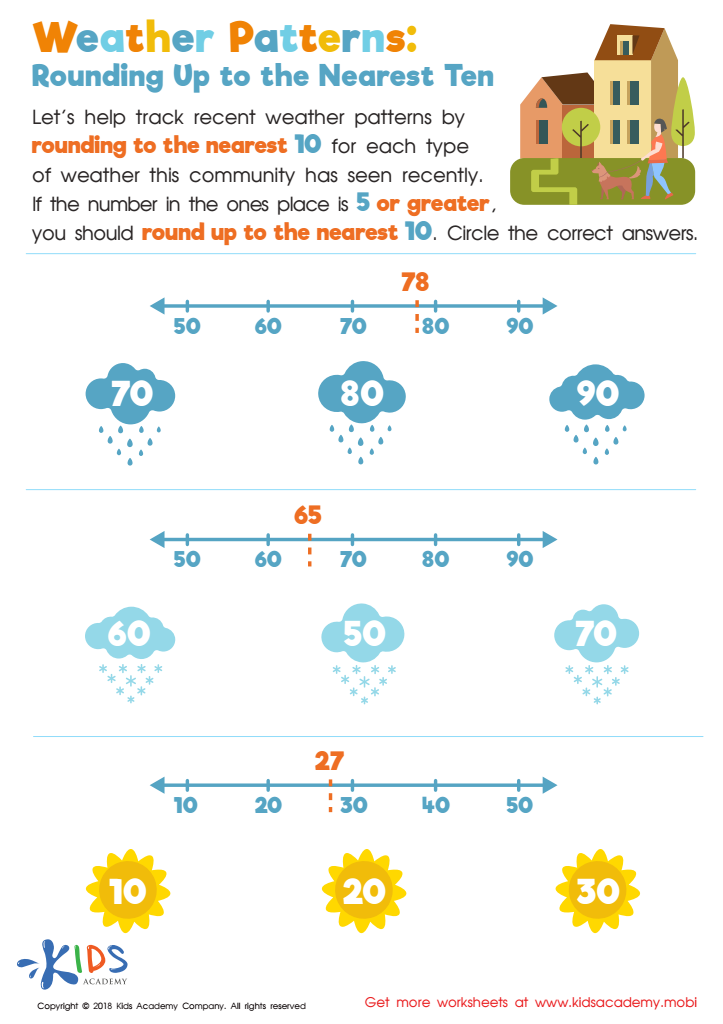
Weather Patterns Worksheet
Use this Weather Patterns worksheet to help your kids develop their mathematical skills. Get them to round the recent weather patterns to the nearest 10 and round up if the number in the ones place is 5 or higher. Work with them to figure out which answers are correct and get them to circle them.
Weather Patterns Worksheet
Worksheet
Join Kids Academy for Free
Who is primarily going to use this learning content?






Rounding numbers is a fundamental mathematical skill that benefits children aged 6-9 in numerous ways. For parents and teachers, understanding and teaching normal rounding is essential because it lays the foundation for more complex math concepts in the future. When children learn to round numbers, they become more comfortable estimating values, which is a valuable skill for everyday situations—whether budgeting, measuring, or comparing quantities.
Rounding also enhances mental math skills, allowing children to compute more quickly by simplifying calculations. This morning skill helps cultivate number sense, where students learn to recognize and manipulate numbers confidently.
Additionally, rounding serves as a gateway to understanding place value. Recognizing how numbers shift when rounded encourages children to engage more deeply with the number system and develop their algebraic thinking.
Moreover, a solid grasp of rounding can improve performance in standardized testing, where students must often determine the most reasonable estimate quickly. Ultimately, encouraging rounding in early education fosters critical thinking, problem-solving abilities, and a positive attitude toward math, setting children up for future academic success and practical life skills. Parents and teachers should invest time in this area for the broad benefits it provides to a child's overall mathematical literacy.