
Hand-eye Coordination Normal Addition & Subtraction Worksheets for 6-Year-Olds
3 filtered results
Difficulty Level
Grade
Age
-
From - To
Subject
Activity
Standards
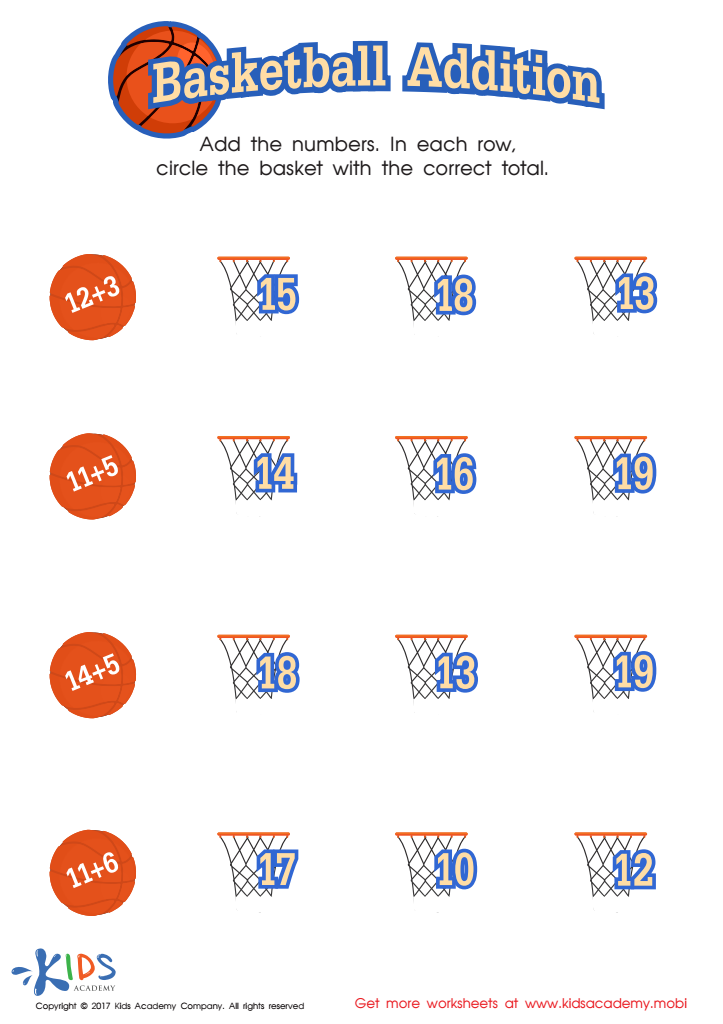
Enhance your child's hand-eye coordination with our engaging addition and subtraction worksheets designed for 6-year-olds! These fun, printable activities seamlessly combine essential math skills with interactive tasks to improve visual-motor integration. Each worksheet challenges young learners to solve age-appropriate addition and subtraction problems, while also honing their ability to follow directions and complete tasks independently. Ideal for developing fine motor skills and boosting academic confidence, our worksheets provide a structured yet enjoyable learning experience for early graders. Perfect for classrooms or at-home practice, support your child’s foundational math and coordination skills with our expertly crafted resources!
Favorites
With answer key
Interactive
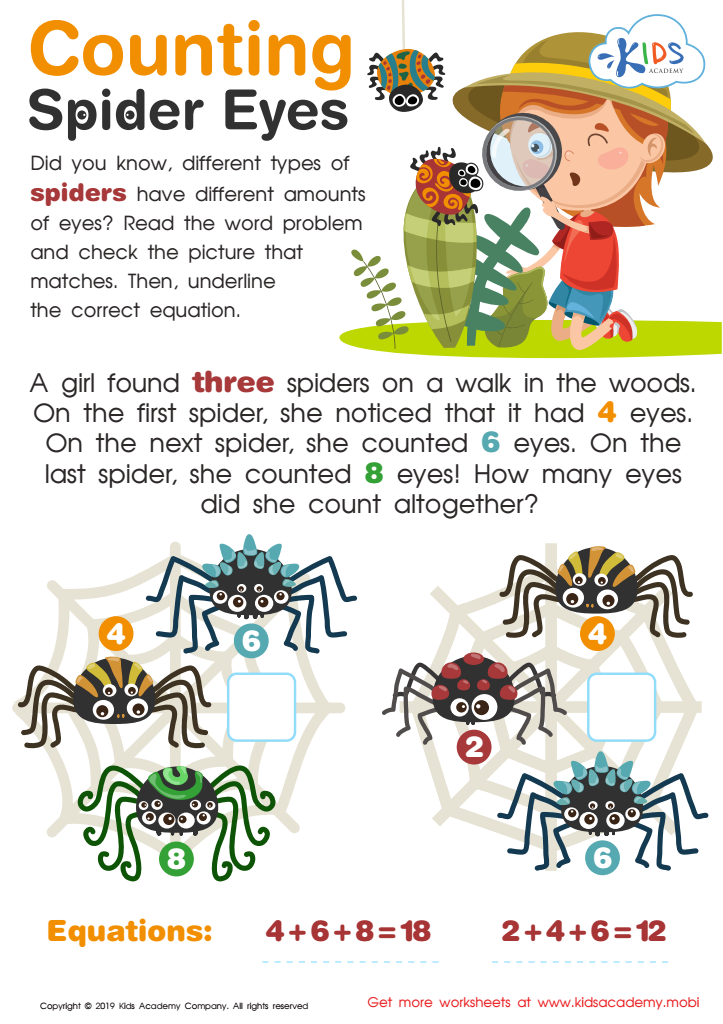
Counting Spider Eyes Worksheet
Did you know different spiders have different eye numbers? Kids will love learning this fact and solving the spider word problems on this free worksheet! Word problems promote a deeper understanding of the concept, plus they get to add up the spiders’ eyes while solving addition problems with more than one addend. Fun and math all in one!
 Assign to My Students
Counting Spider Eyes Worksheet
Worksheet
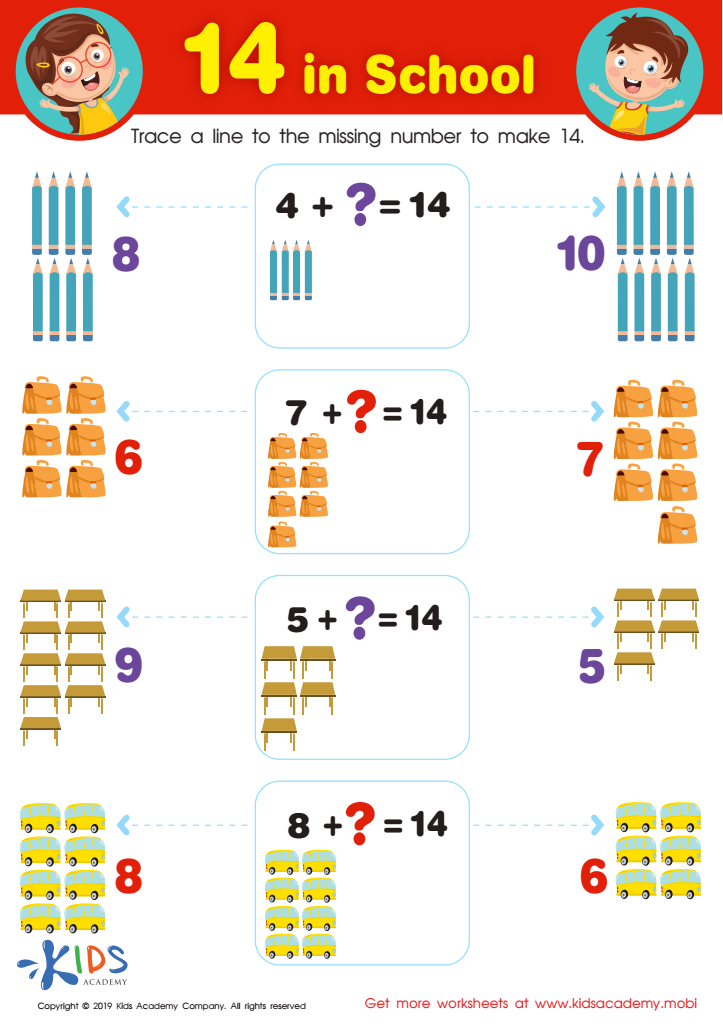
14 in School Worksheet
Remind your kids that adding different sets of numbers can give the same total (e.g. 2+3=5, 4+1=5). Ask them for more examples. Afterwards, work through the exercise. Help them count the objects and trace a line to the missing number that makes the total 14.
14 in School Worksheet
Worksheet
Join Kids Academy for Free
Who is primarily going to use this learning content?








Hand-eye coordination is crucial for a 6-year-old's overall development and success in various tasks. For parents and teachers, fostering this skill with normal addition and subtraction exercises offers several benefits. First, strong hand-eye coordination enhances fine motor skills, allowing children to perform activities such as writing, cutting, and tying shoelaces, which are essential for their daily routines and academic tasks.
By integrating addition and subtraction exercises, children not only practice their mathematical abilities but also improve their visual tracking and manual dexterity. For example, using physical objects to count and manipulate, such as counting bears or abacus beads, helps children develop a stronger grasp of numerical concepts while also honing their ability to coordinate their hand movements with what they see.
Additionally, nurtured hand-eye coordination contributes to better concentration and focus. When children correctly align their hand movements with visual inputs during arithmetic tasks, they develop patience and attention to detail, critical for more complex future learning. Therefore, addressing hand-eye coordination in the context of mathematical operations lays a foundational stone for academic success, physical development, and daily living competencies, making it a vital aspect of early childhood education.








