
Reading proficiency Normal Phonics Worksheets for Ages 7-8
5 filtered results
Difficulty Level
Grade
Age
-
From - To
Subject
Activity
Standards
Enhance your child's reading skills with our Normal Phonics Worksheets for Ages 7-8. Designed for early learners, these engaging worksheets focus on developing reading proficiency through fun phonics activities. Each worksheet is tailored to strengthen their understanding of letter sounds, blending, and recognition, providing a solid foundation for fluent reading. Our resources encourage active participation, making learning enjoyable and effective. With a variety of exercises, children will gain confidence as they progress in their reading journey. Explore our comprehensive selection of phonics worksheets today to support your child's educational growth and foster a lifelong love of reading!
Favorites
With answer key
Interactive
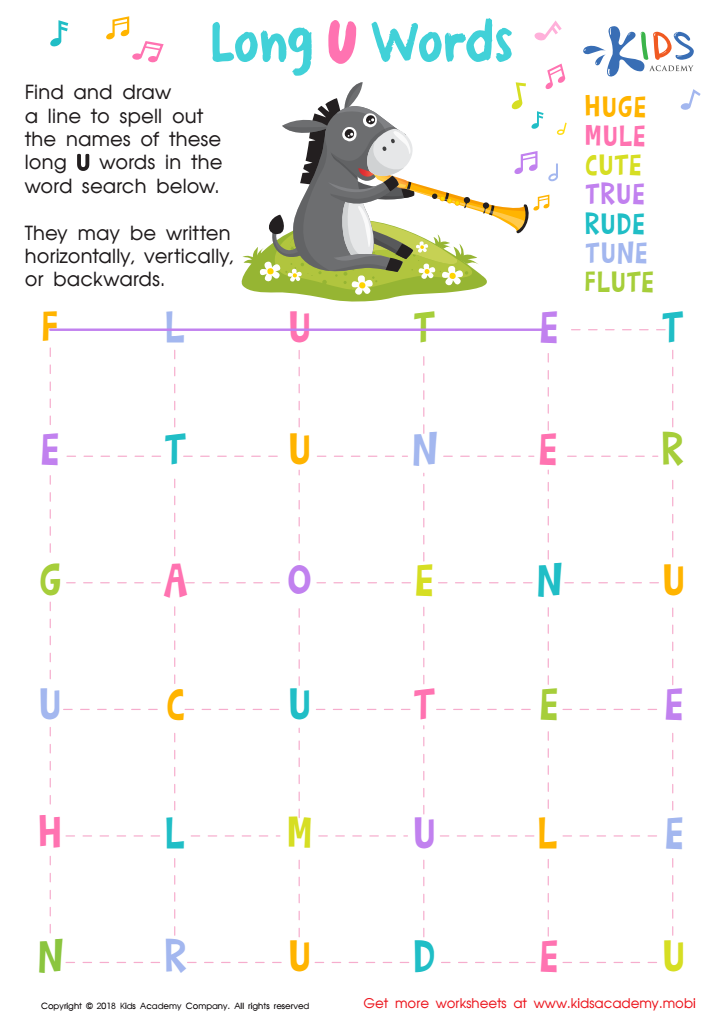
Long /u/ Words Worksheet
Your child needs to learn phonetics to enunciate and differentiate words. This fun worksheet encourages them to find and draw lines connecting the long 'U' words in the word search. Help them read the words on the right side of the picture, then look for them in the word search (horizontally, backwards or vertically).
Long /u/ Words Worksheet
Worksheet
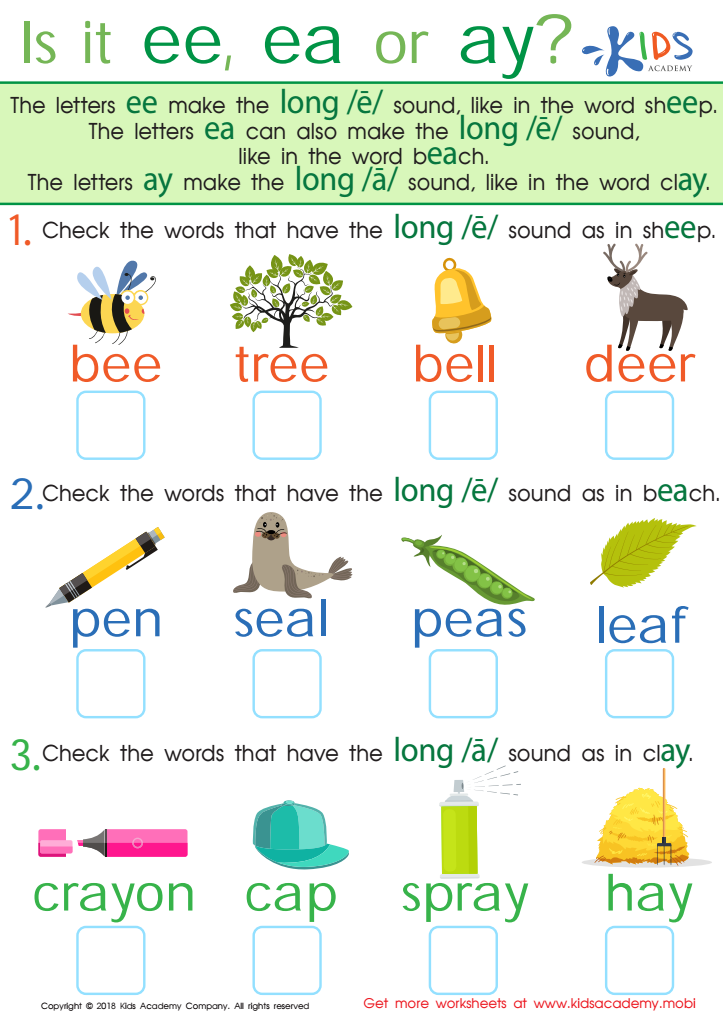
Is It EE, EA, or AY? Worksheet
When 'ee', 'ea' and 'ay' are in words, they usually make the long /e/ and /a/ sounds. Examples of words with 'ee' are "sheep", 'beach' and 'seat' with 'ea', and 'clay' and 'play' with 'ay'. Check this colourful worksheet with your kids; help them find the words that make the long /e/ sound like 'sheep'.
Is It EE, EA, or AY? Worksheet
Worksheet
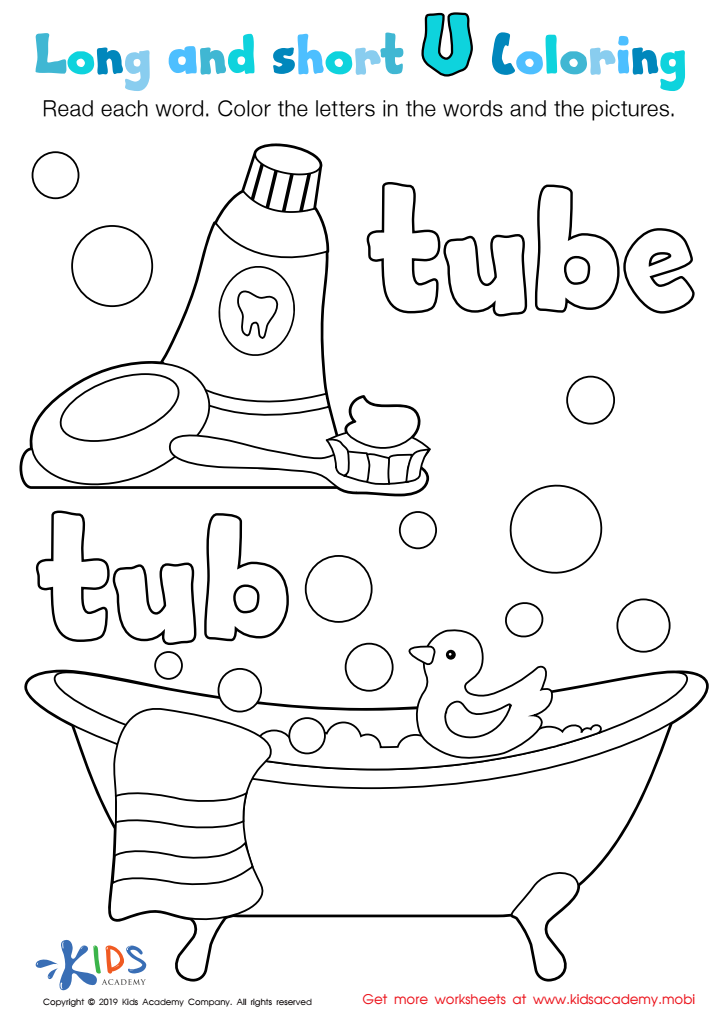
Long and Short U Worksheet
Revised: Spice up your lesson on long and short vowels with this fun printout! Kids read the words "tube" and "tub," then reinforce the sound by coloring in the words and pictures. It's a great way to make phonics class enjoyable!
Download (PDF)
 Assign to My Students
Assign to My Students
Long and Short U Worksheet
Worksheet
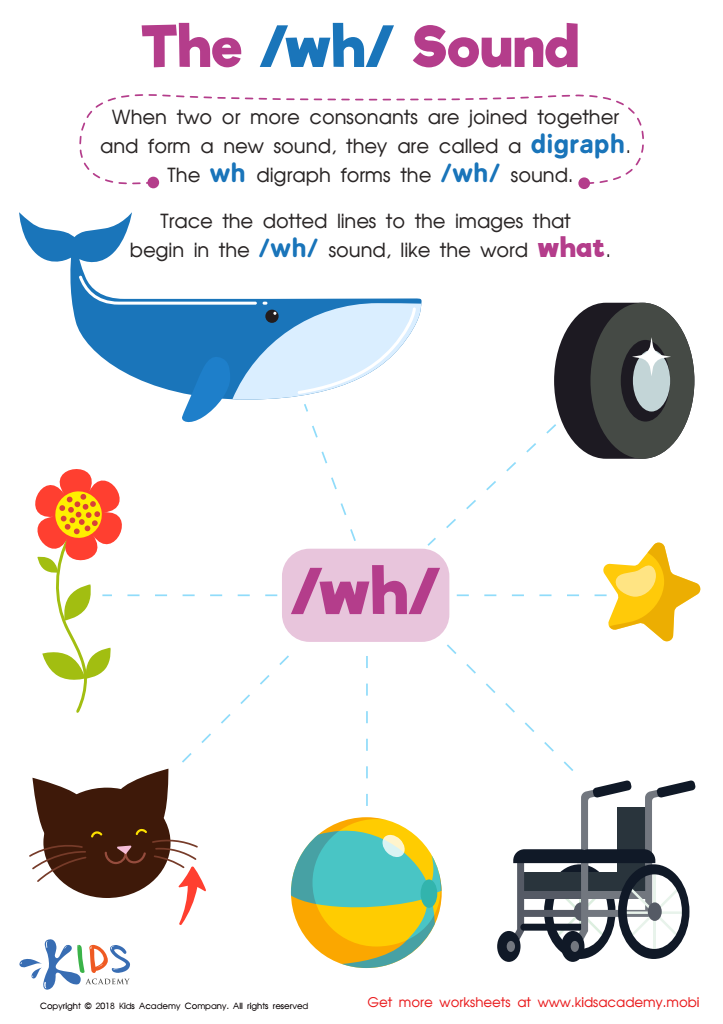
The /wh/ Sound Worksheet
Digraphs join two consonants to make a new sound, like /wh/. Give examples, like "whale", "when" and "why". Ask kids to name pictures in a worksheet and trace dotted lines to images beginning with the /wh/ sound; "what" is one example.
The /wh/ Sound Worksheet
Worksheet
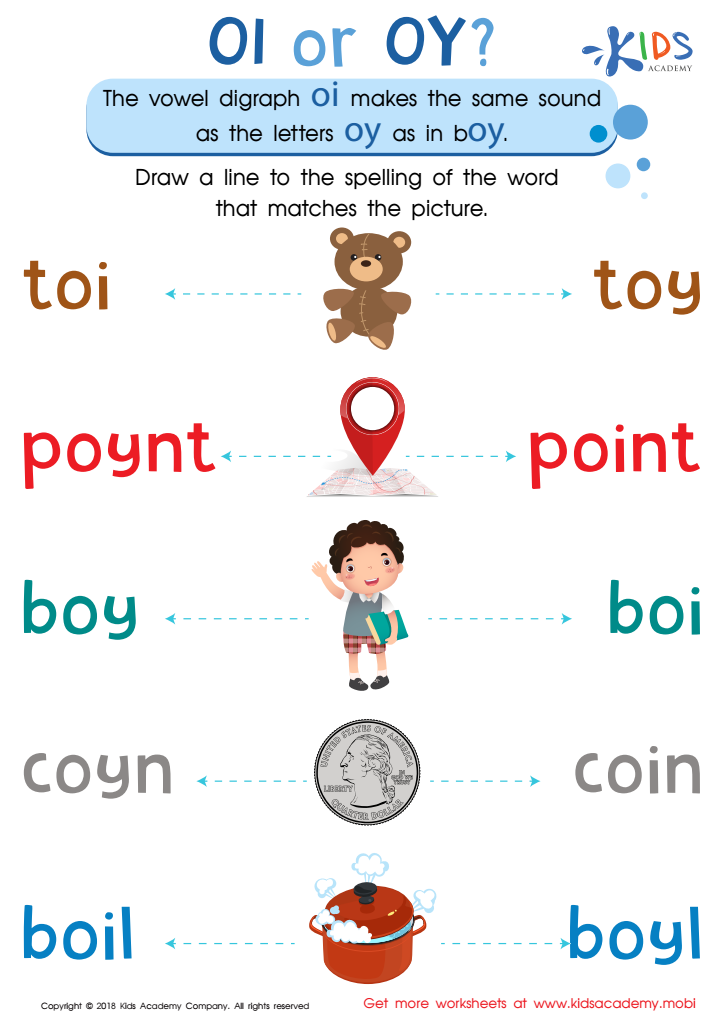
Reading: OI and OY Worksheet
Ask your students if they know the rule for words with /oi/ or /oy/ sound. If not, it's easy to learn! Rule: If /oy/ at end of word, spell with 'oy'; if /oi/ in middle of word, spell with 'oi'. Use this worksheet to help them master these digraphs and improve their ability to decode.
Reading: OI and OY Worksheet
Worksheet
Join Kids Academy for Free
Who is primarily going to use this learning content?








Reading proficiency in early grades, particularly in phonics for ages 7-8, is crucial for several reasons. First, phonics serves as a foundational skill that enables children to decode unfamiliar words, fostering independent reading. At this age, children transition from "learning to read" to "reading to learn." When they grasp phonics, they become more confident readers, which positively influences their comprehension and overall academic performance.
Furthermore, phonics instruction enhances vocabulary development. Strong phonics skills allow children to accurately sound out words, promoting richer language use and comprehension in all subjects, including math and science. This is essential as standardized tests often assess knowledge through reading skills.
Additionally, research shows that early reading proficiency is linked to long-term academic success. Students who struggle with reading are more likely to experience challenges in later grades, which can lead to diminished self-esteem and disengagement from school.
Finally, fostering strong reading skills cultivates a lifelong love for reading and learning. By emphasizing reading proficiency, parents and teachers set children up for future success and encourage critical thinking skills vital for personal and professional growth. Ensuring that children have a solid grasp of phonics is, therefore, a dedicated investment in their future.







